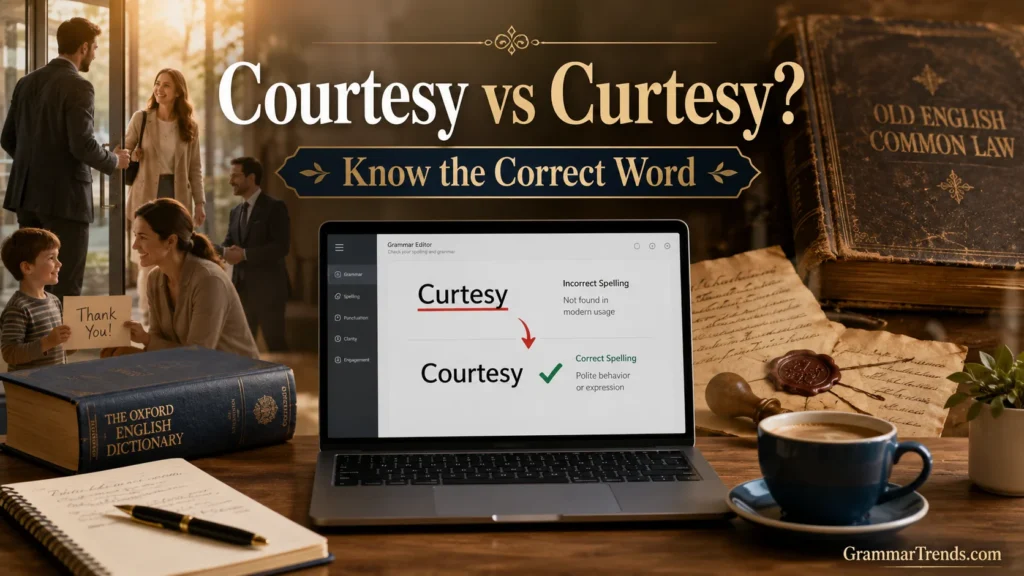
Courtesy vs Curtesy shows how easily writers get confused when they typed similar-looking words like Curtesy instead of courtesy, often paused mid-sentence and wondering if it is correctly written—this is very common in modern writing among students, beginners, and language learners struggling with spelling, pronunciation, and usage in modern English.
These words look identical, sound same, and appear nearly similar, which often confuses people in emails, social media posts, and everyday interaction, especially when showing professional behavior, respect, and politeness through simple actions like saying please, thank-you, and holding the door, all improving communication-skills and courteous behavior in real-life situations.
In modern English, the widely accepted term is courtesy, which represents consideration, respectful conduct, and polite expression in daily interaction and social communication. Many people struggle to differentiate it from Curtesy, an old English law term, rarely used today, linked to deceased wife’s property and a husband’s right, found in legal word, old English common law, and dusty legal textbooks.
Mixing them can cause embarrassing mistakes, misunderstandings, and harm clear commnication in formal settings, school assignments, and professional emails, so it is important to follow simple rules, practice, and always use the correct term to ensure understanding and build confidence.
Quick Answer
If you only remember one thing, remember this:
Courtesy is the correct and commonly used word for politeness, respect, and good manners in modern English.
Curtesy is not another spelling of courtesy. It is a rare historical legal term referring to a husband’s inheritance rights under old English common law.
For almost every email, conversation, article, or social media post, use “courtesy.” Unless you’re discussing historical property law, **”curtesy” is almost certainly the wrong choice.
Courtesy vs Curtesy: Understanding the Core Difference
The quickest way to understand the difference is simple:
| Word | Meaning | Common Today? |
| Courtesy | Polite behavior, respect, good manners | Yes |
| Curtesy | An old legal term related to inheritance rights | Rarely |
In modern English, courtesy is the word almost everyone needs.
Curtesy, on the other hand, survives mainly in historical legal discussions. Outside of law archives or old property cases, you’ll barely see it.
That’s why using “curtesy” instead of “courtesy” usually counts as a spelling mistake
What Does Courtesy Mean?
The word courtesy refers to polite behavior, respect, kindness, and consideration toward others.
It’s one of those words woven deeply into everyday communication. You’ll hear it in workplaces, restaurants, schools, emails, and customer service interactions.
For example:
- “Thank you for your courtesy.”
- “She treated every guest with courtesy.”
- “Courtesy matters in professional communication.”
The idea behind the word is simple. Good manners make interactions smoother.
The Modern Meaning of Courtesy
Today, courtesy extends far beyond saying “please” and “thank you.”
It also includes:
- Respectful communication
- Professional etiquette
- Digital manners
- Hospitality
- Thoughtful behavior
- Social awareness
In many industries, courtesy directly affects reputation and trust.
A rude email can damage a business relationship in seconds. A courteous reply can strengthen one for years.
That’s why companies spend millions training employees in customer courtesy.
The Origin of the Word Courtesy
The word traces back to Old French and Latin roots connected to royal courts.
Originally, “courtesy” described the polished behavior expected at court. Nobles needed refined manners to survive politically and socially.
Over time, the word evolved into its modern meaning:
respectful and considerate behavior toward others.
Interestingly, the history explains why courtesy still feels slightly formal even today.
Common Uses of Courtesy in Everyday English
You probably encounter the word daily without noticing.
Here are some of the most common phrases:
| Phrase | Meaning |
| Courtesy call | A polite visit or phone call |
| Courtesy email | A friendly reminder or update |
| Courtesy copy (CC) | Copying someone in an email |
| Courtesy car | Temporary replacement vehicle |
| Courtesy reminder | Gentle notification |
Businesses especially love the term because it sounds professional without feeling cold.
What Does Curtesy Mean?
Now comes the confusing part.
Curtesy is not a modern alternative spelling of courtesy.
It’s an entirely different word.
In historical common law, curtesy referred to a husband’s legal right to inherit property from his deceased wife under certain conditions.
Yes. That specific.
The term comes from old English property law traditions dating back centuries.
The Legal Definition of Curtesy
Under traditional English common law:
- If a married woman owned property
- And she died
- Her husband could sometimes claim a life estate in that property
That right was called tenancy by the curtesy.
Modern legal systems rarely use the term because inheritance laws changed dramatically over time.
Still, dictionaries keep the word because of its historical importance.
Why Most People Never Use Curtesy
Outside legal history, “curtesy” almost never appears in modern writing.
That’s why confusion happens so often.
People assume:
- “curtesy” must be another spelling of “courtesy”
- or perhaps a British variation
Neither is true.
In modern communication, using “curtesy” instead of “courtesy” usually signals a typo or misunderstanding.
Courtesy vs Curtesy: Side-by-Side Comparison
Here’s the easiest way to separate them permanently.
| Feature | Courtesy | Curtesy |
| Primary Meaning | Politeness and respect | Historical inheritance right |
| Usage Frequency | Extremely common | Extremely rare |
| Context | Everyday communication | Old legal documents |
| Part of Speech | Noun/adjective | Noun |
| Modern Relevance | High | Minimal |
| Example | “He showed courtesy.” | “The estate passed by curtesy.” |
One belongs in customer service emails.
The other belongs in medieval property law discussions.
Big difference.
Courtesy vs Curtesy vs Curtsey
Things get even trickier because another similar word exists:
Curtsey.
Many people accidentally mix up all three.
What Is a Curtsey?
A curtsey is a formal gesture where someone bends their knees slightly as a sign of respect.
You’ll often see it in:
- Royal ceremonies
- Classical dance
- Historical dramas
- Traditional etiquette schools
For example:
“The young woman performed a curtsey before the queen.”
Now compare all three.
| Word | Meaning |
| Courtesy | Politeness |
| Curtesy | Old inheritance law |
| Curtsey | Formal bowing gesture |
Tiny spelling changes. Completely different meanings.
English loves doing this.
Which Word Should You Use Today?
For almost every situation, use courtesy.
Use it in:
- Emails
- Essays
- Business communication
- Conversations
- Customer support
- Academic writing
- Articles
- Social media posts
You should only use curtesy if discussing historical legal systems.
That’s it.
How To Use Courtesy Correctly in Sentences
The best way to master a word is seeing it in real situations.
Here are examples that sound natural and modern.
Courtesy in Everyday Conversations
- “Thanks for showing courtesy to the new employees.”
- “Simple courtesy goes a long way.”
- “He opened the door as a courtesy.”
Notice how the word often connects with kindness or respect.
Courtesy in Professional Writing
Professional communication relies heavily on courtesy.
Examples:
- “This is a courtesy reminder about tomorrow’s meeting.”
- “We appreciate your courtesy and patience.”
- “Please accept this courtesy notice regarding schedule changes.”
Companies intentionally use the word because it softens communication.
A message feels less aggressive when framed politely.
Courtesy in Customer Service
Customer experience experts constantly emphasize courtesy because it affects retention and loyalty.
Example:
Imagine two hotel front desk employees.
One says:
“Check-in starts at 3 PM.”
The other says:
“As a courtesy, we’ll notify you if your room becomes available early.”
Same policy. Totally different experience.
That small touch changes how customers feel.
Real-Life Examples of Courtesy in Action
Courtesy isn’t just grammar. It shapes daily interactions.
Workplace Courtesy
Strong workplace courtesy improves:
- Team communication
- Leadership trust
- Employee morale
- Conflict resolution
A respectful office usually performs better because people feel heard.
Examples of workplace courtesy:
- Responding to emails promptly
- Respecting meeting times
- Listening without interrupting
- Giving constructive feedback politely
These habits seem small. They compound over time.
Digital Courtesy
The internet made courtesy even more important.
Without tone of voice or facial expressions, messages can easily sound rude.
Digital courtesy includes:
- Avoiding ALL CAPS
- Using respectful language
- Giving context before criticism
- Replying professionally
- Respecting boundaries online
A short email can accidentally sound hostile if written carelessly.
That’s why digital etiquette matters more than ever.
How Curtesy Appears in Historical Law
Although rare today, curtesy played a major role in older legal systems.
Tenancy by the Curtesy
Historically, tenancy by the curtesy gave husbands inheritance rights tied to their wives’ property.
Several conditions often applied:
- The marriage had to be legal
- The wife needed property ownership
- Children from the marriage sometimes affected eligibility
These laws reflected old social structures where property inheritance heavily favored men.
Modern inheritance law largely replaced these systems.
Why Dictionaries Still Include Curtesy
Some people wonder:
“If nobody uses curtesy anymore, why keep it in dictionaries?”
Because dictionaries record language history, not just modern popularity.
Legal historians, researchers, and law students still encounter the term in older documents.
Removing it entirely would erase part of English legal history.mr
Read more: Affend or Offend: This Common Spelling Mistake
Common Mistakes People Make With Courtesy and Curtesy
This confusion appears everywhere online.
Let’s clear up the biggest errors.
Mistake: Using Curtesy Instead of Courtesy
This happens because both words sound nearly identical.
Incorrect:
- “Thank you for your curtesy.”
Correct:
- “Thank you for your courtesy.”
If you’re talking about manners, politeness, or respect, you almost always want courtesy.
Mistake: Thinking Curtesy Is British English
It isn’t.
British English still uses courtesy for politeness.
“Curtesy” remains a separate legal term in both American and British English.
Mistake: Confusing Curtesy With Curtsey
This mix-up happens surprisingly often.
Quick memory trick:
- Courtesy = kindness
- Curtsey = bowing
- Curtesy = legal history
One extra letter changes the meaning entirely.
Why Courtesy Matters More Than Ever Today
Modern communication moves fast.
Too fast sometimes.
People fire off emails, texts, and comments without thinking about tone. That creates friction instantly.
Courtesy acts like social oil. It keeps conversations moving smoothly.
Courtesy Builds Trust
Whether in business or personal life, respectful communication builds credibility.
People remember how you make them feel.
A courteous manager often earns stronger loyalty than a highly skilled but rude one.
The same applies online.
Courtesy Improves Professional Reputation
Employers consistently value communication skills.
Courtesy signals:
- professionalism
- emotional intelligence
- maturity
- reliability
Even small gestures matter.
For example:
- thanking colleagues
- acknowledging effort
- responding respectfully during disagreements
These habits shape career growth more than many people realize.
The Psychology Behind Courtesy
Interesting research shows courteous behavior creates reciprocal responses.
In simple terms:
kindness tends to produce more kindness.
Psychologists call this social reciprocity.
When people feel respected, they usually respond more positively.
That’s why courteous communication often reduces:
- workplace conflict
- customer complaints
- misunderstandings
- social tension
Good manners aren’t just tradition. They’re practical.
Courtesy in Different Contexts
The meaning stays similar across situations, though the tone changes slightly.
Courtesy in Business
Business courtesy focuses on professionalism.
Examples include:
- punctuality
- respectful emails
- polite negotiation
- proper introductions
Companies with strong customer courtesy often outperform competitors in retention.
Courtesy in Schools
Educational environments teach courtesy early because it supports healthy learning.
Students learn:
- respectful discussion
- listening skills
- classroom etiquette
These habits later transfer into careers and relationships.
Courtesy in Public Spaces
Simple public courtesy includes:
- holding doors
- respecting lines
- lowering loud phone volume
- helping elderly people
Tiny actions shape shared social environments more than most people notice.
Examples of Courtesy in Sentences
Here are more natural examples you can model.
Everyday Examples
- “Her courtesy impressed everyone at the dinner.”
- “Basic courtesy costs nothing.”
- “Please extend the same courtesy to others.”
Business Examples
- “We sent a courtesy follow-up after the interview.”
- “The airline offered a courtesy upgrade.”
- “Thank you for your professional courtesy.”
Hospitality Examples
- “The hotel staff treated guests with exceptional courtesy.”
- “As a courtesy, breakfast was included.”
- “Their courteous service earned excellent reviews.”
Examples of Curtesy in Sentences
Because the word is rare, examples mostly appear in legal or historical writing.
- “The husband claimed tenancy by the curtesy.”
- “Curtesy rights varied under old common law.”
- “The estate transferred according to curtesy traditions.”
Notice how formal and historical these sound.
That’s your clue.
Easy Memory Tricks To Remember the Difference
Sometimes spelling rules stick better with visual shortcuts.
Memory Trick #1
Courtesy = Courtly manners
Both words connect to politeness and civilized behavior.
Memory Trick #2
Curtesy = Curious legal word
“Curtesy” feels unusual because it belongs to old legal language.
Memory Trick #3
If you’re writing:
- about kindness → courtesy
- about inheritance law → curtesy
Simple.
How Spellcheck Creates Confusion
Ironically, autocorrect sometimes worsens the problem.
Why?
Because “curtesy” is technically a valid dictionary word.
Spellcheck sees it as legitimate even when context makes it wrong.
That means proofreading still matters.
Especially in:
- resumes
- business emails
- academic writing
- published content
One wrong word can weaken credibility instantly.
Quick Editing Checklist
Before publishing anything, ask yourself:
| Question | If Yes | If No |
| Am I discussing politeness? | Use courtesy | Continue checking |
| Am I discussing historical law? | Use curtesy | Use courtesy |
| Am I discussing bowing gestures? | Use curtsey | Continue checking |
This quick check prevents nearly every mistake.
Mini Case Study: Why One Letter Matters
A small business once sent automated emails thanking customers for their “curtesy.”
Most readers ignored it.
A few noticed immediately.
Some even shared screenshots online joking about the spelling mistake.
That tiny typo damaged professionalism more than expected.
Why?
Because spelling affects trust.
Readers subconsciously judge accuracy fast. Errors make content feel rushed or careless.
One missing letter changed the entire perception of the brand.
FAQs
1. What is the main difference between Courtesy and Curtesy?
Courtesy means politeness and respectful behavior in modern English, while Curtesy is a rare old legal term related to property law.
2. Is Curtesy still used in modern English?
No, Curtesy is rarely used today. It mainly appears in old English law or legal history texts.
3. Why do people confuse Courtesy and Curtesy?
They look and sound very similar, which causes confusion, especially in writing and quick typing.
4. Where do we commonly use Courtesy?
We use courtesy in everyday interaction, emails, social communication, and professional behavior to show respect and politeness.
5. Can using the wrong word affect writing?
Yes, using Curtesy instead of courtesy in modern writing can lead to mistakes, confusion, and less clear communication.
6. What is an example of courtesy in daily life?
Simple acts like saying “please,” “thank you,” or holding the door for someone are examples of courtesy.
7. How can I avoid mixing these words?
Practice regularly, understand meanings clearly, and always remember that courtesy = politeness, while Curtesy = old legal term.
Conclusion
In simple terms, courtesy is about everyday politeness, respect, and good behavior that improves communication and relationships. It is widely used in modern English across emails, conversations, and social interactions.
On the other hand, Curtesy belongs to old English law and has almost no use in modern writing. Remembering this clear difference helps you avoid mistakes and write with more confidence and clarity in any situation.

Emma Brooke brings 15 years of experience in the Department of English Language and Literature at the University of California, Berkeley, where she has taught and mentored students across courses in British and American literary traditions, critical theory, and narrative form. Her expertise spans 19th- and 20th-century fiction, poetic prosody, postcolonial literatures, and digital humanities, with a focus on how narrative voice shapes cultural meaning. Emma’s work has been presented at international conferences and published in peer-reviewed venues, reflecting her deep commitment to rigorous literary scholarship and accessible teaching.