
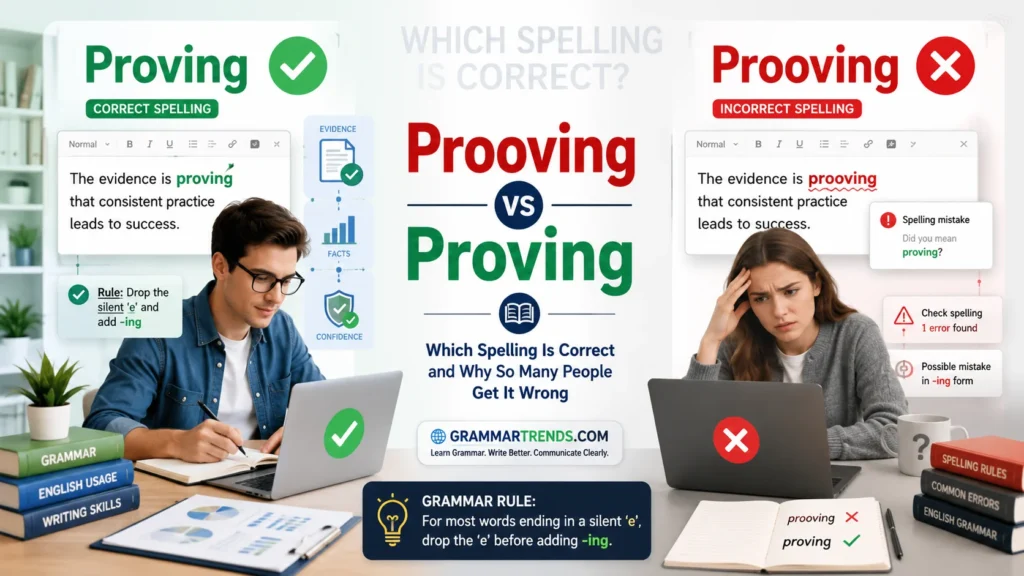
“Proving” vs “prooving” is a common spelling confusion in English writing. Many writers, especially beginners, accidentally use the double “o” form “prooving,” which is incorrect. This mistake often appears in emails, blog posts, social media captions, and school assignments. At first glance, both spellings may look correct, but only one is accepted in standard English.
The correct spelling is “proving.” It comes from the base word “prove,” which means to demonstrate the truth or existence of something using evidence or arguments. For example, The lawyer is proving the defendant’s innocence in court. On the other hand, “prooving” is not a real word in standard English dictionaries. It is simply a common misspelling of “proving,” and it should be avoided in formal writing.
This confusion can affect the clarity and professionalism of your writing. In academic work, job applications, or professional emails, such small mistakes can make your content look less trustworthy. That’s why it’s important to remember the correct spelling and use it consistently.
Quick Answer: Is It “Prooving” or “Proving”?
If you’re in a hurry, here is the answer immediately:
| Word | Correct? | Meaning |
| Proving | ✅ Yes | Demonstrating or showing something is true |
| Prooving | ❌ No | Misspelling of proving |
The correct form comes from the base verb prove.
When you turn prove into its -ing form, English follows a standard spelling rule:
- Remove the silent e
- Add -ing
Result:
Prove → Proving
Not:
Proove → Prooving
Simple on paper. Yet people still misspell it every day.
Why People Mistakenly Write “Prooving”
Spelling errors rarely happen because someone lacks intelligence. They happen because your brain likes shortcuts.
Language behaves like a city full of roads and shortcuts. Most days your brain takes familiar routes. Occasionally it turns down the wrong street.
Let’s look at why that happens.
Confusion Created by Similar Word Patterns
English contains many words that look similar but follow different rules.
Take these examples:
| Base Word | -ing Form |
| Move | Moving |
| Approve | Approving |
| Improve | Improving |
| Arrive | Arriving |
| Prove | Proving |
Notice something?
The ending e disappears.
English often drops a silent ending e before adding -ing.
That rule works across many verbs.
Why Your Brain Wants Another “O”
The mistake feels natural because your brain searches for familiar visual patterns.
Consider these words:
- Proof
- Groove
- School
- Smooth
- Balloon
Double vowels appear frequently in English. Because prove sounds somewhat similar to some of these words, many people instinctively type:
Prooving
The mind sees:
“That looks balanced.”
But English occasionally behaves like a magician pulling a coin from behind your ear. The pattern looks predictable until suddenly it isn’t.
Understanding the Rule Behind “Proving”
Grammar becomes easier when you stop treating it like a list of random commands.
Think of it as a recipe.
Here’s the recipe for verbs ending in silent e:
Verb ending with e
↓
Drop e
↓
Add ing
Examples:
| Base Verb | Correct Form |
| Prove | Proving |
| Move | Moving |
| Improve | Improving |
| Approve | Approving |
| Arrive | Arriving |
| Drive | Driving |
| Write | Writing |
Notice that the extra o never appears.
The spelling process removes letters rather than adding them.
Why the Silent E Disappears
The silent e serves a purpose in many English words.
It often changes vowel pronunciation.
Examples:
- Hop → Hope
- Rid → Ride
- Not → Note
However, once -ing gets attached, that final e no longer needs to stay.
English essentially says:
“Thanks for your service. Time to leave.”
Then the e exits.
What Does “Proving” Actually Mean?
Knowing the spelling matters. Knowing the meaning matters even more.
The word proving means:
- Demonstrating truth
- Showing evidence
- Establishing facts
- Confirming a claim
- Testing something successfully
You can use proving in many situations.
Proving in Everyday Life
People use proving constantly without noticing.
Examples:
- “You’re proving your point.”
- “She keeps proving everyone wrong.”
- “The results are proving helpful.”
Everyday conversations rely heavily on evidence and confirmation.
Imagine two friends arguing over directions.
One says:
“I told you this route was faster.”
After arriving early:
“Well, Google Maps is proving me right.”
The word quietly appears everywhere.
Proving in Academic Writing
Schools and universities use the word frequently.
Students:
- prove arguments
- prove theories
- prove hypotheses
- prove mathematical solutions
Example:
“The researchers are proving the relationship between sleep and memory performance.”
Evidence drives education.
Without proof, ideas remain assumptions.
Proving in Business Communication
Companies use proving when discussing results.
Examples:
- “The campaign is proving successful.”
- “The strategy is proving effective.”
- “The data is proving customer demand.”
Business decisions revolve around measurable outcomes.
Numbers speak loudly.
Proving in Legal Contexts
Law depends heavily on evidence.
Lawyers spend enormous effort:
- proving negligence
- proving intent
- proving liability
- proving innocence
Example:
“The attorney focused on proving that the contract had been violated.”
Evidence can reshape entire cases.
Read more: Kinesthesiology vs Kinesiology: The Correct Usage
Real Sentence Examples Using “Proving”
Examples make grammar easier because you see words functioning in real situations.
Everyday Examples of Proving
- “She is proving her dedication through actions.”
- “Time is proving that the decision was correct.”
- “You are proving your abilities every day.”
- “The weather is proving difficult to predict.”
- “The new routine is proving useful.”
Workplace Examples of Proving
- “The company is proving its value to investors.”
- “The team is proving its consistency.”
- “Customer feedback is proving the demand exists.”
- “The market is proving more competitive than expected.”
Educational Examples of Proving
- “The student is proving the mathematical theorem.”
- “The experiment keeps proving the hypothesis.”
- “Researchers are proving new relationships between variables.”
Sports Examples of Proving
- “The player is proving critics wrong.”
- “The team keeps proving its resilience.”
- “The season is proving difficult.”
Sports headlines use the word constantly.
Why “Prooving” Is Incorrect
Now for the important part.
Why exactly does prooving fail?
Because standard English dictionaries and grammar systems do not recognize it as the proper form.
Major language authorities consistently use:
Proving
Not:
Prooving
The mistake breaks established spelling rules.
Problems Created by Using “Prooving”
Spelling mistakes create ripple effects.
Those ripple effects include:
Reduced credibility
Readers notice errors quickly.
Academic papers, resumes, and professional documents lose polish.
Spell-check warnings
Writing software immediately flags the word.
Programs such as:
- Microsoft Word
- Google Docs
- Grammarly
recognize prooving as incorrect.
Reader distraction
Small mistakes interrupt reading flow.
Think of a spelling mistake like a pebble inside your shoe.
Tiny problem.
Constant irritation.
Dictionary Standards for “Proving”
Here is how standard dictionaries recognize the word:
| Dictionary Reference | Accepted Form |
| Merriam-Webster | Proving |
| Oxford English Dictionary | Proving |
| Cambridge Dictionary | Proving |
| Collins Dictionary | Proving |
Language evolves over time. However, prooving has not become accepted standard usage
Common Spelling Errors Related to Proving
People who type prooving often make similar mistakes elsewhere.
Let’s clear those up.
Proove vs Prove
| Incorrect | Correct |
| Proove | Prove |
Example:
❌ “I can proove it.”
✅ “I can prove it.”
Prooved vs Proved
Many writers also confuse past tense forms.
| Word | Usage |
| Proved | Standard past tense |
| Proven | Common past participle |
Examples:
Past tense
“She proved her argument.”
Past participle
“The evidence has proven useful.”
Both appear often in modern English.
Other Commonly Confused Spellings
| Incorrect | Correct |
| Stoped | Stopped |
| Analist | Analyst |
| Cacoon | Cocoon |
| Comprable | Comparable |
Patterns trick people repeatedly.
Small Case Study: How One Letter Changed Reader Perception
A marketing agency tested two nearly identical email campaigns.
Version A included:
“Our research is proving effective.”
Version B included:
“Our research is prooving effective.”
The difference looked tiny.
However, readers reported that Version B appeared:
- less professional
- rushed
- less trustworthy
One letter changed perception.
That tiny detail mattered.
Why Spelling Accuracy Matters More Than People Think
Some people say:
“You understood what I meant anyway.”
Technically, that’s true.
Yet language does more than transfer information.
It creates impressions.
Think of writing like showing up to a job interview.
Wrinkled clothes may not change your intelligence. They may change how people perceive you.
Spelling works similarly.
Accurate writing communicates:
- attention to detail
- professionalism
- credibility
- care
Quick Memory Trick to Never Misspell “Proving” Again
Memory tricks work because the brain remembers images better than rules.
Try this:
If a word ends with silent e, remove it before inviting -ing inside.
Visual version:
Prove
↓
Remove e
↓
Proving
Read it several times.
Your brain usually stores visual shortcuts more effectively than abstract grammar rules.
Mini Quiz: Test Yourself
See if the rule sticks.
Fill in the Blank
She is ______ her argument with evidence.
The experiment keeps ______ successful.
They are ______ their commitment.
Answers:
- proving
- proving
- proving
Choose the Correct Word
Which option is correct?
Prooving / Proving
Answer:
✅ Proving
Which option is correct?
Proove / Prove
Answer:
✅ Prove
Which option is correct?
Prooved / Proved
Answer:
✅ Proved
Frequently Asked Questions (FAQs)
1. What is the correct spelling: proving or prooving?
The correct spelling is proving. “Prooving” is a common misspelling and is not accepted in standard English.
2. Is “prooving” ever used in English?
No, “prooving” is not a recognized English word. It only appears as a typing or spelling error.
3. What does “proving” mean?
“Proving” means showing or demonstrating the truth of something using evidence, logic, or argument.
4. Why do people mistakenly write “prooving”?
People often overapply spelling rules or double letters incorrectly, especially when typing quickly.
5. Does spelling “prooving” affect writing quality?
Yes, it can make writing look less professional and may reduce clarity in academic or formal contexts.
6. Where is the word “proving” commonly used?
It is commonly used in legal writing, academic essays, professional emails, and everyday communication.
7. How can I avoid this mistake?
Practice the correct spelling “proving,” and remember it comes from the base word “prove,” not “proove.”
Conclusion
In conclusion, the correct form is “proving,” vs “prooving” is simply a common spelling mistake. Understanding this difference helps improve clarity, accuracy, and professionalism in writing. Whether you are writing emails, essays, or blog posts, using the correct spelling ensures your content looks more polished and trustworthy.

Emma Rose has spent 15 years in the English Department at the University of California, Los Angeles (UCLA), guiding students through British and American literary classics, critical theory, and narrative techniques. Her scholarly focus includes 19th- and 20th-century fiction, the art of poetry, postcolonial writing, and digital humanities particularly how storytelling voice influences cultural perspectives. Emma has presented her research at major international conferences and published in respected academic journals, underscoring her dedication to both high-level scholarship and engaging teaching.