
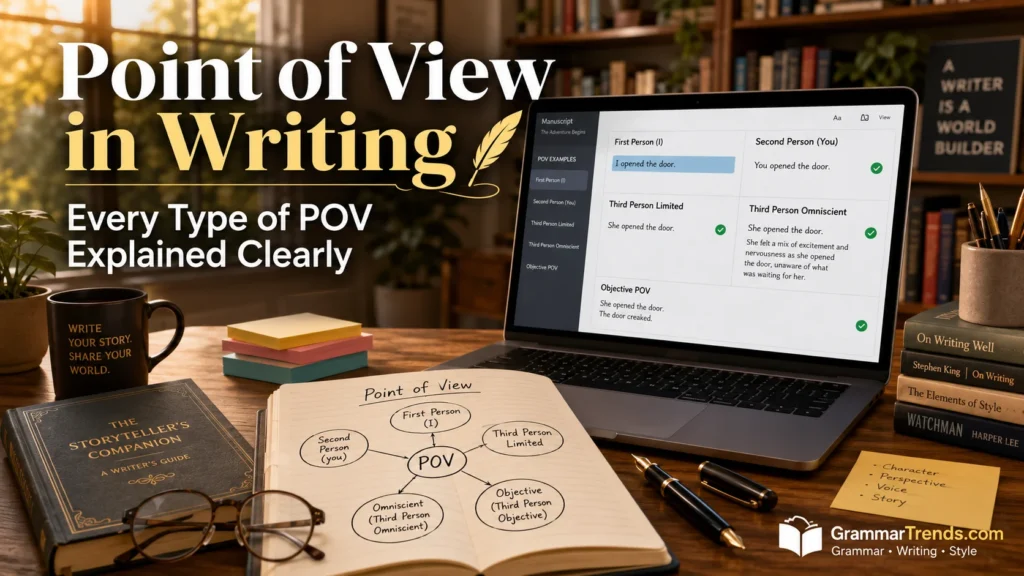
Point of View in Writing is key when shaping story, writing, and novel, where POV, point of view, and define point of view guide how reader, readers, experience the narrative, tone, and clarity. It must stay consistent, clear, and sets how you decide the whole approach, because even small changes create confusion in a book or writing point of view system.
As an editor, I see inexperienced writers making top mistakes, where point of view problems, major POVs, and POV rules are not used with common sense, causing things to goes wrong, instantly breaking reader trust, and erode credibility. This often leads to fracture, suspension of disbelief, and can threaten trust, especially when handling stories, post, or written work without understanding major pitfalls and simple to master principles.
What Is Point of View in Writing?
Point of view in writing refers to who tells the story and how they see it. That “who” controls the lens everything passes through.
Think of it like a camera:
- First person puts the camera inside one character’s head
- Third person pulls it slightly back
- Omniscient POV flies above everything
- Second person points the camera directly at the reader
Here’s a simple breakdown:
| POV Type | Narrator | Pronouns | Distance |
| First Person | Character | I, me, my | Very close |
| Second Person | Reader as character | You | Immersive |
| Third Person Limited | Outside narrator (one mind) | He, she, they | Close-medium |
| Third Person Omniscient | All-knowing narrator | He, she, they | Wide |
| Objective POV | Camera-like observer | He, she, they | Detached |
Here’s the key idea most writers miss:
Point of view doesn’t just tell the story. It decides what the reader is allowed to know.
That alone changes everything.
Why Point of View in Writing Matters More Than Most Writers Think
POV does more than “who speaks.” It controls emotional impact, pacing, tension, and even genre expectations.
Let’s break it down.
POV controls emotional distance
- Close POV = intense emotions, deep connection
- Distant POV = more objectivity, less emotional pull
POV controls suspense
If the narrator doesn’t know something, the reader doesn’t either. That’s powerful.
POV controls information flow
You decide:
- What the reader sees
- When they see it
- How clearly they understand it
POV shapes voice
Even the same scene feels different depending on who tells it.
Example:
- First person: “I felt my hands shake before I knocked.”
- Third person: “He stood outside the door, his hands shaking.”
Same moment. Completely different experience.
First Person Point of View in Writing
First person POV uses I / me / my and puts the reader inside one character’s mind.
Why writers love first person point of view
First person works because it feels personal. Immediate. Honest.
You get:
- Strong emotional immersion
- A natural character voice
- Instant connection
It works especially well in:
- Memoirs
- YA fiction
- Psychological thrillers
- Romance
Types of first person narration
Reliable narrator
The character tells the truth as they understand it.
Unreliable narrator
The character lies, misleads, or misunderstands reality.
Example:
- Gone Girl style narration
- Stories with mental distortion or bias
Retrospective narration
The character tells the story after it happens.
This allows reflection like:
“I didn’t realize it then, but that moment changed everything.”
The limits of first person POV
First person has constraints:
- You only know what the narrator knows
- You can’t easily show other scenes
- You risk overusing internal thoughts
Common first person mistakes
Writers often slip into:
- Overusing “I think” or “I feel”
- Repeating internal commentary
- Explaining emotions instead of showing them
- Making the narrator unrealistically observant
A quick fix:
Instead of writing “I felt scared,” write what fear does:
My stomach tightened. My breath shortened.
Second Person Point of View in Writing
Second person uses you, which directly places the reader inside the story.
When second person point of view works
It works best when you want immersion or experimentation:
- Interactive fiction (like choose-your-path stories)
- Psychological tension
- Instructional storytelling
- Experimental literary fiction
Example:
You open the door. The room is colder than you expected.
It creates immediacy. Almost pressure.
When second person doesn’t work
Second person can fail when:
- The reader doesn’t relate to the action
- Emotional assumptions feel forced
- The story becomes repetitive
Most readers resist being told what they “do” for long periods.
How to use second person effectively
Keep it sharp:
- Use short scenes
- Focus on sensory detail
- Avoid overly specific emotions
Think of it like a guided experience, not a lecture.
Third Person Limited Point of View in Writing
Third person limited uses he / she / they, but stays inside one character’s perspective at a time.
What third person limited really means
You see the world through one character, but the narrator stays outside them.
Example:
She stepped into the room. Her pulse jumped when she saw the letter.
We stay with her experience, but we don’t become her.
Why third person limited dominates modern writing
This POV offers balance:
- Emotional closeness
- Narrative flexibility
- Easier worldbuilding
It’s the most common POV in:
- Fantasy novels
- Thrillers
- Contemporary fiction
Deep POV explained
Deep POV removes distance between narrator and character.
Instead of:
She felt nervous.
You write:
Her fingers tightened around the paper.
No filter words. No distance.
Multiple POV characters
Many novels rotate between characters:
- Each chapter = one POV
- Clear breaks signal switch
- Each character has a distinct voice
Example structure:
| Chapter | POV Character |
| 1 | Character A |
| 2 | Character B |
| 3 | Character A |
Common mistakes in third person limited
Writers often:
- Accidentally jump into other minds
- Add narrator commentary
- Keep emotional distance too wide
Third Person Omniscient Point of View in Writing
Omniscient POV means the narrator knows everything.
What omniscient POV actually does
It allows:
- Access to multiple characters
- Knowledge of past, present, and future
- Authorial commentary
Think of it as storytelling from above the world.
The danger of confusion vs head-hopping
Head-hopping is random switching inside scenes.
Omniscient POV is controlled switching with purpose.
That difference matters.
Benefits of omniscient POV
- Epic storytelling scope
- Rich thematic layering
- Flexible narrative movement
Risks of omniscient POV
- Emotional distance
- Reader confusion
- Weak character attachment
Free indirect discourse explained
This blends narrator and character voice.
Example:
The town looked peaceful. Of course it did. It always lied like that.
You feel the character inside the narration without breaking structure.
Third Person Objective Point of View in Writing
This POV acts like a camera.
No thoughts. No emotions. Only action.
What it looks like
She walked into the room. He picked up the knife. He left.
No interpretation. Just facts.
Why it works
It creates:
- Mystery
- Tension
- Reader interpretation
Best uses
- Crime fiction
- Minimalist storytelling
- Suspense scenes
Challenge
You lose emotional depth. The reader must infer everything.
Read more: “Channel vs Chanel” What’s the Real Difference?
Rare and Experimental POV Styles in Writing
First person plural (“We” narration)
We walked into the forest, and we didn’t come back the same.
This creates collective identity.
Fourth person POV (collective “one” voice)
Used in experimental literature to blur identity.
Epistolary POV
Story told through:
- Letters
- Emails
- Journals
Example:
- Dracula
- The Perks of Being a Wallflower
Hybrid POV structures
Modern novels often mix:
- First person + third person chapters
- Multiple narrators
- Frame narratives
The Biggest Point of View Mistake in Writing: Head-Hopping
Head-hopping happens when a story jumps between minds without structure.
Example of head-hopping
She loved him. He wondered if she noticed. She suddenly felt unsure about his silence.
This confuses readers fast.
How to fix head-hopping
Step 1: Lock one POV per scene
Stick to one mind.
Step 2: Filter everything through that character
If they don’t know it, don’t show it.
Step 3: Break scenes before switching POV
Never switch mid-paragraph.
How to Choose the Right Point of View in Writing
Choosing POV isn’t random. It depends on story goals.
Ask these questions:
- Who holds the most tension?
- How close should readers feel?
- What information should stay hidden?
- Is voice or scope more important?
POV by genre
| Genre | Best POV Choice |
| Thriller | First or tight third |
| Romance | Dual third limited |
| Fantasy | Multiple third limited |
| Horror | First or close third |
| Mystery | Limited POV |
Can You Mix or Switch Point of View in Writing?
Yes, but carefully.
Switching between chapters
Works well when:
- Each POV adds new information
- Voice differences are clear
Mixing first and third person
Used in:
- Memoir fiction blends
- Experimental novels
Frame narratives
A story inside a story:
- Outer narrator
- Inner character story
What never works
- Random mid-scene POV shifts
- Unsignaled narrator changes
- Confusing perspective stacking
Case Study: The Same Scene in Every POV
Let’s take one simple moment: a character finds a threatening note.
First Person
I opened the door and froze. The note sat on my desk like it had been waiting for me.
Second Person
You open the door. You stop breathing when you see the note on your desk.
Third Person Limited
She opened the door and stopped. The note sat on her desk.
Omniscient
Opening the door, she had no idea the note had been placed there hours earlier. Meanwhile, across town, the sender smiled.
Objective
She opened the door, stared at the desk, and picked up the note.
Same event. Five completely different emotional experiences.
Quick Reference: Point of View in Writing
| POV | Strength | Weakness | Best Use |
| First Person | Emotional depth | Limited scope | Character-driven stories |
| Second Person | Immersion | Reader resistance | Experimental fiction |
| Third Limited | Balance | Risk of POV slip | Most genres |
| Omniscient | Scope | Distance | Epic stories |
| Objective | Tension | Emotional flatness | Mystery |
FAQs on Point of View in Writing
1. What is point of view in writing?
Point of view is the angle a story is told from. It decides who is speaking and how the reader experiences events in the narrative.
2. Why is point of view important in a story?
It controls how close or distant the reader feels from characters. A strong POV builds clarity, emotion, and trust in the story.
3. What are the main types of point of view?
The three main types are first person, second person, and third person. Each one changes how information is shared with the reader.
4. What is first-person point of view?
First person uses “I” or “we.” The story is told directly through a character’s eyes, giving a personal and emotional experience.
5. What is third-person point of view?
Third person uses “he,” “she,” or “they.” The narrator is outside the story and can be limited or all-knowing.
6. What mistakes do writers make with POV?
Common mistakes include switching POVs suddenly, confusing readers, or not staying consistent, which weakens reader trust and clarity.
7. How can I choose the right POV for my story?
Think about the emotion, distance, and information you want to give. Choose the POV that best fits your story’s purpose and tone.
Conclusion
Mastering point of view in writing is one of the most effective ways to make your stories, articles, and other written work more engaging and easier to follow. Whether you choose first person, second person, or third person, the key is selecting the perspective that best serves your purpose and maintaining it consistently from beginning to end.
A clear and consistent POV helps readers connect with your characters, understand your message, and stay immersed in the narrative without confusion. Before you start writing, decide who is telling the story, what they know, and how closely readers should experience the events. By avoiding common POV mistakes and applying the right perspective for each project, you’ll create writing that feels more polished, credible, and enjoyable to read.

Emma Brooke brings 15 years of experience in the Department of English Language and Literature at the University of California, Berkeley, where she has taught and mentored students across courses in British and American literary traditions, critical theory, and narrative form. Her expertise spans 19th- and 20th-century fiction, poetic prosody, postcolonial literatures, and digital humanities, with a focus on how narrative voice shapes cultural meaning. Emma’s work has been presented at international conferences and published in peer-reviewed venues, reflecting her deep commitment to rigorous literary scholarship and accessible teaching.