
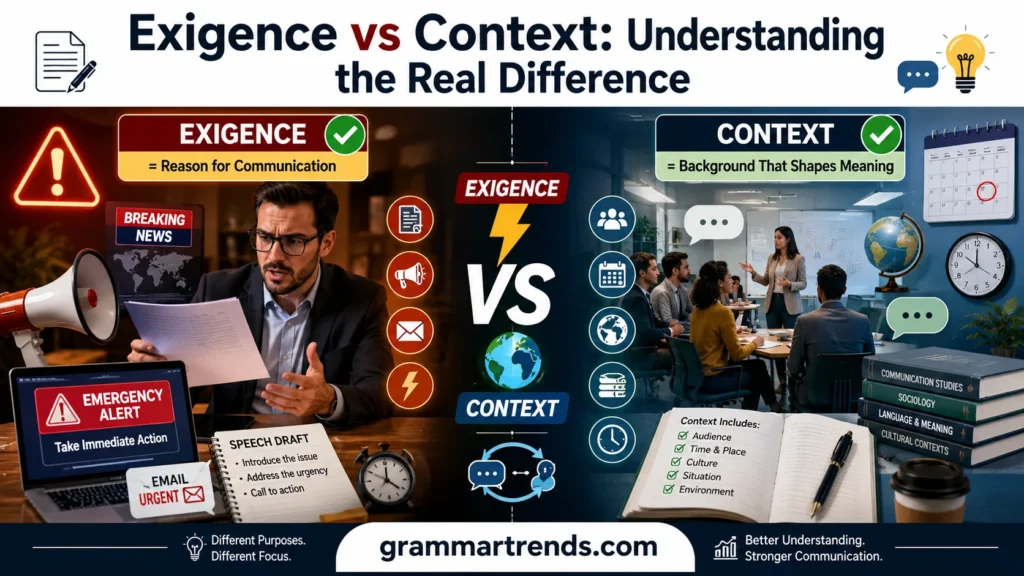
Exigence vs Context often confuses many writers because both terms relate to communication, yet each has a different meaning and purpose. Exigence refers to a specific problem, issue, need, or urgency that motivates a speaker or writer to communicate, while context describes the bigger environment, background, setting, time, place, and surrounding circumstances in which communication occurs. Understanding this difference helps people avoid common mistakes, keep content clear, and ensure the audience interprets a message correctly.
In the communication process, exigence shapes the tone, content, and response, while context influences interpretation through social, cultural, historical, physical, temporal, situational, and contextual factors. For example, a boss asking someone to complete a task in an email, a company addressing declining profits, or a community responding to an earthquake all demonstrate why a message exists. Whether creating social media content, preparing a speech, or writing an academic paper, recognizing these factors helps writers communicate effectively, accurately, and confidently while making their ideas easier for readers to understand.
Why Exigence vs Context Gets Confusing in Real Communication
People mix up exigence and context because both deal with “situations around communication.” On the surface, they feel similar. But they answer different questions.
Here’s the simplest way to see the confusion:
- Exigence feels like the “reason” something exists
- Context feels like the “background” surrounding it
The overlap tricks many learners.
For example:
A news article about a flood has:
- Exigence → the flood itself and the need to inform people
- Context → where it happened, who it affects, and when it occurred
Both matter, but they serve different roles.
Writers struggle because schools often teach them together without clearly separating their function. Once you see the distinction, your analysis sharpens immediately.

Exigence in Communication: What It Really Means
In rhetoric, exigence refers to the urgent situation or problem that triggers communication. It answers one question:
“Why does this message need to exist right now?”
Core Meaning of Exigence
Exigence is not just “a topic.” It is a pressure point that demands a response.
It usually involves:
- A problem that needs solving
- A situation requiring attention
- A gap in understanding or action
- A challenge that forces communication
Think of it as the spark that starts the fire.
Types of Exigence in Real Life
Exigence shows up in different forms depending on the situation.
Immediate Exigence
This involves urgent, time-sensitive issues.
Examples:
- Natural disasters
- Breaking news events
- Medical emergencies
- Cybersecurity breaches
Ongoing Exigence
These are long-term issues that continue to demand discussion.
Examples:
- Climate change debates
- Education reform
- Economic inequality
- Public health awareness
Constructed Exigence
Sometimes writers or speakers create exigence to persuade an audience.
Examples:
- Marketing campaigns that create urgency (“limited-time offer”)
- Political speeches framing issues as crises
- Editorials shaping public concern
Real Case Study: Emergency Communication
During a wildfire alert, authorities release evacuation instructions.
- Exigence: The wildfire spreading rapidly
- Purpose of communication: Save lives through immediate action
Without that exigence, the message would not exist. That’s the key idea.
Key Insight About Exigence
Exigence is always tied to action. If nothing demands a response, exigence doesn’t exist.
Context in Communication: The Hidden Framework of Meaning
If exigence is the “why,” then context is the “environment.”
Context shapes how people interpret messages. Without it, meaning breaks apart.
Core Meaning of Context
Context refers to all the background factors that influence understanding, including:
- Time
- Place
- Audience
- Culture
- Situation
- Prior knowledge
It answers this question:
“What conditions shape how this message is understood?”
Types of Context That Matter Most
Linguistic Context
Words surrounding a statement.
Example:
The word “bank” changes meaning depending on nearby words:
- “river bank”
- “bank account”
Social Context
Relationships between people.
Example:
A joke between friends feels normal, but the same joke in a job interview feels wrong.
Cultural Context
Shared beliefs and customs.
Example:
A thumbs-up gesture means approval in many countries but can be offensive elsewhere.
Historical Context
Time period influences meaning.
Example:
A political speech from the 1960s carries different weight today due to historical events.
Real Case Study: Misunderstood Message
A company launches a slogan: “We are revolutionizing safety.”
- In one country, it sounds innovative
- In another, it sounds alarming due to recent safety scandals
Same message. Different context. Different interpretation.
Key Insight About Context
Context doesn’t change the message itself. It changes how people receive it.
Exigence vs Context: A Clear Side-by-Side Breakdown
Now let’s separate them cleanly so you never confuse them again.
| Feature | Exigence | Context |
| Core role | Triggers communication | Shapes interpretation |
| Main question | Why is this being said? | What affects how it is understood? |
| Focus | Problem or need | Environment and background |
| Function | Initiates response | Frames meaning |
| Nature | Action-driven | Situation-driven |
Simple way to remember it
- Exigence = the reason you speak
- Context = the world around your speech
How They Work Together
They always interact.
Example:
A teacher sends an urgent email about an exam change.
- Exigence → exam schedule change
- Context → students’ stress levels, timing in semester, communication channel
Without exigence, no message exists.
Without context, the message gets misinterpreted.
How to Identify Exigence in Real Situations
You don’t always see exigence clearly. You have to spot it.
Ask these questions:
- What problem triggered this communication?
- What situation demands a response?
- What would happen if no one responded?
Common Signs of Exigence
- Urgent tone
- Calls to action
- Response to events
- Problem-solving language
Example
A city posts:
“Boil water before use due to contamination.”
- Exigence → water contamination
- Response → public safety instruction
How to Identify Context in Real Situations
Context hides in details. You have to read between the lines.
Ask:
- Who is speaking?
- Who is the audience?
- When and where is this happening?
- What background knowledge is assumed?
Context Clues to Watch
- Formal vs informal tone
- Cultural references
- Timing of message
- Platform (email, speech, text)
Example
A message says:
“Nice shot!”
Depending on context:
- Sports game → compliment
- Classroom → feedback on presentation
- Online chat → sarcasm or praise
Read more: Pace vs Phase: The Real Difference and Examples
How to Use Exigence in a Sentence
Using exigence correctly often shows up in academic writing.
Strong sentence patterns
- “The exigence for the article stems from rising misinformation online.”
- “A public health crisis created the exigence for immediate reform.”
- “The writer responds to the exigence of climate anxiety among youth.”
Practical usage tips
- Use it in analysis, not casual speech
- Pair it with verbs like creates, responds, arises, stems from
How to Use Context in a Sentence
Context appears more naturally in everyday language.
Clear sentence examples
- “Without context, the comment seems harsh.”
- “Cultural context changes how the gesture is interpreted.”
- “The meaning depends heavily on historical context.”
Common patterns
- “In this context…”
- “Given the context…”
- “Within this context…”
Common Mistakes in Exigence vs Context
People usually slip in three ways.
Mistake: Treating Them as the Same Thing
This flattens analysis.
Wrong:
“The context of the speech was climate change, so that was the exigence.”
Better:
- Exigence → climate crisis urgency
- Context → political climate and audience expectations
Mistake: Overusing Exigence
Some writers label everything as exigence.
Problem:
Not every detail is a trigger for communication.
Mistake: Ignoring Context
This leads to misreading tone and intent.
Example:
A sarcastic comment becomes misunderstood as serious.
Real-World Examples of Exigence vs Context
Case Study: Political Speech
A leader addresses rising unemployment.
- Exigence → economic downturn
- Context → election season, public frustration, media pressure
Same issue. Different layers.
Case Study: Advertising Campaign
A brand launches:
“Don’t miss out—sale ends tonight!”
- Exigence → limited-time promotion
- Context → consumer psychology, urgency marketing, online retail environment
Case Study: Classroom Discussion
A teacher asks:
“Why did the author choose this tone?”
- Exigence → assignment prompt requiring analysis
- Context → literary text, classroom setting, grading rubric
Edge Cases Where Things Get Interesting
Subtle Exigence
Not all exigence is obvious.
Example:
A brand quietly shifts messaging to respond to public criticism.
When Context Overrides Exigence
Sometimes context completely changes meaning.
Example:
A joke works in one culture but fails in another.
Overlapping Situations
In speeches, exigence and context blend tightly.
Political campaigns are a perfect example:
- Exigence drives urgency
- Context shapes persuasion strategy
Practice Section: Test Your Understanding
Try these:
Identify Exigence
A city issues flood warnings after heavy rain.
What triggered the message?
Identify Context
A student writes a formal essay for an academic audience.
What shapes interpretation?
Separate Both
A company apologizes for a product failure during a live press conference.
Break it into:
- Exigence
- Context
Key Takeaways on Exigence vs Context
- Exigence explains why communication happens
- Context explains how meaning is shaped
- They work together but serve different roles
- Misunderstanding them weakens analysis and writing clarity
- Strong communicators always separate cause from environment
FAQs
What is exigence in communication?
Exigence is the reason, problem, need, or urgency that motivates a person to communicate. It explains why a message is created in the first place.
What is context in communication?
Context is the background surrounding a message. It includes factors such as time, place, culture, audience, and situation that affect how the message is understood.
What is the main difference between exigence and context?
Exigence focuses on why communication happens, while context focuses on the circumstances in which the communication takes place.
Can exigence exist without context?
No. Every message has a context because communication always occurs within a specific environment, audience, and situation.
Why is understanding exigence important?
Understanding exigence helps writers and speakers identify the purpose of their message and communicate more effectively.
How does context affect a message?
Context influences how the audience interprets and responds to a message. The same words can have different meanings in different situations.
How can I use exigence and context correctly in writing?
First, identify the reason for your message (exigence). Then consider the audience, setting, culture, and other surrounding factors (context) to make your message clear and appropriate.
Conclusion
Understanding Exigence vs Context can significantly improve communication skills. Exigence explains the need or reason behind a message, while context provides the background that shapes how the message is received. When writers and speakers recognize both elements, they can create clearer, more effective, and more meaningful communication. Whether you are writing an academic paper, preparing a speech, or creating online content, knowing the difference between exigence and context helps ensure your message reaches the audience as intended.

Emma Rose has spent 15 years in the English Department at the University of California, Los Angeles (UCLA), guiding students through British and American literary classics, critical theory, and narrative techniques. Her scholarly focus includes 19th- and 20th-century fiction, the art of poetry, postcolonial writing, and digital humanities particularly how storytelling voice influences cultural perspectives. Emma has presented her research at major international conferences and published in respected academic journals, underscoring her dedication to both high-level scholarship and engaging teaching.