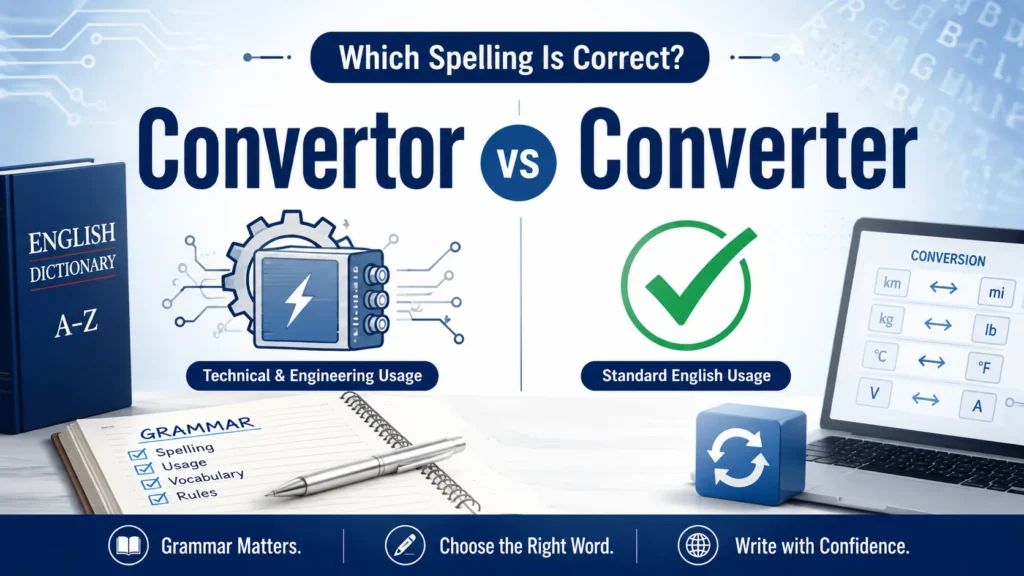
Many people searching Convertor vs Converter in English face real confusion because both words look similar in daily use.
I have worked with writers, developers, and engineers who stop before choosing the right spelling because one extra letter can change trust, clarity, and professional English standards. In most modern applications, converter is more commonly and widely used for digital tools, apps, and common devices, while convertor appears more in technical fields, especially when referring to electrical devices, mechanical devices, or a signal convertor.
Both terms mean someone or something that converts, so the difference mainly depends on context, industry, geography, and how the usage differs in professional scenarios and technical scenarios. This article explains the history, definitions, rules, and practical examples in simple language with short sentences to help readers gain understanding quickly and use convertors correctly without mistakes.
From my personal writing experience, I have noticed that this topic often confuses professionals because both forms technically share the same root, meaning, and usage, even though the spelling differences still matter in everyday language and industry applications. Some people see convertor misspelling as a simple typo, while others use it frequently when discussing electrical devices or other technical scenarios.
In a general context, converter dominates because it sounds more natural in online content, digital tools, and other applications, but both forms still appear in certain particular circumstances. This guide also helps readers avoid a sheer mistake caused by force of habit, especially when someone that changes or someone that converts a signal, file, or system is involved. These clear examples provide a quick answer for anyone wondering which is the correct term for writing or daily use, while the subtle differences in spelled differently terms continue to influence accurate writing, proper use, and technical communication.
Quick Answer: Convertor or Converter?
If you want the safest, most widely accepted spelling, use converter.
It works in:
- Everyday writing
- Business communication
- Blog posts
- Software terminology
- Academic writing
- Product descriptions
Meanwhile, convertor survives mainly in:
- Electrical engineering
- Industrial machinery
- Technical patents
- Legacy engineering systems
For most readers, “convertor” looks unusual. Some people even assume it’s a typo. That matters if clarity and trust matter to your content.
Here’s the simplest breakdown:
| zWord | Status | Best Use Case |
| Converter | Standard modern spelling | General writing |
| Convertor | Technical variant | Engineering and industrial contexts |
If you’re writing for a broad audience, stick with converter almost every time.
Why People Confuse Convertor and Converter
The confusion makes perfect sense. Both words come from the verb convert. Both sound exactly the same when spoken aloud. On top of that, dictionaries recognize both spellings.
That creates a linguistic gray zone.
English already contains many noun endings using:
- -er
- -or
For example:
- actor
- creator
- instructor
- printer
- teacher
- editor
Because English borrowed vocabulary from Latin, French, and Germanic roots over centuries, noun endings became inconsistent. Some words naturally settled into “-er” endings while others kept “-or.”
“Converter” eventually became dominant because it matched familiar English word patterns better.
Think about it:
- write → writer
- print → printer
- teach → teacher
- convert → converter
It simply feels more natural to modern readers.
However, engineering fields often preserve older terminology long after mainstream English moves on. That’s exactly why “convertor” still appears in technical environments.
What Does “Converter” Mean?
A converter is anything that changes one thing into another form.
That sounds broad because it is.
The word applies to:
- software
- machines
- electronics
- energy systems
- currencies
- files
- media formats
- chemical processes
In plain English, a converter transforms input into a different output.
Common Examples of Converter
Here are some examples you probably see every day:
| Type | Example |
| Software | Video converter |
| Finance | Currency converter |
| Electronics | Power converter |
| Automotive | Torque converter |
| Digital tools | PDF converter |
| Energy | Solar power converter |
Notice something important here.
Almost every modern company, app, and software tool uses converter, not convertor.
That’s not random. It reflects current language standards and user expectations.
Examples of “Converter” in Real Sentences
Understanding usage becomes easier when you see real examples.
Everyday Examples
- I used a video converter to change the file format.
- The voltage converter protected the device overseas.
- This currency converter updates exchange rates instantly.
Business Examples
- The company launched a cloud-based file converter.
- Our PDF converter handles encrypted documents securely.
Technical Examples
- The catalytic converter reduces harmful emissions.
- Engineers replaced the power converter during maintenance.
Each sentence sounds natural because “converter” fits standard English patterns.
Is “Convertor” a Real Word?
Yes. Absolutely.
“Convertor” is not a fake word or an outright spelling mistake.
Major dictionaries recognize it as:
- a variant spelling
- a technical form
- an alternative noun form
Still, recognition does not equal popularity.
That distinction matters.
Many words exist in English without sounding natural in everyday writing. “Convertor” falls into that category for most audiences.
Where “Convertor” Still Appears
Although rare in general writing, “convertor” continues to appear in specialized industries.
Electrical Engineering
Older electrical systems often use the term:
- rotary convertor
- synchronous convertor
These machines historically converted electrical current types.
Industrial Equipment
Manufacturers sometimes keep traditional naming conventions for:
- industrial convertors
- signal convertors
- phase convertors
Scientific Literature
Some research papers preserve older terminology to match industry standards or historical documentation.
Patent Language
Patent filings frequently maintain original technical naming patterns. Once terminology enters a patent system, it often remains unchanged for decades.
Examples of “Convertor” in Technical Contexts
Here’s where the spelling still appears naturally.
- The rotary convertor stabilized the power system.
- Engineers repaired the frequency convertor yesterday.
- The industrial convertor handled high-voltage loads.
Outside engineering, though, these examples sound unusual to average readers.
Converter vs Convertor: The Real Difference
Now let’s clear away the confusion completely.
The difference between converter and convertor is mostly about:
- usage frequency
- audience expectations
- technical tradition
Not meaning.
Side-by-Side Comparison
| Feature | Converter | Convertor |
| Pronunciation | Same | Same |
| Meaning | Same | Same |
| Common in modern English | Yes | Rare |
| Preferred in software industry | Yes | No |
| Seen in engineering fields | Sometimes | Yes |
| Looks natural to readers | Yes | Usually not |
That last row matters more than people realize.
Language is partly about correctness. However, it’s also about familiarity.
Readers trust words that feel normal.
Why “Converter” Became the Dominant Spelling
Language evolves through repeated public usage. “Converter” won because it aligned with broader English patterns.
Several factors pushed it ahead.
Software and Technology Boom
During the internet era, digital tools exploded:
- MP3 converters
- PDF converters
- currency converters
- video converters
Millions of users saw the “-er” spelling repeatedly. That repetition reinforced the standard.
Reader Familiarity
Most English nouns describing tools end in “-er”:
- blender
- toaster
- scanner
- printer
“Converter” naturally fits the pattern.
Why Engineers Still Use “Convertor”
Technical industries often resist language changes.
That’s not stubbornness. It’s practicality.
Changing terminology across:
- manuals
- engineering diagrams
- patents
- standards
- training systems
would create confusion and documentation problems.
As a result, legacy terms survive far longer in engineering than in everyday language.
A good example appears in older power systems where “rotary convertor” became an established engineering term decades ago.
Once a term becomes embedded in industrial standards, replacing it becomes expensive and unnecessary.
Read more: Forteen or Fourteen? The Correct Spelling Explained With Easy Examples
What Major Dictionaries Say About Converter vs Convertor
Dictionaries overwhelmingly favor converter.
Still, most acknowledge “convertor” as a variant spelling.
Merriam-Webster
Lists converter as the primary spelling while recognizing convertor as a variant.
Cambridge Dictionary
Uses converter as the standard modern form.
Oxford English Dictionary
Recognizes both spellings but strongly favors converter in modern usage.
Collins Dictionary
Also prioritizes “converter.”
The pattern becomes obvious quickly.
“Converter” dominates mainstream English.
Converter vs Convertor in American and British English
Sometimes spelling differences come down to geography.
For example:
- color vs colour
- organize vs organise
That’s not the case here.
American English
American English overwhelmingly prefers:
- converter
You’ll see it in:
- software
- consumer electronics
- education
- publishing
- journalism
British English
British English also strongly favors:
- converter
However, some British engineering fields still preserve “convertor” more often than American consumer writing does.
When You Should Use “Converter”
For most situations, converter is the correct choice.
Use “Converter” In:
- Blog posts
- Marketing pages
- Product descriptions
- Academic essays
- Technical writing for general readers
- Software naming
- Educational content
Examples
- Currency converter
- Audio converter
- Voltage converter
- File converter
- Catalytic converter
If your audience includes everyday readers, “converter” almost always wins.
When “Convertor” Might Actually Be Correct
Despite its rarity, “convertor” still has legitimate uses.
Engineering Systems
Some established machine names retain older terminology.
Examples include:
- rotary convertor
- synchronous convertor
Legacy Documentation
Industrial companies often preserve terminology for consistency.
Changing established wording could:
- confuse technicians
- break documentation standards
- create compliance issues
Patents and Manufacturer Terminology
Certain product lines legally or historically retain “convertor” in official naming structures.
In those cases, changing the spelling would technically be incorrect.
Common Mistakes Writers Make
Writers frequently misunderstand the relationship between these words.
Here are the biggest mistakes.
Assuming “Convertor” Is Always Wrong
It isn’t wrong.
It’s simply uncommon outside technical fields.
Using Both Spellings Randomly
Consistency matters.
Switching between:
- converter
- convertor
inside one article makes writing look sloppy.
Choose one unless you’re specifically discussing the difference.
Overcorrecting Technical Language
If a machine’s official name includes “convertor,” changing it to “converter” may introduce inaccuracies.
Context matters.
Real-World Examples From Technology and Brands
Look around modern software platforms and you’ll notice a clear pattern.
Common Products Using “Converter”
| Product Type | Typical Naming |
| Video apps | Video converter |
| Audio tools | Audio converter |
| PDF tools | PDF converter |
| Online utilities | File converter |
| Currency apps | Currency converter |
Modern digital products overwhelmingly prefer “converter.”
Technical Systems Using “Convertor”
| Industry | Example |
| Electrical engineering | Rotary convertor |
| Industrial machinery | Signal convertor |
| Legacy power systems | Phase convertor |
Again, the divide is mostly audience-based.
A Simple Trick to Remember the Correct Spelling
Here’s an easy mental shortcut.
Most English tools end in:
- -er
Think about:
- mixer
- scanner
- printer
- blender
- charger
So naturally:
- convert → converter
That’s why “converter” feels instantly familiar.
“Convertor” breaks the pattern for most readers.
Case Study: Why Software Companies Use “Converter”
Imagine launching two apps.
App A
Fast Video Convertor
App B
Fast Video Converter
Which one feels more trustworthy?
Most people choose the second instantly.
That reaction matters.
Software companies spend millions building user trust through:
- branding
- clarity
- familiarity
- readability
A strange-looking spelling introduces friction. Even tiny friction can lower conversions.
That’s why nearly every major software platform prefers:
- converter
not convertor.
How Language Evolution Changed the Preferred Spelling
English constantly simplifies itself over time.
Words often shift toward:
- easier pronunciation
- familiar patterns
- widespread consistency
“Converter” followed that path naturally.
The rise of:
- digital tools
- internet searches
- global English communication
accelerated the dominance of the “-er” version.
Today, “convertor” survives mostly because technical industries preserve historical terminology longer than ordinary language does.
Converter vs Convertor in Professional Writing
Professional editors almost always recommend:
- converter
Why?
Because professional writing values:
- clarity
- readability
- consistency
- audience familiarity
Using uncommon spellings without a technical reason can distract readers unnecessarily.
That distraction weakens communication.
Good writing should feel effortless to read.
The Psychology Behind Familiar Spellings
People trust familiar language faster.
That psychological effect influences:
- branding
- user engagement
- readability
When readers encounter unfamiliar spellings, their brains pause briefly to evaluate the word.
That tiny interruption affects reading flow.
“Converter” eliminates that friction because readers instantly recognize it.
FAQs
Is converter the correct spelling in English?
Yes, converter is the more common spelling in modern English. It is widely used in daily use, digital tools, apps, and general writing.
Why do people use convertor instead of converter?
Many people use convertor because it appears in some technical fields, especially when discussing electrical devices or mechanical devices. In some industries, the term has become familiar through habit and repeated usage.
Is convertor considered a typo?
In most situations, convertor misspelling is treated as a typo or a less common variation. However, it still appears in certain technical and professional contexts.
What is the difference between convertor and converter?
The main difference is based on context and common usage. Converter dominates in everyday and professional language, while convertor appears more in specialized technical communication.
Which spelling should students and writers use?
Students, writers, and professionals should usually use converter because it sounds more natural in professional English and modern communication.
Why does one extra letter matter?
One extra letter can affect trust, clarity, and accurate writing. Correct spelling helps avoid confusion in academic, technical, and professional content.
Are both words technically correct?
Both words technically share the same root and meaning because they describe someone or something that converts. Still, converter is the preferred spelling in most situations.
Conclusion
The debate around Convertor vs Converter may seem small, but the choice of spelling can influence clarity, professional communication, and reader trust. While both forms share the same meaning, converter remains the more accepted and widely used term in modern English, especially in digital tools, applications, and general writing. Understanding the subtle differences helps readers avoid mistakes and choose the right spelling with confidence in both technical and everyday situations.

Emma Brooke brings 15 years of experience in the Department of English Language and Literature at the University of California, Berkeley, where she has taught and mentored students across courses in British and American literary traditions, critical theory, and narrative form. Her expertise spans 19th- and 20th-century fiction, poetic prosody, postcolonial literatures, and digital humanities, with a focus on how narrative voice shapes cultural meaning. Emma’s work has been presented at international conferences and published in peer-reviewed venues, reflecting her deep commitment to rigorous literary scholarship and accessible teaching.