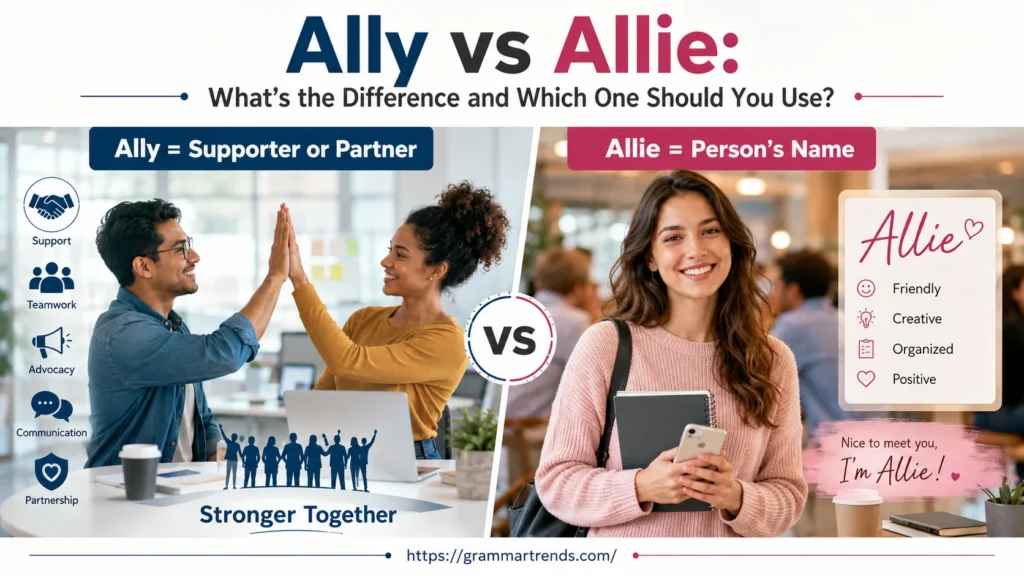
Many people mix up Ally vs Allie in daily writing because both words sound alike, yet their meanings change completely in context. An ally is a loyal supporter, companion, partner, or friend who supports, helps, and cooperates beside a person, group, or country, while Allie is usually a female name, nickname, or traditional spelling linked with Allison, Alexandra, or Alice.
I once paused mid-sentence while writing an important message because one tiny spelling mistake almost flipped the meaning and made the sentence awkward and unintentionally funny. This article will explain the main differences, proper usage, pronunciation, grammar, terminology, and communication rules so writers, students, editors, and even a digital assistant can communicate with more confidence, clarity, and accurate written or verbal expression.
In many contexts, allyship, friendship, partnership, cooperation, alliance, and assistance relate to support, while Allie primarily refers to a personal identity or acceptable variant spelling. To avoid misuse, misspelling, and other common mistakes, it is important to identify the distinction through comparison, guidance, clarification, examples, and learning so readers can confidently choose the correct term every time in emails, gaming, politics, online conversation, digital content, meetings, or real-life communication.
Quick Answer: Ally vs Allie
Here’s the simplest explanation possible:
| Word | Meaning | Example |
| Ally | A supporter, partner, or someone who helps another person or group | “She became my strongest ally.” |
| Allie | Usually a person’s first name or nickname | “Allie called me yesterday.” |
The pronunciation stays the same. The meaning does not.
That tiny spelling difference completely changes how readers interpret your sentence.
Why People Confuse Ally and Allie
Homophones trip people up all the time. These are words that sound alike but have different meanings and spellings.
Think about:
- Their vs there
- Principal vs principle
- Brake vs break
“Ally” and “Allie” belong in the same category.
The confusion usually happens because people write the word based on sound instead of meaning. Since both words sound identical, many writers rely on instinct. Unfortunately, instinct doesn’t always save the day.
Spellcheck Often Misses the Error
Here’s the sneaky part.
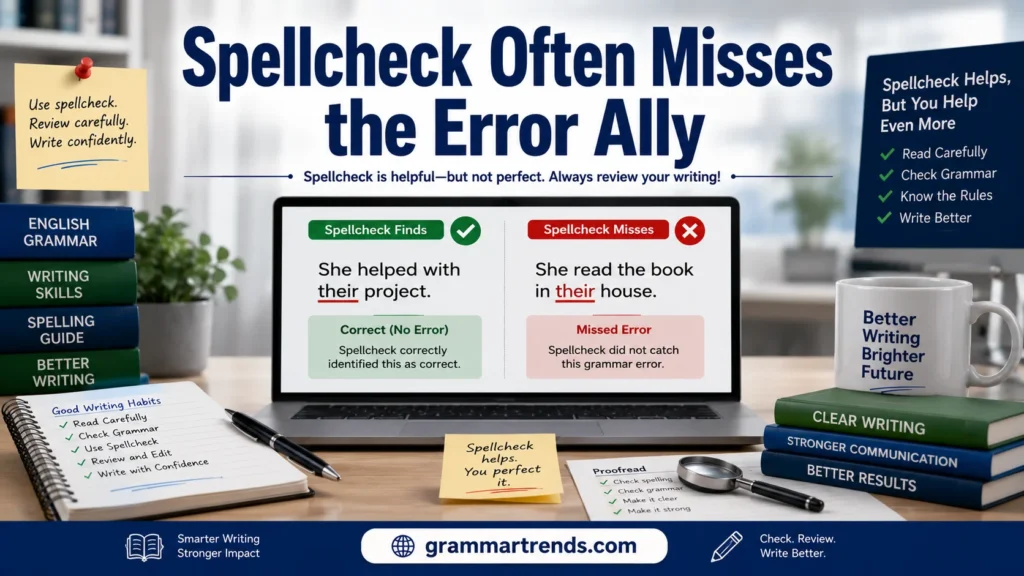
Both words are technically correct spellings. Spellcheck won’t always flag the mistake because neither word is misspelled.
For example:
- “She is my best allie.”
A grammar checker might ignore it even though “allie” is incorrect in that sentence.
That’s why context matters more than pronunciation.
What Does “Ally” Mean?
The word ally usually refers to support, cooperation, or partnership.
At its core, an ally stands beside someone else.
Definition of Ally
An ally is:
A person, group, or nation that supports or cooperates with another for a shared purpose.
People use the word in personal relationships, politics, activism, business, and military discussions.
Ally as a Noun
Most people use “ally” as a noun.
Examples:
- “Canada remained a strong ally.”
- “She became my closest ally at work.”
- “Good leaders value loyal allies.”
In these examples, the ally provides support or assistance.
Ally as a Verb
“Ally” can also function as a verb.
When used this way, it means joining forces with someone.
Examples:
- “The two companies allied to expand globally.”
- “Several nations allied against the threat.”
- “Local organizations allied to raise funds.”
Although the verb form exists, people use the noun version far more often in everyday conversation.
Common Contexts Where “Ally” Appears
The word “ally” appears in several important areas of life.
Politics
Countries often form alliances for defense, trade, or diplomacy.
Example:
During World War II, the Allied Powers worked together against the Axis Powers.
In political writing, “ally” usually refers to strategic partnerships.
Social Justice and Activism
The word gained major popularity in conversations about inclusion and equality.
An ally supports marginalized groups even if they don’t personally belong to those groups.
For example:
- LGBTQ+ ally
- Disability rights ally
- Mental health ally
In these settings, allyship means active support rather than silent agreement.
Business and Workplace Culture
Workplaces often use “ally” to describe trusted collaborators.
Example:
- “She became an ally during the merger process.”
Strong allies help build trust, solve problems, and improve teamwork.
Personal Relationships
Sometimes the word simply means someone who has your back.
That might include:
- Friends
- Family members
- Mentors
- Teammates
A true ally supports you when things get messy. Fair-weather friends disappear. Allies stick around.
Synonyms for Ally
Using variations improves your writing and avoids repetition.
Here are common synonyms for “ally”:
| Synonym | Best Use Case |
| Supporter | General support |
| Advocate | Social causes |
| Partner | Business relationships |
| Associate | Professional contexts |
| Backer | Financial or political support |
| Collaborator | Teamwork projects |
| Companion | Personal support |
Each carries a slightly different tone. “Advocate” sounds stronger than “supporter.” “Partner” sounds more equal than “backer.”
Choose carefully.
Real Sentence Examples Using “Ally”
Seeing the word in action makes the meaning clearer.
Everyday Examples
- “My sister has always been my ally.”
- “You need allies in difficult situations.”
- “A loyal ally can change everything.”
Professional Examples
- “The startup found a powerful ally in the tech industry.”
- “Managers should act as allies rather than critics.”
- “The organization allied with local charities.”
Activism Examples
- “Being an ally requires action.”
- “He spoke openly as an ally for equal rights.”
- “Communities grow stronger when allies step forward.”
Notice how every sentence revolves around support or partnership.
That’s the key.
What Does “Allie” Mean?
Unlike “ally,” Allie is usually a name.
Simple as that.
Definition of Allie
“Allie” functions as a proper noun. People commonly use it as:
- A first name
- A nickname
- A shortened version of another name
Because it’s a name, writers typically capitalize it.
Examples:
- Allie
- Aunt Allie
- Dr. Allie Harper
Names Commonly Shortened to Allie
Many longer names use “Allie” as a nickname.
Popular examples include:
| Full Name | Common Nickname |
| Allison | Allie |
| Alison | Allie |
| Alexandra | Allie |
| Alice | Allie |
| Alyssa | Allie |
Nicknames create familiarity and warmth. That’s why “Allie” feels casual and friendly.
Is Allie Ever Used as a Regular Word?
Rarely.
In modern English, “Allie” almost always refers to a person.
You might occasionally see creative slang or usernames online, but standard grammar treats “Allie” as a proper noun.
That distinction matters.
Real Sentence Examples Using “Allie”
Casual Examples
- “Allie texted me after class.”
- “I’m meeting Allie for coffee.”
- “Allie loves hiking.”
Workplace Examples
- “Allie handled the presentation perfectly.”
- “Please send the report to Allie.”
Storytelling Examples
- “Allie stood quietly near the window.”
- “Everyone trusted Allie immediately.”
Each sentence clearly identifies a person.
Ally vs Allie: Side-by-Side Comparison
Sometimes a table explains things faster than paragraphs.
| Feature | Ally | Allie |
| Meaning | Supporter or partner | Person’s name |
| Part of Speech | Noun or verb | Proper noun |
| Capitalization | Usually lowercase | Usually capitalized |
| Common Usage | Politics, teamwork, advocacy | Names and nicknames |
| Example Sentence | “He became my ally.” | “Allie became my friend.” |
This single chart eliminates most confusion.
The Biggest Difference Between Ally and Allie
Here’s the simplest way to remember it:
- Ally = support
- Allie = person
One describes a relationship. The other identifies an individual.
That’s why context matters so much.
Compare these two sentences:
- “Jordan became my ally.”
- “Jordan became friends with Allie.”
The first sentence discusses support. The second introduces a person named Allie.
Tiny spelling change. Huge meaning shift.
When You Should Use “Ally”
Using “ally” correctly depends on context.
In Professional Writing
Business communication frequently uses the word.
Examples include:
- Strategic allies
- Brand allies
- Corporate allies
Example sentence:
“The company found a reliable ally during negotiations.”
Professional writing values precision. Using “Allie” instead would look careless.

In Social and Political Discussions
The word “ally” exploded in popularity during discussions about equality and representation.
Today, people often talk about:
- LGBTQ+ allies
- Workplace allies
- Educational allies
However, allyship goes beyond labels.
Real allyship includes:
- Listening
- Advocating
- Supporting
- Taking action
A silent supporter rarely creates change.

In Historical and Military Contexts
History books use “ally” constantly.
One famous example involves World War II.
The Allied Powers included countries like:
- United States
- United Kingdom
- Soviet Union
- France
These nations worked together against a shared enemy.
That historical usage helped popularize the term globally.
In Everyday Conversation
People casually use “ally” in daily life too.
Examples:
- “She’s always been an ally.”
- “Good coworkers become allies.”
- “Parents should act as allies for their children.”
The tone can feel serious or supportive depending on context.
When You Should Use “Allie”
You should use “Allie” when referring to someone’s name.
That’s the rule nearly every time.
Referring to a Person Named Allie
Examples:
- “Allie joined the meeting.”
- “I borrowed Allie’s notebook.”
- “Allie recommended that restaurant.”
Since it’s a proper noun, capitalization matters.
Using Allie as a Nickname
Nicknames create familiarity.
People often use “Allie” casually among:
- Friends
- Family members
- Coworkers
- Teammates
Example:
“Only her grandparents still call her Allison. Everyone else says Allie.”
Why Capitalization Matters
Capitalization signals meaning instantly.
Compare:
- “allie helped me.”
- “Allie helped me.”
The lowercase version looks like a typo. The capitalized version clearly identifies a person.
English relies heavily on capitalization cues for proper nouns.
Ignore them and readers notice immediately.
Common Grammar Mistakes People Make
Even experienced writers mix these words up occasionally.
Here are the biggest mistakes to avoid.
Writing “Allie” Instead of “Ally”
This happens constantly online.
Incorrect
“She became my strongest allie.”
Correct
“She became my strongest ally.”
Remember, “ally” refers to support.
Read More: “Channel vs Chanel” What’s the Real Difference?
Using “Ally” as Someone’s Name
Sometimes writers accidentally replace a person’s name with the vocabulary word.
Incorrect
“Ally said she would arrive early.”
If the person’s actual name is Allie, the sentence should read:
Correct
“Allie said she would arrive early.”
Forgetting to Capitalize “Allie”
Names require capitalization.
Incorrect
“I met allie yesterday.”
Correct
“I met Allie yesterday.”
This seems small, but readers often judge professionalism based on details like this.
Assuming Both Words Mean the Same Thing
They don’t.
Pronunciation tricks people into thinking the spellings are interchangeable. They are not.
Think of it this way:
- Ally = role
- Allie = identity
That mental shortcut helps prevent mistakes.
Ally vs Allie in Pop Culture and Online Use
Language evolves online faster than anywhere else.
These words appear constantly across social platforms, entertainment, and digital culture.
Social Media Usage
People use “ally” heavily in hashtags and advocacy campaigns.
Examples:
- #BeAnAlly
- #Allyship
- #CommunityAllies
Meanwhile, “Allie” appears more often in:
- Usernames
- Influencer handles
- Character names
The context usually makes the intended meaning obvious.
“Ally” in Modern Activism
The word “ally” gained cultural weight during conversations about inclusion and equality.
However, many activists emphasize an important point:
Calling yourself an ally means little without action.
Modern allyship often includes:
- Amplifying marginalized voices
- Challenging discrimination
- Supporting equal opportunities
- Learning continuously
In other words, allyship requires participation.
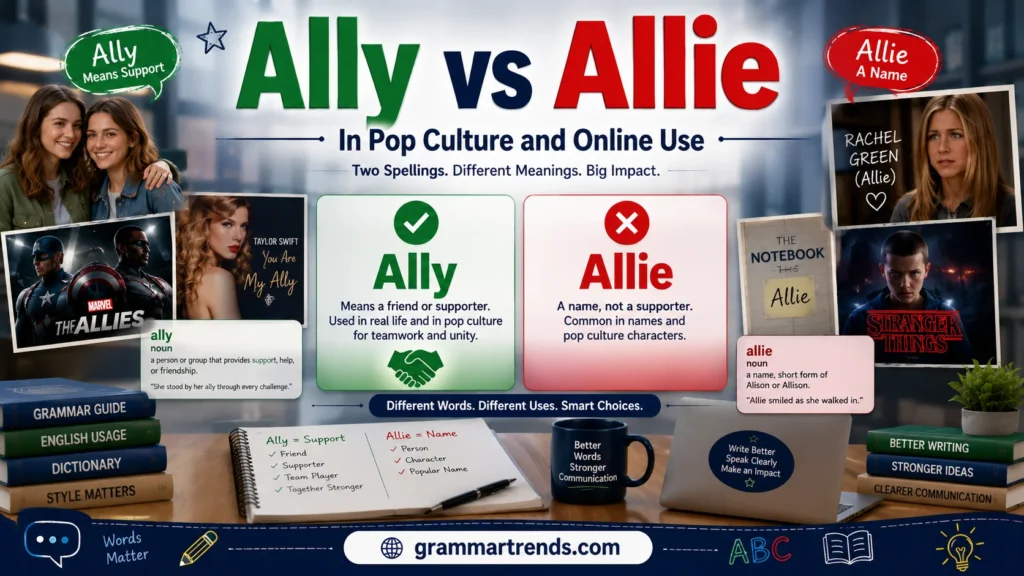
Famous Fictional Characters Named Allie
Pop culture helped normalize the name “Allie.”
Examples include characters from:
- Romance novels
- Teen dramas
- Streaming series
- Young adult fiction
Writers often choose “Allie” because it sounds approachable and friendly.
Names influence perception more than people realize.
Simple Tricks to Remember the Difference
Memory tricks work because they attach meaning to patterns.
Here are the easiest ones.
The “Y Means You Support” Trick
Think about the last letter.
Ally ends with Y.
You can connect that “Y” to:
“Why support someone? Because you care.”
It sounds silly, but it sticks.
The “IE Looks Like a Name” Trick
Many names end in “ie.”
Examples:
- Katie
- Ellie
- Sophie
- Natalie
- Allie
That familiar naming pattern helps readers recognize proper nouns instantly.
Quick Memory Sentence
Here’s the fastest shortcut:
“An ally supports you. Allie is someone’s name.”
Simple. Clear. Hard to forget.
Ally vs Allie Quiz
Let’s test your understanding.
Fill-in-the-Blank Practice
Choose either ally or Allie.
- Sarah became my closest ______ during college.
- ______ forgot her laptop at the office.
- Good leaders act as trusted ______s.
- I met ______ at the conference.
- The countries remained strong ______s.
Answers
- ally
- Allie
- allies
- Allie
- allies
Multiple Choice Questions
Which sentence is correct?
A. “Allie supported the movement as an ally.”
B. “Ally supported the movement as an Allie.”
Correct answer:
A
The first “Allie” refers to a person. The second “ally” refers to support.
Context-Based Challenge
Read this sentence carefully:
“Allie became an ally for the campaign.”
This sentence uses both words correctly.
- Allie = person
- Ally = supporter
That’s where context becomes everything.
Why These Tiny Word Differences Matter
Some people dismiss spelling mistakes as harmless.
In casual texting, maybe they are.
In professional writing, they matter a lot.
Incorrect word choice can:
- Damage credibility
- Confuse readers
- Make content look rushed
- Reduce trust
Small grammar details create a surprisingly strong first impression.
Think of writing like a handshake. Tiny signals influence how people judge quality.
Case Study: How One Letter Changes Meaning
Imagine reading this email:
“Jennifer has been a great allie during the transition.”
The sentence feels awkward immediately.
Why?
Because readers expect “ally” when discussing support.
Now compare it to this version:
“Jennifer has been a great ally during the transition.”
Smooth. Natural. Professional.
One letter fixed the entire sentence.
That’s the power of precision.
Read More: “Channel vs Chanel” What’s the Real Difference?
How Search Engines Interpret Word Accuracy
Search engines have become smarter about language intent.
Using the correct variation helps:
- Improve readability
- Match search intent
- Reduce confusion
- Increase topical relevance
For example:
Someone searching “ally meaning” probably wants a vocabulary explanation.
Someone searching “Allie name meaning” wants information about the name.
Different intent. Different audience.
Smart content recognizes the difference immediately.
FAQs
1. What is the main difference between Ally and Allie?
The main difference is that ally means a supporter, partner, or loyal friend, while Allie is usually a personal name or nickname.
2. Is Allie a correct spelling of ally?
No, Allie is not a substitute for ally unless you are referring to someone’s name.
3. Why do people confuse Ally vs Allie?
People often confuse them because both words have the same pronunciation and sound exactly alike in speaking.
4. Can ally be used in politics and international relations?
Yes, ally is commonly used in politics, military discussions, and global partnerships to describe supportive countries or groups.
5. Is Allie a popular female nickname?
Yes, Allie is a popular nickname and is often short for Allison, Alexandra, Alice, or similar names.
6. How can I remember the correct usage of ally and Allie?
A simple trick is to remember that ally relates to alliance and support, while Allie usually refers to a person’s identity or name.
7. Are Ally and Allie pronounced differently?
No, both words share the same pronunciation, which is one reason the confusion is very common.
8. Can using the wrong spelling change a sentence meaning?
Yes, a tiny spelling difference can completely change the meaning of a sentence and sometimes make it awkward or unintentionally funny.
9. Where do mistakes with Ally vs Allie usually appear?
These mistakes commonly appear in emails, social media posts, gaming chats, online conversations, school writing, and everyday communication.
Conclusion
Understanding Ally vs Allie is important for clear communication and accurate writing. Although the words sound the same, their meanings are very different. Ally refers to support, cooperation, friendship, and partnership, while Allie is mainly used as a personal name or nickname. Learning the correct spelling, pronunciation, usage, and context helps writers, students, editors, and everyday speakers avoid confusion and communicate with more confidence and clarity.

Mia Rose brings fifteen years of experience at The University of Edinburgh’s English Literature department, leading students through explorations of classic and contemporary texts, literary theory, and narrative design. Her academic interests center on Victorian and modernist fiction, poetic rhythms, postcolonial storytelling, and digital approaches to literary study—with a keen eye on how voice and perspective frame cultural dialogue. Mia has delivered talks at prestigious global conferences and authored articles in scholarly journals, showcasing her commitment to meaningful research and lively classroom engagement.