
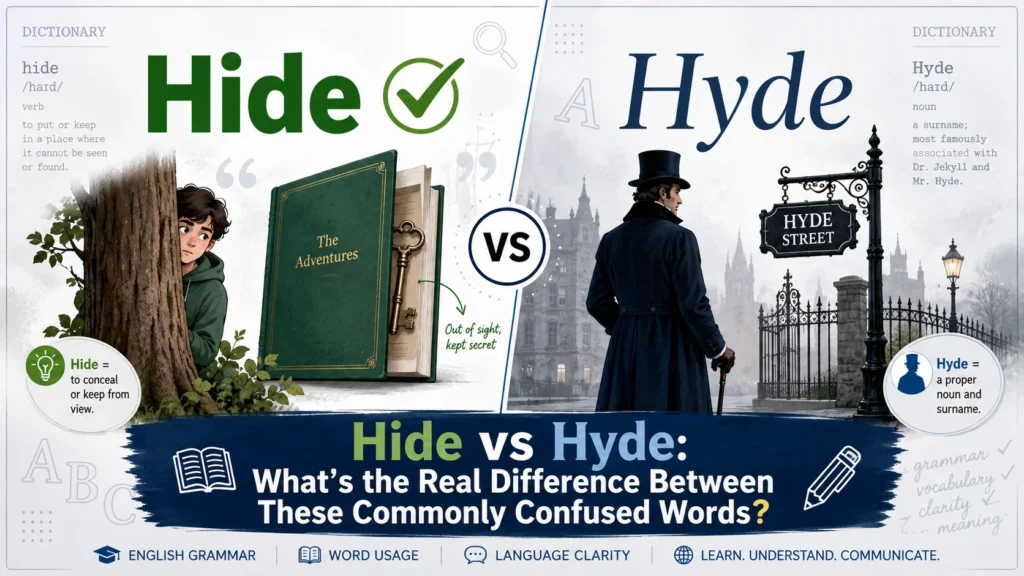
People often confuse Hide vs Hyde because they are homophones that sound the same but have completely different meanings. Hide is a common English word used as both a verb and a noun. It can mean to conceal, stay out of sight, or refer to animal skin such as cowhide, sheepskin, or leather. It also has historical roots in Old English as a unit of land measurement.
In contrast, Hyde is a proper noun, surname, and well-known fictional identity from Dr. Jekyll and Mr. Hyde, where it represents an evil alter ego and the darker side of human nature. Learning the distinction, context, grammar, pronunciation, and usage differences between these words helps prevent common spelling mistakes and improves writing clarity and language learning.
The expression “hide your Hyde” can also symbolize overcoming fear, self-doubt, and Automatic Negative Thoughts (ANTs). Whether in sports or daily life, developing confidence, self-belief, focus, emotional resilience, and positive thinking supports better decision making, personal growth, sports performance, and effective communication.
Hide vs Hyde: Quick Answer
Here’s the simplest explanation possible:
| Word | Meaning | Part of Speech | Example |
| Hide | To conceal something or keep it out of sight | Verb/Noun | “Please hide the key.” |
| Hyde | A proper noun, usually a name or place | Proper Noun | “Mr. Hyde appears in the story.” |
The biggest clue is capitalization.
- hide = action or object
- Hyde = name
Think of it this way:
You can hide your wallet.
You cannot Hyde your wallet.
Simple. Clean. Easy to remember.
What Does “Hide” Mean?
The word hide has several meanings in English. Most people recognize it as a verb. However, it also works as a noun in specific contexts.
That flexibility explains why the word appears constantly in books, movies, conversations, apps, and even cybersecurity discussions.
“Hide” as a Verb
As a verb, hide means:
- To keep something out of sight
- To conceal
- To prevent discovery
- To stay unseen
Examples of “hide” in everyday life
- Children hide during games.
- People hide surprises before birthdays.
- Animals hide from predators.
- Criminals hide evidence.
- Apps let users hide private files.
You probably use this word dozens of times each week without noticing.
Common sentence structures
| Structure | Example |
| Hide + object | “Hide the gift.” |
| Hide + yourself | “Hide yourself quickly.” |
| Hide + from | “She hid from the storm.” |
| Hide + behind | “The cat hid behind the couch.” |
Why “hide” matters in communication
The word carries emotional weight too.
People don’t just hide objects. They hide:
- Fear
- Anxiety
- Secrets
- Intentions
- Excitement
- Pain
That emotional versatility makes the word powerful in storytelling.
For example:
“He smiled while trying to hide his disappointment.”
That sentence instantly creates tension.
“Hide” as a Noun
Now things get interesting.
As a noun, hide refers to an animal’s skin, especially when prepared for leather production.
Examples
- Cowhide
- Buffalo hide
- Deer hide
For centuries, humans used hides for:
- Clothing
- Shelter
- Armor
- Drums
- Shoes
- Furniture
Before synthetic fabrics existed, animal hides were survival tools.
Historical context
Ancient civilizations depended heavily on hides. Hunters preserved animal skins using salt, smoke, and tanning methods.
Some of the oldest surviving human artifacts include hide-based items.
Example sentence
“The hunter stretched the deer hide beside the fire.”
That usage sounds more traditional or historical today, but it still appears in fashion and manufacturing industries.
Common Synonyms of “Hide”
Using synonyms keeps your writing fresh and less repetitive.
Here are some strong alternatives:
| Synonym | Best Use Case |
| Conceal | Formal writing |
| Cover | Physical protection |
| Mask | Emotions or identity |
| Camouflage | Military or nature |
| Shelter | Protection |
| Bury | Figurative concealment |
| Disguise | Appearance changes |
Example comparison
Instead of writing:
“She tried to hide her fear.”
You could say:
“She tried to mask her fear.”
Or:
“She concealed her fear behind a smile.”
Small wording shifts create richer writing.
What Does “Hyde” Mean?
Unlike hide, the word Hyde is almost always a proper noun.
That means it functions as:
- A surname
- A fictional character name
- A place name
You’ll usually see it capitalized.
“Hyde” as a Surname
Hyde appears as a family name in English-speaking countries.
Famous people with the surname Hyde
| Name | Known For |
| Douglas Hyde | First President of Ireland |
| Laurence Hyde | English statesman |
| Annabeth Gish Hyde | Academic and historian |
The surname has old English origins and traces back centuries.
Important grammar rule
Because Hyde is a proper noun, it must usually begin with a capital letter.
Correct:
- Hyde
- Mr. Hyde
- Hyde Park
Incorrect:
- hyde
“Hyde” in Literature and Pop Culture
This is where most people recognize the word.
The name became famous through the novella:
Strange Case of Dr Jekyll and Mr Hyde
Written by Robert Louis Stevenson, the story introduced one of literature’s most iconic characters: Mr. Hyde.
Why Mr. Hyde became legendary
Mr. Hyde represents:
- Hidden evil
- Dark impulses
- Split personality
- Moral conflict
The story explores duality inside human nature.
That theme still influences modern films, psychology discussions, and pop culture.
Cultural impact
People now use the phrase:
“Jekyll and Hyde personality”
It describes someone whose behavior suddenly changes from kind to aggressive.
That’s massive cultural influence from a single fictional surname.
Place Names That Use “Hyde”
You’ll also see Hyde in geographic locations.
The most famous example is:
Hyde Park
Hyde Park ranks among London’s most famous parks and tourist destinations.
Other examples
- Hyde Street
- Hyde County
- Hyde Park neighborhoods
Again, notice capitalization. That’s your clue.
Hide vs Hyde: The Core Difference
Let’s simplify everything into one quick comparison table.
| Feature | Hide | Hyde |
| Pronunciation | Same | Same |
| Meaning | Concealment or animal skin | Name/place |
| Part of Speech | Verb/Noun | Proper Noun |
| Capitalized? | Usually no | Usually yes |
| Used Daily? | Very often | Less often |
The easiest memory trick
If it’s an action, use hide.
If it’s a name, use Hyde.
That rule solves almost every confusion instantly.
When Should You Use “Hide”?
The word “hide” appears constantly in modern English.
You’ll see it in conversation, literature, software design, psychology, and entertainment.
Hide in Everyday Conversation
Here are common real-world examples:
Hiding objects
- “Hide the remote.”
- “Hide the birthday cake.”
- “Where did you hide my keys?”
Hiding emotions
Humans hide emotions all the time.
People hide:
- jealousy
- embarrassment
- sadness
- excitement
Hiding information
Companies sometimes hide:
- fees
- clauses
- terms
- data practices
That’s why the phrase “hidden costs” exists.
Read more: Challange vs Challenge: What’s the Correct Spelling?
Hide in Writing and Storytelling
Good storytelling depends heavily on hidden information.
Mystery novels thrive on concealment.
Writers hide:
- clues
- motives
- identities
- plot twists
Example
“The letter remained hidden beneath the floorboards for decades.”
That instantly sparks curiosity.
Hidden information creates suspense. Suspense keeps readers engaged.
Hide in Business and Technology
Modern technology uses the word constantly.
Examples in software
| Phrase | Meaning |
| Hide folder | Make folder invisible |
| Hide notifications | Silence alerts |
| Hide file extensions | Simplify display |
| Hidden menu | Secret navigation area |
Cybersecurity usage
Hackers often hide malicious code inside files.
Meanwhile, privacy tools help users hide personal information online.
The same simple word now carries major digital importance.
When Should You Use “Hyde”?
Use “Hyde” only when referring to a name, place, or title.
That’s it.
Referring to a Person
Examples
- “Professor Hyde taught literature.”
- “Ms. Hyde wrote the report.”
- “Detective Hyde solved the case.”
Because Hyde acts as a surname, capitalization matters.
Referring to Fictional Characters
The most famous usage remains Mr. Hyde.
Example sentence
“Mr. Hyde symbolizes suppressed darkness.”
Even readers who never finished the novel recognize the reference.
That’s cultural staying power.
Referring to Locations
Examples
- Hyde Park
- Hyde Street
- Hyde County
Again, these are proper nouns.
Never write:
- “hyde park”
Always write:
- “Hyde Park”
Common Mistakes With Hide and Hyde
People confuse these words for three main reasons:
- Same pronunciation
- Fast typing
- Autocorrect errors
Let’s fix those issues permanently.
Using “Hyde” Instead of “Hide”
This mistake happens constantly online.
Incorrect
“Please Hyde the files.”
Correct
“Please hide the files.”
Why?
Because hiding is an action.
Hyde is not a verb.
Treating “Hyde” Like a Verb
Some people assume Hyde works like an alternative spelling.
It doesn’t.
You cannot:
- Hyde your feelings
- Hyde money
- Hyde documents
Those sentences are grammatically wrong.
Forgetting Capitalization
This one causes subtle errors.
Correct
- Hyde Park
- Mr. Hyde
- Douglas Hyde
Incorrect
- hyde Park
- mr. Hyde
Proper nouns require capitalization.
Side-by-Side Sentence Examples
Seeing both words together helps lock the difference into memory.
Sentences Using “Hide”
Everyday examples
- “Hide the presents before the kids arrive.”
- “She tried to hide her laughter.”
- “The rabbit hid beneath the fence.”
Emotional examples
- “You can’t hide regret forever.”
- “He hid his nervousness surprisingly well.”
Professional examples
- “The software lets users hide private folders.”
Sentences Using “Hyde”
Literary examples
- “Mr. Hyde terrified Victorian readers.”
- “The professor compared the villain to Hyde.”
Place examples
- “They walked through Hyde Park at sunset.”
Name examples
- “Officer Hyde handled the investigation.”
Hide vs Hyde in Grammar and Usage
Grammar clears up confusion fast.
Verb Forms of “Hide”
| Tense | Word |
| Base Form | hide |
| Past Tense | hid |
| Past Participle | hidden |
| Present Participle | hiding |
Example sentences
- “I hide my notes.”
- “Yesterday I hid them.”
- “The notes were hidden.”
- “She is hiding nearby.”
Notice how flexible the word becomes.
Why “Hyde” Has No Verb Form
Hyde functions as a name.
Names do not usually transform into verb tenses.
That’s why these forms do not exist:
- hyded
- hyding
- hidden by Hyde (unless referencing a person named Hyde)
English grammar draws a sharp line between common nouns/verbs and proper nouns.
Popular Idioms and Expressions With “Hide”
The word “hide” appears inside many common English expressions.
“Hide and Seek”
One of the world’s oldest children’s games.
How it works
- One player counts
- Others hide
- The seeker searches
Simple. Timeless. Universal.
Nearly every culture has a variation of this game.
“Hide Your Feelings”
This phrase means concealing emotions.
Example
“He laughed to hide his insecurity.”
That emotional masking appears constantly in human behavior.
“Hidden Agenda”
A hidden agenda means secret motives.
Example
“The proposal sounded helpful, but many suspected a hidden agenda.”
Politicians, businesses, and negotiators often face accusations of hidden agendas.
Memory Tricks to Never Confuse Hide and Hyde Again
You don’t need complicated grammar lessons.
These tricks work instantly.
The Capital Letter Rule
If the word starts with a capital letter, it’s probably Hyde.
Example
- Hyde Park
- Mr. Hyde
Actions usually don’t need capitalization.
The Meaning Shortcut
Hide = does something
Hyde = names someone
That’s the easiest shortcut in the entire article.
Pronunciation Reminder
Both words sound identical.
That makes them homophones.
Other common homophones include:
- there / their
- knight / night
- flower / flour
English loves these traps.
Hide vs Hyde in Literature and Media
The literary influence behind Hyde deserves attention.
Few fictional names became this culturally powerful.
The Importance of Mr. Hyde in English Literature
Strange Case of Dr Jekyll and Mr Hyde changed horror fiction forever.
The novel explored:
- morality
- repression
- identity
- psychological darkness
At the time, Victorian society valued public respectability. Stevenson challenged that image by suggesting everyone hides darker impulses beneath the surface.
That psychological tension made the book unforgettable.
Why the Character Name Causes Spelling Confusion
Because people hear the pronunciation before seeing the spelling.
Imagine someone hearing:
“Dr. Jekyll and Mr. Hyde”
They may naturally assume the spelling relates to “hide” because the story centers on hidden darkness.
That connection actually strengthens the confusion.
Ironically, the themes overlap while the spellings differ.
FAQs
What is the main difference between hide and hyde?
Hide is a verb or noun used in everyday English language for concealment, animal skin, or leather. Hyde is usually a proper noun linked with Dr. Jekyll and Mr. Hyde, the famous literary character.
Why do people confuse hide and hyde?
People often confuse these words because they are homophones with similar pronunciation. Their spelling differences can create vocabulary confusion and common mistakes in writing.
Is hide a verb or a noun?
Hide works as both a verb and noun. As a verb, it means to conceal or stay out of sight. As a noun, it can describe cowhide, sheepskin, leather, or animal skin used in leatherworking.
What does Hyde mean in literature?
In literary context, Hyde refers to Mr. Hyde, the evil alter ego from the famous novel Dr. Jekyll and Mr. Hyde. The character represents the darker human side and inner battle.
How can I avoid spelling mistakes with hide and hyde?
Focus on context clues, sentence structure, semantic meaning, grammar, and proper usage. Reading sentence examples also improves understanding and writing clarity.
Why is Mr. Hyde connected with psychology themes?
Mr. Hyde is often connected with psychology, sports psychology, and mental coaching because the character reflects fear, negative thinking, self-doubt, emotional response, and internal conflict.
How does learning hide vs hyde improve English skills?
Learning Hide vs Hyde improves language learning, English vocabulary, reading comprehension, communication, vocabulary building, and writing skills while helping readers write clearly.
Conclusion
Understanding Hide vs Hyde becomes easier when you focus on meanings, usage, context, and literary reference instead of only pronunciation. Hide is commonly used for concealment, invisibility, leather, and animal skin, while Hyde is strongly associated with the fictional character Mr. Hyde and the famous novel Dr. Jekyll and Mr. Hyde. Paying attention to grammar, semantic meaning, context clues, and proper usage helps avoid word confusion, spelling mistakes, and vocabulary confusion. With regular reading, writing practice, and sentence examples, learners can improve English usage, language clarity, and communication skills more confidently.

Emma Rose has spent 15 years in the English Department at the University of California, Los Angeles (UCLA), guiding students through British and American literary classics, critical theory, and narrative techniques. Her scholarly focus includes 19th- and 20th-century fiction, the art of poetry, postcolonial writing, and digital humanities particularly how storytelling voice influences cultural perspectives. Emma has presented her research at major international conferences and published in respected academic journals, underscoring her dedication to both high-level scholarship and engaging teaching.