
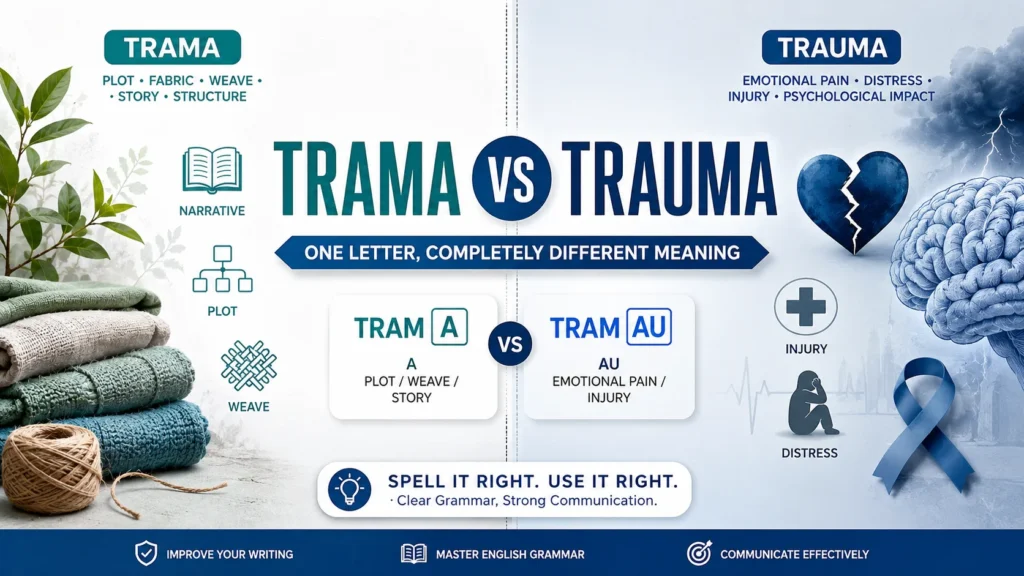
Trama vs Trauma confusion happens quickly because one small letter changes meaning, clarity, and communication accuracy.
I once edited an academic email where “trama” was used instead of “trauma”, and it completely changed the intended meaning. These words look and sound similar, which causes frequent spelling mistakes, typing errors, and autocorrect confusion in academic, professional, and everyday writing.
The word trauma refers to emotional trauma, mental health impact, physical injury, and deeply distressing experiences such as accidents, abuse, illness, or disasters. It can lead to anxiety, depression, PTSD symptoms, and long-term psychological distress.
In contrast, trama is used in botany, fungal anatomy, plant structure, and also in Spanish/Italian contexts meaning texture, weaving pattern, or narrative structure.
These errors often happen due to fast typing, cognitive reading shortcuts, bilingual influence, and grammar confusion.
The best way to avoid this confusion is through contextual understanding, reading practice, word comparison, and strong grammar awareness.
Trama vs Trauma: Quick Answer
Here’s the short version:
- Trauma is the correct English word.
- Trama is usually a misspelling of trauma in English.
- In some languages like Spanish or Italian, “trama” has legitimate meanings unrelated to psychological trauma.
That distinction matters more than most people realize.
Quick Comparison Table
| Word | Correct in English? | Meaning | Common Usage |
| Trama | Usually no | A typo or a foreign-language word | Rare in English |
| Trauma | Yes | Physical or emotional injury/distress | Medical, psychological, and everyday writing |
If you’re writing in English, you almost always want “trauma.”
What Does “Trauma” Mean?
The word trauma carries serious weight. People use it in medicine, psychology, counseling, journalism, and ordinary conversation.
At its core, trauma refers to a deeply distressing experience or physical injury that overwhelms a person’s ability to cope normally.
Medical Definition of Trauma
In medicine, trauma usually means a serious physical injury.
Doctors often use the term after:
- Car accidents
- Falls
- Burns
- Gunshot wounds
- Sports injuries
- Head injuries
For example:
“The patient suffered blunt force trauma during the collision.”
That sentence has nothing to do with emotions. It refers to physical damage to the body.
Hospitals even have dedicated trauma centers designed to treat life-threatening injuries quickly.
Psychological Definition of Trauma
In psychology, trauma refers to a deeply disturbing emotional experience.
Examples include:
- Abuse
- Violence
- Neglect
- War
- Natural disasters
- Severe bullying
- Sudden loss of a loved one
Psychological trauma can affect the brain, nervous system, relationships, and daily behavior for years.
Some people develop conditions like:
- PTSD (Post-Traumatic Stress Disorder)
- Anxiety disorders
- Depression
- Panic attacks
- Sleep disturbances
Not everyone reacts to traumatic events the same way. Two people can experience the same event yet process it very differently.
That’s one reason mental health professionals avoid oversimplifying trauma.
Types of Trauma
Trauma isn’t one-size-fits-all. Mental health experts classify it into several categories.
Acute Trauma
Acute trauma results from a single shocking event.
Examples include:
- A car crash
- Witnessing violence
- Sudden assault
- A natural disaster
The event happens once but leaves a strong emotional impact.
Chronic Trauma
Chronic trauma develops from repeated exposure to distressing experiences.
Examples include:
- Domestic abuse
- Long-term neglect
- Ongoing bullying
- Living in a war zone
This type often causes deeper emotional complications because the stress never truly stops.
Complex Trauma
Complex trauma usually develops during childhood from repeated harmful experiences involving trust or safety.
Examples include:
- Childhood abuse
- Emotional neglect
- Dysfunctional households
- Repeated abandonment
This form can affect identity, attachment, emotional regulation, and relationships later in life.
Physical Trauma
Physical trauma refers to bodily injury.
Common examples include:
| Physical Trauma Type | Example |
| Blunt trauma | Car accident injuries |
| Penetrating trauma | Knife or bullet wounds |
| Head trauma | Concussions |
| Orthopedic trauma | Broken bones |
What Does “Trama” Mean?
Now comes the confusing part.
“Trama” isn’t completely meaningless. It simply doesn’t mean what most English writers think it means.
Is “Trama” an English Word?
In standard English dictionaries, “trama” rarely appears as a common standalone English word.
Most of the time, it’s:
- A typo
- A misspelling
- A phonetic spelling mistake
- An autocorrect error
If someone writes:
“She experienced severe trama after the accident.”
The correct word is trauma.
“Trama” in Other Languages
Things change outside English.
In Spanish, trama means:
- Plot
- Storyline
- Narrative structure
For example:
“La trama de la película fue increíble.”
Translation:
“The plot of the movie was incredible.”
In Italian, “trama” can also refer to:
- Plot
- Weaving pattern
- Fabric structure
So if you encounter “trama” in multilingual contexts, it may actually be correct.
That’s why context matters.
Read more: Togather vs Together: Which Word Is Correct?
Why People Confuse “Trama” and “Trauma”
The confusion happens for several reasons.
Pronunciation Confusion
English pronunciation can feel wildly inconsistent.
Consider these words:
- Though
- Through
- Tough
- Thought
They all look similar yet sound different.
“Trauma” contains the vowel combination “au,” which some people accidentally simplify when typing quickly.
The spoken word sounds close enough that many people omit the “u” entirely.
Typing Mistakes and Autocorrect
Fast typing causes countless spelling errors.
Common reasons include:
- Mobile keyboards
- Fat-finger typing
- Predictive text
- Missed keystrokes
- Poor autocorrect suggestions
One missing letter transforms “trauma” into “trama.”
Search engines understand this mistake so they often still show trauma-related results.
Language Influence
Non-native English speakers sometimes transfer spelling patterns from their native language.
For example:
- Spanish speakers already know “trama”
- Italian speakers recognize “trama”
- Portuguese spelling patterns may influence typing habits
That overlap creates accidental confusion in English writing.
How To Use “Trauma” Correctly in a Sentence
Correct usage depends on context.
Trauma in Medical Writing
Medical professionals use trauma very specifically.
Examples
- “The victim suffered chest trauma during the crash.”
- “Doctors treated blunt force trauma immediately.”
- “The hospital opened a new trauma unit.”
In these cases, trauma refers to bodily injury.
Trauma in Mental Health Discussions
Mental health usage focuses on emotional harm.
Examples
- “Childhood trauma can affect adult relationships.”
- “She started therapy to process past trauma.”
- “Trauma recovery takes time and support.”
These examples involve emotional and psychological experiences.
Everyday Usage Examples
People also use trauma casually in conversation.
Examples
- “The breakup left emotional trauma.”
- “Losing the family home caused deep trauma.”
- “Combat veterans often carry invisible trauma.”
Still, experts warn against overusing the word for ordinary discomfort.
Not every stressful experience equals trauma.
That distinction matters.
Should You Ever Use “Trama” Instead of “Trauma”?
In English writing, almost never.
Still, there are a few exceptions.
When “Trama” Is Correct
You may correctly use “trama” when:
- Writing in Spanish
- Discussing foreign literature
- Referring to a movie plot in another language
- Quoting original text
- Discussing textile terminology
Example
“The novela’s trama becomes darker in the final chapter.”
That works in Spanish-language discussion.
When “Trama” Is Incorrect
Avoid using “trama” in:
- Academic essays
- Professional emails
- Medical writing
- Blog articles
- Journalism
- Psychology discussions
Incorrect Example
“The soldier experienced trama after combat.”
Correct Version
“The soldier experienced trauma after combat.”
Trama vs Trauma: Key Differences
Spelling Differences
The difference comes down to one missing letter:
- Trauma = correct English spelling
- Trama = usually incorrect in English
Simple. Yet easy to overlook.
Pronunciation Differences
Trauma Pronunciation
Trauma is commonly pronounced:
TRAW-muh
The “au” creates the broader vowel sound.
Some people mistakenly hear or type it without the “u.”
Meaning Differences
Here’s where the meanings completely split apart.
| Feature | Trama | Trauma |
| Standard English word | Rare | Yes |
| Psychological meaning | No | Yes |
| Medical usage | No | Yes |
| Foreign-language usage | Yes | Sometimes |
| Common typo? | Very common | No |
Common Mistakes Writers Make
Small language errors can damage credibility quickly.
Here are the biggest mistakes people make with trauma-related writing.
Using “Trama” as a Misspelling
This happens constantly online.
Common examples include:
- “Childhood trama”
- “Emotional trama”
- “Trauma bonding and trama response”
Spellcheck usually catches these mistakes immediately.
Still, many slip through.
Using “Trauma” for Everyday Stress
Modern internet culture sometimes overextends clinical language.
Not every inconvenience qualifies as trauma.
Not Trauma
- A bad haircut
- Losing a game
- Minor embarrassment
- A difficult workday
Potentially Traumatic
- Assault
- Severe abuse
- Violent accidents
- Life-threatening events
Using precise language matters because trauma has serious psychological meaning.
Confusing Trauma With Drama
This mistake exploded on social media.
Some people casually say:
“I don’t want trauma.”
when they really mean:
“I don’t want drama.”
The words are completely different.
Drama
Drama involves conflict, gossip, or emotional tension.
Trauma
Trauma involves serious emotional or physical harm.
Huge difference.
Trauma vs Stress vs Anxiety
These words often overlap in casual conversation. However, they don’t mean the same thing.
What Is Stress?
Stress is the body’s response to pressure or demands.
Examples include:
- Exams
- Deadlines
- Financial pressure
- Job interviews
Stress can actually motivate performance in small amounts.
What Is Anxiety?
Anxiety involves persistent worry or fear.
Symptoms may include:
- Racing thoughts
- Panic
- Restlessness
- Rapid heartbeat
- Sleep problems
Anxiety sometimes exists without a clear external threat.
What Makes Trauma Different?
Trauma overwhelms a person’s sense of safety or stability.
It often leaves lingering emotional or neurological effects.
Comparison Table
| Term | Meaning | Duration | Example |
| Stress | Response to pressure | Temporary | Work deadlines |
| Anxiety | Persistent fear or worry | Ongoing | Panic attacks |
| Trauma | Deep emotional or physical harm | Long-lasting | Abuse or violent events |
Why Accurate Trauma Language Matters
Words shape how people understand mental health.
Misusing trauma terminology can:
- Minimize real suffering
- Spread misinformation
- Confuse medical discussions
- Dilute serious experiences
Mental health professionals encourage careful language because trauma affects millions of people worldwide.
At the same time, language evolves socially. Casual speech sometimes stretches definitions. The key lies in understanding the difference between clinical meaning and conversational exaggeration
How Trauma Affects the Brain
This topic deserves attention because many readers misunderstand trauma’s biological effects.
Trauma doesn’t just exist emotionally. It can physically affect brain function.
Researchers have linked trauma to changes involving:
- The amygdala
- The hippocampus
- Stress hormone regulation
- Nervous system activation
Common Trauma Responses
People often experience:
- Hypervigilance
- Emotional numbness
- Flashbacks
- Dissociation
- Irritability
- Sleep disturbances
Trauma responses aren’t weakness. They’re survival adaptations.
That distinction matters deeply in mental health conversations.
Signs Someone May Be Struggling With Trauma
Trauma symptoms vary widely.
Still, common signs include:
| Emotional Signs | Physical Signs | Behavioral Signs |
| Fear | Fatigue | Isolation |
| Shame | Headaches | Anger outbursts |
| Anxiety | Sleep issues | Avoidance |
| Depression | Muscle tension | Substance abuse |
Not everyone develops symptoms immediately. Some reactions appear months or years later.
How To Remember the Correct Spelling of “Trauma”
Spelling tricks help more than people realize.
Easy Memory Trick
Think:
TRAUMA contains “AU” like “CAUSE.”
Trauma usually has a cause.
That little association helps many writers remember the spelling.
Pronunciation Tip
Break the word into syllables:
TRAU-MA
Saying it slowly often prevents spelling errors.
Proofreading Tips
Before publishing anything:
- Use spellcheck
- Read aloud
- Use grammar software
- Search for common typo patterns
- Slow down during editing
Tiny mistakes weaken otherwise strong writing.
Correct Examples of “Trauma”
Formal Examples
- “The patient showed signs of severe psychological trauma.”
- “Doctors treated multiple trauma injuries after the crash.”
- “Researchers continue studying childhood trauma outcomes.”
Informal Examples
- “That experience caused lasting trauma.”
- “He’s still working through emotional trauma.”
- “Trauma can shape relationships for years.”
Medical Context Examples
| Sentence | Correct Usage? |
| “The trauma surgeon arrived quickly.” | Yes |
| “She suffered spinal trauma.” | Yes |
| “The trama center admitted five patients.” | No |
Incorrect “Trama” Examples
Here are examples people commonly write incorrectly.
| Incorrect Sentence | Correct Sentence |
| “He experienced trama after the accident.” | “He experienced trauma after the accident.” |
| “Childhood trama affects adulthood.” | “Childhood trauma affects adulthood.” |
| “The doctor specialized in trama care.” | “The doctor specialized in trauma care.” |
Case Study: How One Letter Changes Credibility
Imagine two resumes.
Resume A
“Experienced in trauma-informed counseling.”
Resume B
“Experienced in trama-informed counseling.”
One looks professional. The other raises immediate concerns.
Tiny spelling errors can quietly damage trust.
That’s why precision matters in writing.
Trauma in Popular Culture
The word trauma appears everywhere today:
- Podcasts
- TikTok videos
- Therapy discussions
- Television
- Self-help books
- Social media
That visibility helped reduce mental health stigma. However, it also blurred definitions in some online spaces.
Terms like:
- Trauma dumping
- Trauma bond
- Generational trauma
have become increasingly mainstream.
Some uses are clinically accurate. Others stretch psychological terminology beyond its intended meaning.
Trauma-Informed Care Explained
You may hear professionals discuss trauma-informed care.
This approach recognizes that trauma can shape behavior, emotional reactions, and trust.
Trauma-informed systems prioritize:
- Safety
- Empathy
- Trust
- Emotional awareness
- Nonjudgmental communication
Hospitals, schools, therapists, and social workers increasingly use trauma-informed practices today.
Common Myths About Trauma
Myth: Only Soldiers Experience Trauma
False.
Trauma can affect anyone regardless of age, profession, gender, or background.
Myth: Trauma Always Causes PTSD
False.
Not everyone who experiences trauma develops PTSD.
Recovery differs from person to person.
Myth: Trauma Means Weakness
False.
Trauma responses are survival mechanisms, not character flaws.
Myth: Stress and Trauma Are Identical
False.
Stress may feel intense without becoming traumatic.
FAQs
What is the difference between trama and trauma?
Trauma refers to emotional trauma, physical trauma, mental injury, or a deeply distressing experience, while trama is mainly a botanical term used in mycology and plant biology.
Is trama a correct English word?
Yes, trama is a real word, but it is rarely used in everyday English language. It usually appears in scientific context, fungi anatomy, mushroom anatomy, or botanical usage.
Why do people confuse trama and trauma?
People confuse these similar words because of their identical look, sound alike pronunciation, fast typing, autocorrect mistakes, bilingual influence, and one letter difference.
Which word should I use in everyday writing?
In most everyday communication, formal writing, academic writing, and spoken language, the correct word is usually trauma because it relates to emotional or physical injury.
Can using trama instead of trauma hurt credibility?
Yes, one incorrect spelling or spelling mistake can reduce communication clarity, affect credibility in writing, and create confusion in professional or academic work.
What are examples of trauma?
Trauma may result from accidents, abuse, neglect, loss, illness, natural disasters, stressful situations, or overwhelming events that affect emotional health and mental health.
How can I avoid this spelling confusion?
You can avoid this language confusion through reading habit, carefully reading, word comparison, spelling guide, grammar help, contextual meaning, and regular language learning.
Conclusion
Understanding Trama vs Trauma is important because one small spelling change can completely shift the meaning of a sentence. Trauma relates to emotional suffering, psychological pain, mental health, and physical health, while trama belongs to botanical usage, fungi structure, and scientific context. Paying attention to contextual relevance, proper usage, sentence structure, and word choice helps improve communication accuracy, writing clarity, and confidence in everyday writing without confusion.

Mia Rose brings fifteen years of experience at The University of Edinburgh’s English Literature department, leading students through explorations of classic and contemporary texts, literary theory, and narrative design. Her academic interests center on Victorian and modernist fiction, poetic rhythms, postcolonial storytelling, and digital approaches to literary study—with a keen eye on how voice and perspective frame cultural dialogue. Mia has delivered talks at prestigious global conferences and authored articles in scholarly journals, showcasing her commitment to meaningful research and lively classroom engagement.