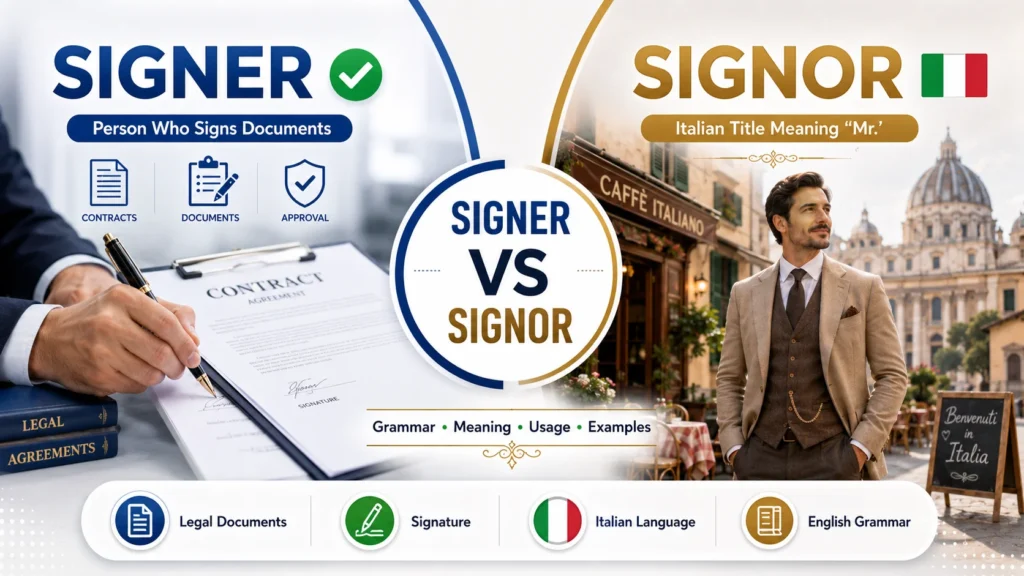
Signer vs Signor often confuses writers because a single letter changes the meaning completely.
A signer is a person who signs documents, contracts, checks, or other legal paperwork. A document signer, authorized signatory, or contract signer has the legal authority to approve official papers, making the term common in business communication and legal writing.
In contrast, Signor is an Italian formal title meaning “Mr.” It comes from Italian signore and is used respectfully when addressing a man, such as Signor Rossi or Signor Giovanni. The word is widely used in Italian culture, travel communication, and formal conversation.
Understanding the difference between Signer and Signor improves grammar, vocabulary, and professional writing while preventing embarrassing mistakes in both legal contexts and Italian etiquette. Remember: a signer signs documents, while a Signor is a gentleman addressed with respect.
Signer vs Signor: Quick Answer
Here’s the short version:
| Word | Meaning | Language | Example |
| Signer | A person who signs something | English | “The signer approved the contract.” |
| Signor | An Italian title meaning “Mr.” | Italian | “Signor Rossi owns the restaurant.” |
So if you’re talking about:
- signatures
- documents
- contracts
- agreements
- petitions
then the correct word is signer.
If you’re referring to:
- an Italian man
- formal Italian address
- Italian culture or language
then the correct word is signor.
Simple. Yet many writers still confuse them because they sound somewhat similar when spoken quickly.
What Does “Signer” Mean?
The word signer refers to a person who signs a document, agreement, form, letter, or official paper.
It comes directly from the English verb sign.
Definition of Signer
A signer is:
Someone who places their signature on a document or agreement.
The word appears frequently in:
- legal writing
- business contracts
- banking paperwork
- government forms
- petitions
- digital authentication systems
You’ll also see it in historical contexts. For example, people often refer to the “signers of the Declaration of Independence.”
Common Situations Where “Signer” Is Used
Here are some everyday examples where the word naturally appears.
Legal Documents
Lawyers constantly use the term signer because signatures create legal accountability.
Example:
“Each signer must provide valid identification.”
Banking Forms
Banks verify the identity of every signer attached to an account.
Example:
“The authorized signer can withdraw funds.”
Employment Contracts
HR departments use the term in onboarding paperwork.
Example:
“The signer agrees to follow company policy.”
Digital Signatures
Modern software platforms also use the word heavily.
For example:
- DocuSign
- Adobe Sign
- PandaDoc
These systems often refer to users as “document signers.”
Real Sentence Examples Using “Signer”
Understanding usage becomes easier when you see the word in context.
Formal Examples
- The signer accepted all terms of the agreement.
- Every signer must initial the final page.
- The signer failed to provide proof of identity.
Informal Examples
- I was the last signer on the birthday card.
- The signer forgot to date the form.
- She became the primary signer on the lease.
Business Examples
- The company requires two authorized signers.
- The signer electronically approved the invoice.
- Each signer receives a confirmation email.
Notice something important here:
Every example connects to signatures or approval.
That’s the core meaning.
What Does “Signor” Mean?
Now things shift completely.
The word signor has nothing to do with signing documents.
Instead, it’s an Italian title.
Definition of Signor
Signor means:
Mister or Sir in Italian.
It’s a respectful way to address an adult man in Italy.
Think of it like:
- Mr. in English
- Señor in Spanish
- Monsieur in French
When Italians Use “Signor”
The title appears in both formal and polite conversation.
Formal Introductions
Example:
“Signor Bianchi will arrive shortly.”
Restaurants and Hotels
Staff members often address guests respectfully.
Example:
“Good evening, Signor Romano.”
Business Etiquette
Italian professionals may use signor in meetings and correspondence.
Example:
“Thank you for your time, Signor Ferrari.”
Cultural Settings
You’ll hear it frequently in:
- Italian films
- operas
- novels
- travel conversations
Real Sentence Examples Using “Signor”
Travel Examples
- Signor Bellini recommended the seafood pasta.
- We met Signor Ricci in Florence.
Italian Conversation Examples
- “Buongiorno, Signor Conti.”
- “How are you today, Signor?”
Literary and Film Examples
Classic films and novels often use the title to establish Italian identity or atmosphere.
For example:
“Signor Vitelli speaks very highly of you.”
That style immediately signals Italian culture.
Signer vs Signor: The Key Differences Explained
This is where confusion disappears completely.
Difference in Meaning
The meanings are unrelated.
| Word | Core Meaning |
| Signer | Someone who signs |
| Signor | Italian title for a man |
One involves signatures.
The other involves respectful address.
Difference in Language Origin
The two words evolved from entirely different linguistic roots.
| Word | Origin |
| Signer | English |
| Signor | Italian |
Even though they look similar, they did not develop from the same modern usage.
Difference in Pronunciation
Here’s how most English speakers pronounce them.
| Word | Pronunciation |
| Signer | SYE-ner |
| Signor | Seen-YOR |
The pronunciation difference becomes more noticeable in Italian speech.
Difference in Usage Context
Use “Signer” For:
- contracts
- signatures
- forms
- petitions
- legal agreements
Use “Signor” For:
- Italian names
- Italian greetings
- formal Italian speech
- cultural references
Difference in Grammar Role
| Word | Part of Speech |
| Signer | Noun |
| Signor | Noun/title |
However, their functions differ.
A signer performs an action.
A signor identifies a respected male person.
Why People Confuse Signer and Signor
English learners aren’t alone here. Native speakers confuse these words too.
Several factors create the mix-up.
Similar Spelling
Only one letter changes.
- signer
- signor
Your brain naturally assumes they’re related.
Similar Sound
In fast speech, pronunciation overlaps slightly.
That causes:
- autocorrect errors
- typing mistakes
- subtitle inaccuracies
Foreign Language Influence
People familiar with Spanish words like “señor” may incorrectly assume “signor” belongs in English contexts involving respect or signatures.
Internet Grammar Errors
Online articles sometimes misuse the terms. Once readers see incorrect usage repeatedly, the mistake spreads.
It’s the linguistic equivalent of a snowball rolling downhill.
Etymology and Word Origins
Word origins tell a fascinating story here.
Origin of the Word “Signer”
The word derives from the English verb sign.
That traces back through:
- Old French
- Latin
The Latin root signum means:
mark, symbol, or seal
Over time, English speakers developed:
- sign
- signature
- signer
- signatory
All connected to written marks and authentication.
Origin of the Word “Signor”
Signor comes from Italian.
Its deeper roots trace to the Latin word:
senior
meaning:
elder or respected man
That same root influenced words like:
- senior
- sir
- señor
- seigneur
So although signer and signor look related, their histories diverged centuries ago.
How the Meanings Evolved
Language evolves like branching rivers.
Signer Evolution
The word moved toward legal and administrative usage.
Today, it strongly connects to:
- paperwork
- identity
- contracts
- verification
Signor Evolution
This word stayed rooted in social respect and formal address.
Its modern role remains largely cultural and linguistic
Read more: Plating vs Platting: What’s the Difference?
How to Pronounce Signer and Signor Correctly
Pronunciation mistakes can instantly reveal confusion.
Pronunciation of “Signer”
Phonetic Style
SYE-ner
Rhymes loosely with:
- diner
- minor
The “g” stays silent.
Pronunciation of “Signor”
Italian-Influenced Pronunciation
Seen-YOR
The ending carries more emphasis.
In authentic Italian pronunciation, the rhythm sounds smoother and more melodic.
Easy Pronunciation Trick
Remember this:
- Signer signs
- Signor sounds Italian
That memory shortcut works surprisingly well.
Which Word Should You Use?
This section solves the confusion permanently.
Use “Signer” When Talking About Documents
Correct contexts include:
- legal agreements
- signatures
- forms
- petitions
- financial documents
Correct Examples
- The signer approved the mortgage.
- Every signer must provide ID.
- The signer accepted the contract terms.
Use “Signor” When Talking About Italian Culture
Correct contexts include:
- Italian names
- respectful address
- travel situations
- Italian dialogue
Correct Examples
- Signor Mancini greeted the guests.
- We spoke with Signor Russo in Rome.
- Signor Bellucci owns the vineyard.
Quick Memory Hack
Here’s the easiest way to remember the difference forever:
| Word | Memory Trick |
| Signer | A signer signs |
| Signor | Signor sounds sophisticated and Italian |
Tiny trick. Huge payoff.
Common Mistakes and Incorrect Usage
Writers frequently misuse these words in ways that completely change the sentence meaning.
Incorrect Examples
Wrong
“The signor signed the contract.”
Unless the person is literally being addressed in Italian, this sounds incorrect.
Correct
“The signer signed the contract.”
Wrong
“Please ask the signer how his pasta tastes.”
Correct
“Please ask Signor Ricci how his pasta tastes.”
Grammar Tips to Avoid Confusion
Ask Yourself One Question
Is the sentence about:
- a signature?
- or an Italian man?
That single question usually solves everything.
Signer vs Signor in Popular Culture and Media
These words appear regularly in books, films, and entertainment.
Usage in Movies and TV
Italian mob films often use “signor” to create authentic dialogue.
Examples include:
- mafia dramas
- historical Italian stories
- travel-based narratives
Meanwhile, “signer” appears more often in:
- courtroom dramas
- legal thrillers
- political documentaries
Usage in Literature
Classic literature sometimes uses signor to establish nationality and social etiquette.
For example:
“Good evening, Signor Bartoli.”
That one phrase instantly paints a cultural setting.
Famous Italian References Using “Signor”
Italian opera especially popularized the term internationally.
Characters frequently address noblemen, merchants, and officials using signor.
That tradition carried into modern media.
Related Words You Should Know
Several related words cause additional confusion.
Signatory
A signatory is officially connected to a signed agreement.
Example:
“All signatories approved the treaty.”
This word sounds more formal than signer.
Signature
A signature is the actual written mark.
The signer creates the signature.
Simple distinction.
Señor
This Spanish title means “Mr.” and resembles signor closely.
| Word | Language |
| Señor | Spanish |
| Signor | Italian |
People frequently mix them up.
Sir
“Sir” functions similarly in English.
However, it lacks the specifically Italian identity of signor.
Mister
“Mister” or “Mr.” serves as the closest English translation.
Example:
| Italian | English |
| Signor Rossi | Mr. Rossi |
Synonyms and Related Terms
Synonyms of Signer
Depending on context, similar words include:
- signatory
- endorser
- witness
- subscriber
- approver
Each carries slightly different legal nuance.
Words Related to Signor
Similar respectful titles include:
- Mister
- Sir
- Señor
- Monsieur
- Don
These titles reflect politeness and social respect.
Can “Signer” Refer to Someone Using Sign Language?
Yes. This surprises many readers.
In linguistics and Deaf culture, a signer can also mean:
A person who communicates using sign language.
For example:
- ASL signer
- fluent signer
- native signer
Here, the word relates to visual signing rather than written signatures.
Signer in ASL and Deaf Culture
Within the Deaf community, the term has important linguistic meaning.
Examples
- She’s a fluent ASL signer.
- Native signers communicate naturally through sign language.
- The conference welcomed Deaf signers from across the country.
This usage remains completely correct and widely accepted.
Interesting Facts About Signer and Signor
The Declaration of Independence Had 56 Signers
One of the most famous uses of the word signer appears in American history.
The 56 signers of the Declaration of Independence became iconic political figures.
Signor Is Still Common in Italy Today
Unlike some outdated formal titles, signor remains widely used in modern Italian society.
You’ll hear it daily in:
- hotels
- restaurants
- banks
- business offices
Autocorrect Frequently Creates Errors
Many spellcheck systems accidentally replace:
- signer → signor
- signor → signer
That’s why proofreading matters.
Practical Examples: Which Word Fits?
| Sentence | Correct Word |
| The ___ approved the contract. | Signer |
| Good evening, ___ Romano. | Signor |
| Each ___ must provide ID. | Signer |
| We met ___ Bianchi in Venice. | Signor |
| The document requires two ___. | Signers |
| ___ Ferrari owns the café. | Signor |
These side-by-side examples make the distinction crystal clear.
Mini Case Study: A Real Writing Mistake
A travel blogger once wrote:
“The signer welcomed us into his restaurant.”
Technically, that sentence implied the restaurant owner had signed something.
What the writer meant was:
“Signor welcomed us into his restaurant.”
One tiny spelling error changed the entire tone.
That’s why precision matters in language. Small details create big differences.
FAQs
What is the main difference between Signer and Signor?
A Signer is a person who signs legal papers, contracts, checks, or official documents. Signor is an Italian polite title used for addressing a man respectfully, similar to Mr. or sir.
Is Signor used in legal documents?
Usually, Signor is used in Italian culture and respectful conversation, not for legal authority or contract signing. In legal paperwork, the correct word is normally Signer or authorized signatory.
Why do people confuse Signer and Signor?
The two words look almost identical, and one missing letter changes the meaning completely. This creates grammar confusion, vocabulary confusion, and communication errors in formal writing.
Can a Signer also use sign language?
Yes. A signer can also mean someone who communicates through American Sign Language (ASL) or other sign language systems.
Is Signor only used in Italy?
Signor comes from Italian language and Italian culture, but people may also use it outside Italy when speaking formally or respectfully in Italian conversation.
Which word should I use in contracts?
For contracts, official paperwork, document approval, and legal documents, always use Signer, legal signatory, or authorized signatory instead of Signor.
How can I remember the difference between Signer and Signor?
A simple trick is to connect Signer with signing papers and signatures, while Signor relates to Italian manners, polite titles, and formal address.
Conclusion
Understanding Signer vs Signor becomes much easier once you focus on context and usage. A Signer belongs to legal communication, contracts, signatures, and official authority, while Signor belongs to Italian etiquette, respectful address, and cultural conversation. Even though the words appear very similar, using the wrong one can change tone, meaning, and professional accuracy instantly. Learning the distinction helps writers, travelers, students, and professionals avoid confusion in both legal and cultural situations.

Emma Brooke brings 15 years of experience in the Department of English Language and Literature at the University of California, Berkeley, where she has taught and mentored students across courses in British and American literary traditions, critical theory, and narrative form. Her expertise spans 19th- and 20th-century fiction, poetic prosody, postcolonial literatures, and digital humanities, with a focus on how narrative voice shapes cultural meaning. Emma’s work has been presented at international conferences and published in peer-reviewed venues, reflecting her deep commitment to rigorous literary scholarship and accessible teaching.