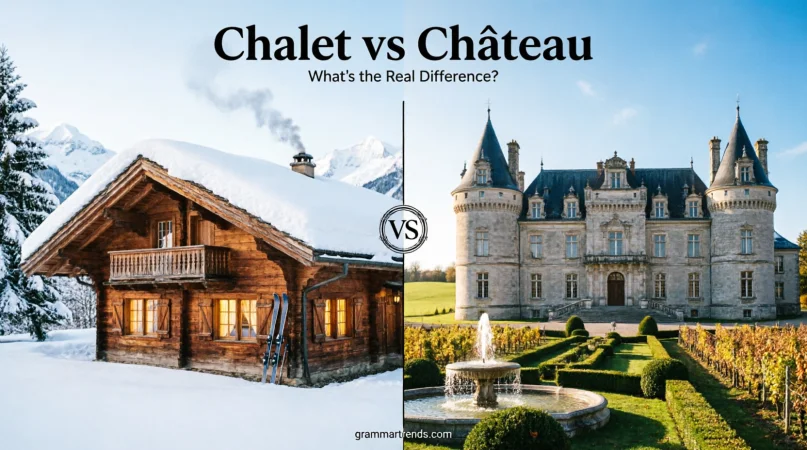
Chalet vs Chateau helps travelers understand the difference between cozy mountain stays and luxurious countryside estates across Europe today.
When I started planning a trip through Europe, I felt unsure about where to stay because the words chalet and chateau often confuse many travelers. After reading several definitions and learning the key differences, it became easier to determine the proper word to use in everyday English vocabulary.
A chalet is usually a small wooden house, cottage, or wooden cabin with overhanging eaves, a sloping roof, and a warm rustic atmosphere. These places are linked with skiing, mountainous regions, the Alps, snowy mountains, and peaceful nature. Many visitors choose this accommodation type for a cozy ski holiday, winter vacation, or relaxing mountain retreat inside an alpine retreat setting.
A château or chateau is very different because it usually describes a large country house, castle, fortress, manor house, or grand estate located in the French countryside or other scenic areas of France. These luxurious properties often include elaborate architecture, elaborate gardens, strong masonry, and fortified walls that reflect rich heritage, culture, and medieval history. During my own Europe travel experience, I noticed that chalets and chateaus suit different types of travel destination and comfort needs.
A mountain lodge, alpine lodge, or mountain cottage near a ski resort makes a perfect chalet accommodation, while a castle-like property, historic building, or luxury estate creates a memorable vacation experience. This article and guide also improve language learning, language usage, grammar, sentence structure, and contextual meaning so readers can describe these beautiful places correctly in sentences before making an informed decision for a future European adventure.
Chalet vs Chateau at a Glance
Sometimes the fastest answer comes from a simple side-by-side comparison.
| Feature | Chalet | Chateau |
| Origin | Swiss Alps | France |
| Traditional purpose | Shelter and mountain housing | Estate or noble residence |
| Typical setting | Mountains | Countryside and estates |
| Construction style | Mostly wood | Mostly stone |
| Architectural feel | Rustic and cozy | Formal and grand |
| Traditional occupants | Farmers and shepherds | Nobility and wealthy landowners |
| Modern use | Ski homes and vacation rentals | Luxury homes, hotels, vineyards |
| Typical size | Small to medium | Large |
| Associated with | Snow, mountains, fireplaces | Vineyards, estates, gardens |
Quick memory trick:
Chalet = Mountains
Chateau = Estates
Simple. Yet the story behind these words gets far more interesting.
What Is a Chalet?
Chalet Definition
A chalet traditionally refers to a wooden house or building found in mountainous regions, especially in the Swiss Alps.
Originally, chalets weren’t luxury retreats. They served practical purposes. Farmers and herders used them as seasonal dwellings while moving livestock between mountain pastures.
Today, the meaning has expanded. People commonly use “chalet” for:
- Ski homes
- Mountain vacation houses
- Rustic cabins
- Alpine-inspired homes
- Cozy retreat properties
Picture a warm wooden home sitting beside snowy mountains with smoke rising from a chimney. That’s the image most people associate with a chalet.
Historical Origins of the Chalet
The history of the chalet starts high in the Alpine mountains.
Centuries ago, Swiss farmers needed practical structures that could withstand harsh weather conditions. Winters brought heavy snow and freezing temperatures. Mountain weather could change quickly.
The design evolved around survival.
Traditional Alpine communities built homes using materials available nearby. Trees supplied timber. Local stone reinforced foundations.
Over time, mountain shelters developed distinctive features that remain recognizable today.
“Architecture often begins with necessity before it becomes style.”
The chalet perfectly fits that idea.
What started as a working building later transformed into a global design trend.
During the nineteenth century, European tourism expanded. Wealthy travelers discovered Alpine regions and admired these mountain homes. Chalet designs spread across Europe and eventually into North America.
Suddenly, practicality became luxury.
Key Features of a Traditional Chalet
Traditional chalets share several characteristics.
Common chalet features include:
- Steep sloping roofs
- Large overhanging eaves
- Wooden construction
- Wide balconies
- Mountain placement
- Large windows
- Warm interior spaces
- Heavy timber beams
Here’s why these features mattered.
| Chalet Feature | Purpose |
| Sloped roof | Prevent snow buildup |
| Wide eaves | Protect walls from rain and snow |
| Wooden materials | Provide insulation |
| Large balconies | Dry crops and provide outdoor space |
| Thick walls | Retain warmth |
The design wasn’t random.
Every element solved a real problem.
How Chalet Meaning Changed Over Time
Modern chalets don’t always sit on Alpine mountainsides.
Today you’ll find:
- Beach chalets
- Luxury chalets
- Resort chalets
- Lakeside chalets
- Contemporary chalets
Developers often use the word because it creates a feeling of comfort and escape.
Imagine reading two vacation descriptions:
Option A: Mountain house rental
Option B: Luxury mountain chalet
The second one instantly paints a richer picture.
Words sell experiences.
What Is a Chateau?
Chateau Definition
A chateau traditionally refers to a large French country estate or manor house.
Many people assume a chateau automatically means castle.
That’s not entirely correct.
A castle mainly exists for defense. A chateau focuses more on residence and status.
Some chateaus resemble castles because they include towers, stone walls, and grand architecture. Others look more like elegant mansions.
Historical Origins of the Chateau
The word “chateau” comes from French roots dating back hundreds of years.
During medieval periods, wealthy landowners and nobility built large country residences that served multiple purposes:
- Family homes
- Administrative centers
- Agricultural hubs
- Symbols of social status
As time passed, architecture evolved.
Medieval defensive structures gradually shifted toward beauty and comfort.
During the Renaissance period, elaborate estates appeared throughout France.
Many included:
- Formal gardens
- Decorative facades
- Sculptures
- courtyards
- expansive grounds
A chateau became more than a house.
It became a statement.
Key Features of a Traditional Chateau
Most traditional chateaus include distinctive elements.
Common characteristics:
- Stone construction
- Large estates
- Symmetrical layouts
- Decorative architecture
- Multiple floors
- Grand entrances
- Formal gardens
- Extensive land
Chateau Features Explained
| Feature | Purpose |
| Stone walls | Durability and prestige |
| Large grounds | Agricultural and status use |
| Formal gardens | Display wealth |
| Multiple rooms | House families and staff |
| Decorative design | Demonstrate power |
Walking through a historic chateau often feels like entering another world.
Massive staircases replace simple hallways.
Ceilings rise dramatically overhead.
Rooms unfold one after another like scenes in a movie.
Modern Meaning of Chateau
Modern usage stretches the definition.
Today the term may refer to:
- Luxury hotels
- Vineyard estates
- Historic residences
- Boutique accommodations
- High-end properties
Many wineries also use the term.
That creates another source of confusion.
Read more: “Realist vs Realest” What’s the Real Difference?
Chalet vs Chateau: Major Differences Explained
Let’s break down the core distinctions.
Chalet vs Chateau Architecture
Architecture immediately reveals the difference.
Chalet architecture:
- Rustic
- Functional
- Warm
- Timber-focused
Chateau architecture:
- Formal
- Decorative
- Symmetrical
- Stone-focused
Imagine two scenes:
A chalet feels like hot chocolate beside a fireplace after skiing.
A chateau feels like walking through elegant gardens before a formal dinner.
Different moods. Different purposes.
Chalet vs Chateau Location and Environment
Location tells an important story.
Chalets usually appear in:
- Alpine regions
- Ski resorts
- Mountain communities
- Lakeside retreats
Chateaus commonly appear in:
- Countryside estates
- Vineyard regions
- Rural landscapes
- Historic properties
The environment shapes the architecture.
Mountain weather creates chalet design.
Estate living shapes chateau design.
Chalet vs Chateau Purpose
Historically their functions differed greatly.
| Structure | Traditional Purpose |
| Chalet | Shelter and agricultural housing |
| Chateau | Residence and estate management |
Today’s functions evolved.
Modern chalets focus on:
- Vacation experiences
- Relaxation
- Tourism
Modern chateaus focus on:
- Luxury
- hospitality
- heritage tourism
- events
Chalet vs Chateau Size and Appearance
Size often creates confusion.
People sometimes assume:
Large house = Chateau
Small house = Chalet
Reality isn’t that simple.
You can find large chalets and smaller chateaus.
The defining factor isn’t size.
Architecture, purpose, and cultural background matter more.
Cultural Identity Matters
The strongest difference may be cultural identity.
Chalet culture reflects:
- Swiss mountain traditions
- practicality
- nature
- simplicity
Chateau culture reflects:
- French aristocratic history
- elegance
- land ownership
- status
Words carry stories.
These two words carry entirely different stories.
When Should You Use Chalet?
Use chalet when referring to:
- Wooden mountain homes
- Ski properties
- Alpine-style houses
- Cozy vacation residences
- Rustic retreats
Correct examples
✓ We booked a chalet near the ski slopes.
✓ Their family owns a lakeside chalet.
✓ Snow surrounded the mountain chalet.
When Should You Use Chateau?
Use chateau when referring to:
- Historic French estates
- Vineyard residences
- Manor-style properties
- Grand country homes
Correct examples
✓ Tourists visited a beautiful French chateau.
✓ The vineyard surrounds the historic chateau.
✓ The restored chateau now operates as a hotel.
Common Mistakes People Make With Chalet and Chateau
Language mistakes usually happen because people recognize sounds more than meanings.
Let’s fix the most common ones.
Using Chalet and Chateau as Synonyms
This happens constantly.
Incorrect:
“We rented a beautiful chateau near the ski lifts.”
Correct:
“We rented a beautiful chalet near the ski lifts.”
Why?
Because ski properties generally fit chalet characteristics.
Assuming Every Large Home Is a Chateau
Large doesn’t automatically mean chateau.
For example:
- A suburban mansion isn’t a chateau
- A luxury apartment isn’t a chateau
- A modern villa isn’t automatically a chateau
The word carries historical and architectural context.
Assuming Every Mountain House Is a Chalet
Imagine a concrete luxury mansion sitting on a hill.
Mountain location alone doesn’t create a chalet.
Traditional chalet design still matters.
Ignoring Cultural Context
Words often inherit cultural DNA.
Using them without context creates confusion.
Real-World Situations Where Context Changes Meaning
Context changes how people use these terms.
Let’s examine common situations.
Travel Listings
Vacation platforms love attractive descriptions.
Examples:
Luxury Chalet Escape
Royal Chateau Experience
Marketing teams know these words trigger emotion.
However, descriptions don’t always match reality.
A small cabin may suddenly become a “luxury chalet.”
An oversized house might magically become a “chateau.”
Always look beyond labels.
Real Estate Advertising
Real estate often bends language.
Case study:
| Listing Description | Reality |
| Mountain chalet | Large modern cabin |
| Country chateau | Upscale suburban house |
Marketing sometimes prioritizes imagery over precision.
Ski Tourism
Ski culture strongly connects with chalet terminology.
You’ll commonly hear:
- Ski chalet
- Alpine chalet
- Luxury chalet
- Chalet resort
The mountain environment naturally supports the term.
Wine Culture
Many famous wine estates use the word “chateau.”
Examples include vineyard properties throughout France.
Historically, wine estates often centered around large residences. The term gradually became part of wine branding.
People sometimes mistake the label as meaning “castle wine.”
That isn’t necessarily true.
Interior Design
Modern design introduced phrases like:
- Chalet style interiors
- Chateau-inspired decor
Designers borrow elements from both traditions.
Chalet-inspired design may include:
- Exposed wood beams
- Natural textures
- Stone fireplaces
Chateau-inspired design may include:
- Chandeliers
- ornate moldings
- elegant furniture
- decorative details
Can a Building Be Both a Chalet and a Chateau?
Technically, rare situations exist.
Imagine:
A massive mountain estate with:
- Timber construction
- Formal grounds
- Luxury architecture
- estate-scale size
Some properties blend influences.
However, hybrid styles don’t erase original definitions.
A building can borrow features from both without becoming a perfect example of either.
Think of it like food.
A pizza with taco ingredients still isn’t entirely a taco.
Chalet vs Chateau Quiz
Test your understanding.
Question 1
A wooden vacation home near snowy mountains is called:
- Chalet
- Chateau
Answer: Chalet
Question 2
A historic French country estate is called:
- Chalet
- Chateau
Answer: Chateau
Question 3
Which term has stronger ties to vineyards?
- Chalet
- Chateau
Answer: Chateau
Question 4
Which one traditionally developed in Alpine regions?
- Chalet
- Chateau
Answer: Chalet
Quick Chalet vs Chateau Cheat Sheet
Choose Chalet If You Think:
- Mountains
- Wood
- Skiing
- Cozy atmosphere
- Alpine design
Choose Chateau If You Think:
- France
- Estates
- Vineyards
- Grand architecture
- Historic elegance
FAQs About Chalet vs Chateau
What is the main difference between a chalet and a chateau?
A chalet is usually a cozy wooden mountain home connected with skiing and alpine regions, while a chateau is a large and luxurious country estate often found in France.
Is a chalet always located in the mountains?
Most chalets are built in mountainous areas like the Alps and are commonly linked with winter vacations, ski resorts, and alpine retreats.
Why do people confuse chalet and chateau?
Many people confuse these words because both describe beautiful places to stay in Europe, but their style, size, architecture, and location are very different.
Is a chateau the same as a castle?
A chateau can be a castle, manor house, fortress, or grand country residence depending on its history and architectural design.
Which option is better for a winter holiday?
A chalet is usually the better choice for a cozy winter holiday because it offers a rustic atmosphere close to snowy mountains and ski resorts.
Are chalets and chateaus both French words?
Yes, both chalet and chateau are French words that later became part of English vocabulary and travel terminology.
Which accommodation is more luxurious?
A chateau is generally considered more luxurious because it often includes elegant architecture, large gardens, historic features, and premium accommodation services.
Conclusion
Understanding Chalet vs Chateau becomes simple once you focus on their purpose, design, and location. A chalet offers a warm and peaceful mountain experience, while a chateau represents luxury, history, and elegant countryside living. Knowing the correct meaning of each word helps travelers, language learners, and tourists choose the right term and the right accommodation for their next European adventure.

Mia Rose brings fifteen years of experience at The University of Edinburgh’s English Literature department, leading students through explorations of classic and contemporary texts, literary theory, and narrative design. Her academic interests center on Victorian and modernist fiction, poetic rhythms, postcolonial storytelling, and digital approaches to literary study—with a keen eye on how voice and perspective frame cultural dialogue. Mia has delivered talks at prestigious global conferences and authored articles in scholarly journals, showcasing her commitment to meaningful research and lively classroom engagement.