
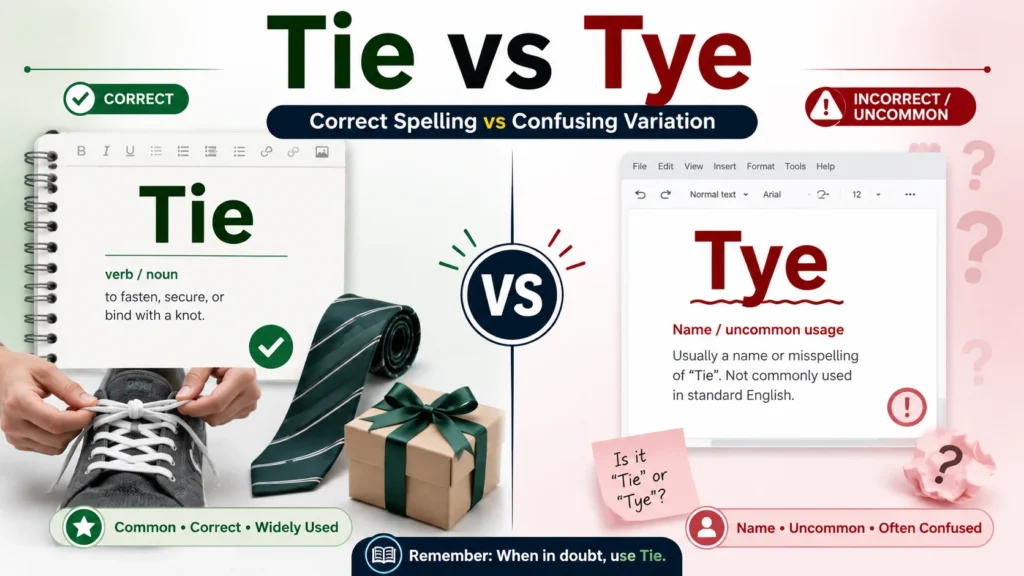
When learning English, it’s easy to recognize a familiar word without fully understanding why it’s correct. That happens with Tie vs Tye. Most people instantly recognize tie because they’ve seen and used it many times. However, when the similar-looking word tye appears, it often creates confusion since both words are pronounced the same.
As someone who has spent years teaching English grammar and helping learners improve their writing, I’ve noticed that spelling mistakes involving homophones are among the most common. Many students assume that if two words sound alike, they can be used interchangeably. In reality, understanding the meaning, history, and correct usage of each word is what builds confidence in writing.
In this guide, we’ll go beyond simple word recognition and explore the real difference between tie and tye. You’ll learn what tie means, including its uses as a noun and a verb to describe fastening, joining, connecting, or uniting things. We’ll also explain why tye is generally considered a misspelling in modern English, while mentioning the few historical and specialized contexts where it has appeared.
Although tie and tye share the same pronunciation (/taɪ/), they are not equal in today’s English. They are examples of homophones—words that sound identical but differ in spelling and meaning. Over time, tie became the standard spelling through the natural evolution of the English language, while tye gradually disappeared from everyday use and never became an accepted standard form.
By the end of this article, you’ll clearly understand the definitions, origins, practical examples, and key differences between tie and tye. Whether you’re writing for school, work, or everyday communication, this guide will help you choose the correct word with confidence and avoid common spelling mistakes.
Quick Answer
Here’s the short version before diving into the details.
- Tie is the standard English word.
- Tye usually appears as a name, surname, place name, or uncommon specialized term.
- In everyday writing, tie is almost always correct.
Difference
| Feature | Tie | Tye |
| Standard English word | Yes | Usually no |
| Used as verb | Yes | Rare |
| Used as noun | Yes | Rare |
| Common in daily writing | Very common | Uncommon |
| Usually appears in dictionaries | Yes | Limited contexts |
| Common typing mistake | No | Yes |
If you write:
“Please tye your shoes.”
That’s incorrect.
The correct version is:
“Please tie your shoes.”
Simple rule. Big difference.
What Does “Tie” Mean?
The word tie has several meanings in English. That versatility explains why you see it everywhere.
You can tie shoes. Teams can tie games. Families can have ties. People wear ties.
One small word does a lot of work.
Tie as a Verb
When used as a verb, tie usually means fastening, connecting, or joining things together.
Think of it like creating a link between two things.
Common meanings of tie as a verb
- Fasten with string, rope, or fabric
- Attach one object to another
- Connect ideas or relationships
- Finish equally in competition
Examples
- Tie your shoes before leaving.
- She tied the package with ribbon.
- The investigation tied several events together.
- Both teams tied at the end of the game.
Notice something interesting.
The action changes depending on context. Yet the basic idea remains the same: bringing things together.
Real-life example
Imagine packing a birthday present.
You fold the wrapping paper. Then you place a ribbon around the box.
Finally, you tie the ribbon.
The word creates an image instantly.
Tie as a Noun
As a noun, tie carries several meanings.
Tie as Clothing
Many people immediately think of a necktie.
Examples include:
- Silk tie
- Bow tie
- Business tie
- Formal tie
Example sentence:
“He wore a navy-blue tie during the interview.”
Tie as an Equal Result
Sports frequently use the word tie.
If both sides finish with the same score, nobody wins.
Example:
“The match ended in a tie.”
Examples:
| Team A | Team B | Result |
| 3 | 3 | Tie |
| 2 | 2 | Tie |
| 1 | 1 | Tie |
Tie as a Relationship or Connection
This use appears frequently in daily conversation.
Examples:
- Family ties
- Emotional ties
- Political ties
- Business ties
- Cultural ties
Example:
“Strong family ties helped them through difficult times.”
This meaning doesn’t involve ropes or knots.
Instead, it describes invisible connections.
Relationships act like threads that hold people together.
What Does “Tye” Mean?
Now things become more interesting.
Many people assume tye is simply another spelling of tie.
It usually isn’t.
Is Tye a Real Word?
Yes. However, context matters.
Tye exists in limited situations.
You will commonly find it used as:
- A first name
- A surname
- A place name
- A rare historical term
That means Tye isn’t normally a substitute for tie.
Examples of Tye used correctly
- Tye spoke at the conference.
- Tye received the award yesterday.
- We drove through Tye during our trip.
Notice the pattern.
Every example refers to a proper noun.
Why People Confuse Tie and Tye
English has a habit of creating traps.
This is one of them.
Identical pronunciation causes confusion
Tie and Tye sound exactly the same.
These words are called homophones.
Homophones are words that sound identical but carry different meanings and spellings.
Examples include:
| Word 1 | Word 2 |
| Their | There |
| Rain | Reign |
| Sea | See |
| Flour | Flower |
| Tie | Tye |
Your ears hear one thing.
Your brain writes another.
That creates problems.
Autocorrect and typing errors
Modern technology helps people.
It also causes strange mistakes.
Consider what happens:
You type quickly on your phone.
Instead of writing:
“Tie the rope.”
Your finger hits the wrong key.
Now you get:
“Tye the rope.”
You press send without noticing.
Suddenly the mistake travels into emails, texts, social media posts, and articles.
Names create uncertainty
Suppose you meet someone named Tye Johnson.
You see the spelling repeatedly.
Eventually you start wondering:
“Wait. Is Tye actually another spelling of tie?”
That assumption spreads confusion.
Names follow different rules than common English vocabulary.
Read more: Maintained vs Maintenanced: What’s Correct use?
Tie vs Tye: Side-by-Side Usage Guide
Here’s a practical comparison.
| Situation | Correct Word |
| Securing shoes | Tie |
| Wearing formal clothing | Tie |
| Equal sports score | Tie |
| Family relationship | Tie |
| Connecting ideas | Tie |
| Person named Tye | Tye |
| Place named Tye | Tye |
A quick glance usually solves the problem.
Common Mistakes People Make With Tie and Tye
Small spelling differences create surprisingly common errors.
Let’s look at them.
Mistake: Using Tye instead of Tie
Incorrect:
❌ Please tye your shoes.
Correct:
✅ Please tie your shoes.
Incorrect:
❌ We need to tye the boat to the dock.
Correct:
✅ We need to tie the boat to the dock.
Incorrect:
❌ The game ended in a tye.
Correct:
✅ The game ended in a tie.
Mistake: Assuming Tye is an accepted spelling variation
Some words allow alternative spellings.
Examples include:
| American English | British English |
| Color | Colour |
| Theater | Theatre |
| Analyze | Analyse |
Tie and Tye do not work this way.
You cannot switch between them.
Mistake: Confusing names with dictionary words
Imagine reading:
“Tye Walker won the award.”
That doesn’t mean tye suddenly replaces tie everywhere else.
Names play by their own rules.
Memory Trick: Never Mix Up Tie and Tye Again
Memory shortcuts work because they attach ideas to images.
Try this one:
Tie contains the letter I.
Think:
“I tie my shoes.”
The sentence becomes easy to remember.
Meanwhile:
Tye usually belongs to someone’s name.
Simple ideas stick better than complicated grammar rules.
Real-World Sentence Examples of Tie
Seeing words in action helps them settle into memory.
Correct uses of Tie
- Tie the rope tightly.
- She bought a red silk tie.
- The soccer match ended in a tie.
- Family ties remain important.
- Strong economic ties exist between the countries.
- Tie your hair before cooking.
- The teams tied after overtime.
Correct uses of Tye
- Tye attended the meeting.
- We visited Tye during the road trip.
- Tye signed the document yesterday.
Notice how different the usage feels.
One acts as a common language tool.
The other behaves like a name tag.
Tie vs Tye in Grammar and Everyday Writing
The real test happens outside grammar books.
Words live in emails, conversations, websites, and social media posts.
Let’s see where confusion appears.
Tie vs Tye in school writing
Students often write quickly during assignments.
Common error:
❌ “The teams ended in a tye.”
Correct:
✅ “The teams ended in a tie.”
Teachers notice spelling errors quickly because repeated mistakes interrupt readability.
Tie vs Tye in professional emails
Professional communication demands precision.
Imagine receiving this message:
“Please tye the files together before sending them.”
The meaning remains understandable.
Still, errors can affect credibility.
Correct spelling creates cleaner communication.
Tie vs Tye in social media
Social platforms move fast.
People type quickly.
Grammar sometimes becomes collateral damage.
Examples:
❌ Tye your shoes lol.
✅ Tie your shoes lol.
Even casual writing benefits from accuracy.
Tie vs Tye in daily conversation
Interestingly, spoken conversation rarely creates problems.
Why?
Because the words sound identical.
The confusion starts only when people write them.
Your ears can’t distinguish the spelling.
Only your eyes can.
Common Expressions That Use Tie
English contains dozens of phrases built around the word tie.
These expressions appear in business, sports, relationships, and casual conversation.
Tie the knot
Meaning:
To get married.
Example:
“They plan to tie the knot next summer.”
Tie up loose ends
Meaning:
Finish remaining tasks.
Example:
“Let’s tie up loose ends before leaving.”
Break a tie
Meaning:
Resolve an equal score or deadlock.
Example:
“The final goal broke the tie.”
Family ties
Meaning:
Relationships among relatives.
Example:
“Strong family ties shaped his childhood.”
Tie yourself in knots
Meaning:
Become confused or overly worried.
Example:
“Don’t tie yourself in knots over a small mistake.”
Interesting Facts About the Word “Tie”
Language becomes more enjoyable when you see its hidden layers.
Here are some interesting facts.
Fact 1
The word tie traces back to Old English and Germanic language roots involving binding or fastening.
Fact 2
The necktie evolved from cloth worn by soldiers several centuries ago.
Military fashion gradually transformed into modern formal wear.
Fact 3
Sports use the word differently around the world.
In some regions:
- “Tie” means equal score
In others:
- “Draw” appears more often
For example:
American sports commonly say:
“The game ended in a tie.”
Many international sports discussions may say:
“The match ended in a draw.”
Mini Case Study: How One Small Letter Changes Meaning
Imagine two online stores selling custom apparel.
Store A writes:
“Tye your favorite designs together.”
Store B writes:
“Tie your favorite styles together.”
Store B sounds natural.
Store A feels awkward because the spelling interrupts the reading flow.
A single misplaced letter changes the reader’s experience.
Tiny details create surprisingly large effects.
My Personal Experience
With over 10 years of experience teaching the English language, I’ve noticed that one of the most common challenges students face is confusing words that sound the same but have different spellings. Tie vs Tye is a perfect example. Many learners assume that because both words are pronounced /taɪ/, they can be used interchangeably. Through years of classroom teaching and one-on-one coaching, I’ve seen that understanding a word’s meaning, usage, and history is far more effective than simply memorizing its spelling.
When I teach this topic, I encourage students to focus on real-world examples instead of isolated word lists. This practical approach helps them remember that tie is the accepted spelling in modern English, while tye is an obsolete form that rarely appears outside historical references. In my experience, students who learn the reason behind the spelling are much less likely to repeat the mistake in their writing.
After a decade of helping learners improve their grammar and vocabulary, I’ve found that mastering small distinctions like this builds stronger writing habits and greater confidence. That’s why this guide doesn’t just tell you which spelling is correct. It explains why it is correct, making the lesson easier to remember and apply in everyday communication.
Quick Cheat Sheet for Tie vs Tye
Keep this nearby if you need a fast answer.
| If you’re talking about… | Use |
| Shoelaces | Tie |
| Ribbons | Tie |
| Neckties | Tie |
| Equal score | Tie |
| Relationships | Tie |
| Connections | Tie |
| Person’s name | Tye |
| Location name | Tye |
FAQs
1. What is the difference between tie and tye?
Tie is the correct modern word meaning to fasten or connect, while tye is an old or incorrect spelling of the same word.
2. Is tye still used today?
Tye is rarely used today. It mostly appears in old texts or historical writing.
3. Why do tie and tye sound the same?
They sound the same because both are pronounced as /taɪ/, even though spelling and usage differ.
4. Is tye a correct English word?
In modern English, tye is considered incorrect or obsolete. The correct form is tie.
5. What does tie mean?
Tie means to knot, attach, fasten, join, or unite something.
6. Can tie have different meanings?
Yes, tie can mean connection, equality in scores, or even a clothing accessory like a necktie.
7. How can I avoid confusion between tie and tye?
Always remember that tie is the standard spelling used in writing today, while tye is outdated.
Conclusion
Understanding Tie vs Tye is straightforward once you know the history behind the two spellings. Although both words are pronounced the same, only tie is recognized as the correct spelling in modern English. It is the standard word used to describe fastening, connecting, joining, or uniting things in both formal and everyday writing. In contrast, tye is an obsolete spelling that survives only in a few historical or highly specialized contexts and should generally be avoided.
As an English teacher, I’ve found that many spelling mistakes happen because words sound alike but have different histories and accepted spellings. Learning these small distinctions not only helps you avoid common errors but also improves your confidence as a writer. Whenever you’re unsure, remember that tie is almost always the correct choice in modern English.
Sources & References
- Merriam-Webster Dictionary
- Cambridge Dictionary
- Oxford English Dictionary
- Online Etymology Dictionary
- Collins Dictionary
Last Updated June 27, 2026

Emma Brooke brings 15 years of experience in the Department of English Language and Literature at the University of California, Berkeley, where she has taught and mentored students across courses in British and American literary traditions, critical theory, and narrative form. Her expertise spans 19th- and 20th-century fiction, poetic prosody, postcolonial literatures, and digital humanities, with a focus on how narrative voice shapes cultural meaning. Emma’s work has been presented at international conferences and published in peer-reviewed venues, reflecting her deep commitment to rigorous literary scholarship and accessible teaching.