
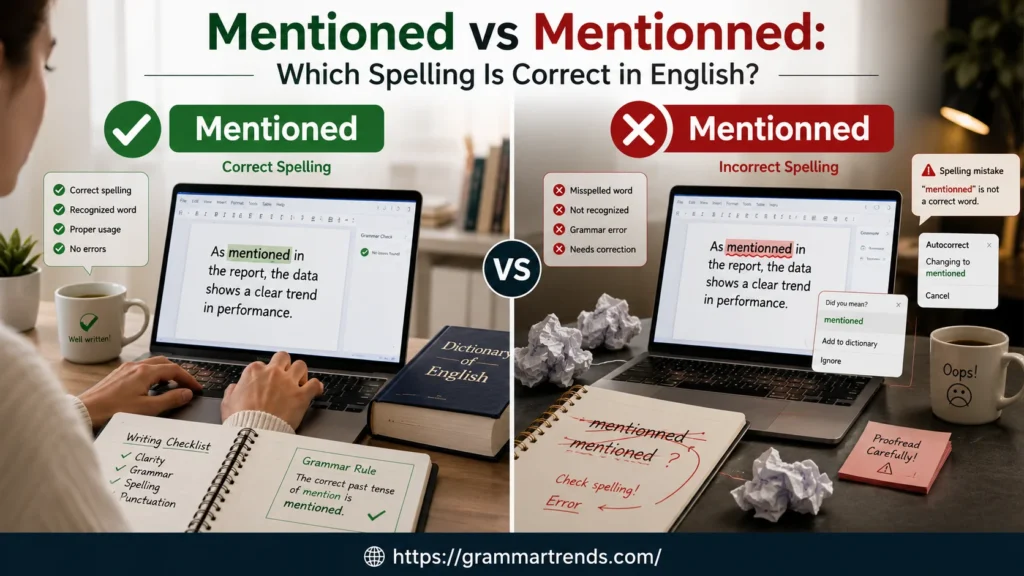
Many English learners and even experienced writers sometimes hesitate when they see mentioned and mentionned because the two spellings look almost identical. I have made the same mistake myself. I still remember typing mentionned while writing quickly and pausing for a moment because the extra n looked surprisingly correct. That small typo reminded me how easily our eyes can accept a familiar-looking word, even when it is incorrect.
During my 15 years of teaching English, I have noticed that this spelling mistake appears frequently in students’ assignments, emails, social media posts, and even professional documents. In most cases, the error happens because people assume the word follows the same spelling pattern as some other English words or copy incorrect spellings they find online.
The good news is that the rule is simple. Mentioned is the only correct spelling in modern English, while mentionned is a misspelling and should never be used in formal or informal writing. Knowing the difference not only improves your grammar and spelling but also makes your writing clearer, more professional, and more trustworthy.
In this guide, you’ll learn why mentioned is correct, why mentionned is wrong, common examples, grammar rules, pronunciation, and practical tips to help you avoid this mistake with confidence.
Quick Answer
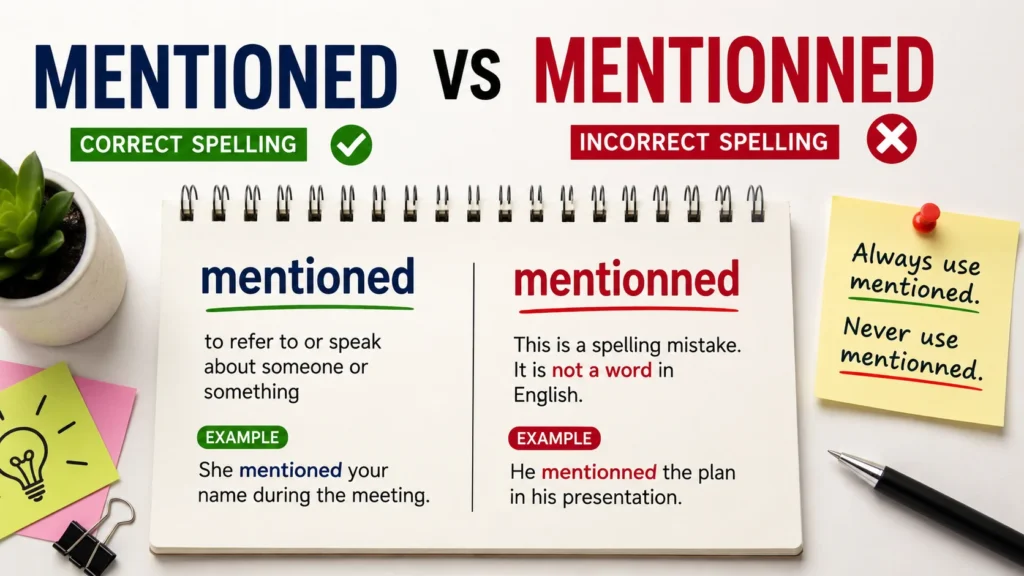
The correct spelling is mentioned. The word mentionned is incorrect and is simply a spelling mistake caused by adding an extra n. Whether you’re writing an email, essay, article, or social media post, always use mentioned. Remember this simple rule: the verb mention becomes mentioned, not mentionned.
Quick Comparison
Before diving deeper, here’s a side-by-side breakdown.
| Feature | Mentioned | Mentionned |
| Correct English spelling | ✅ Yes | ❌ No |
| Recognized in dictionaries | ✅ Yes | ❌ No |
| Used in academic writing | ✅ Yes | ❌ No |
| Accepted in business writing | ✅ Yes | ❌ No |
| Common online typo | Rarely | Frequently |
| Verb form | Past tense/past participle | Misspelling |
If you only remember one thing from this article, remember this:
Always use “mentioned.” Never use “mentionned” in English writing.
What Does “Mentioned” Mean?
The word “mentioned” comes from the verb “mention.” It means:
- To refer to something briefly
- To speak about someone or something
- To bring up a topic in conversation or writing
Simple Definition
Mentioned = talked about or referred to.
Examples
- She mentioned your name during the meeting.
- The article mentioned climate change several times.
- He never mentioned the delay.
Short. Clear. Everyday English.
Pronunciation of “Mentioned”
People sometimes misspell the word because pronunciation can trick the brain.
The correct pronunciation is:
MEN-shənd
Notice something interesting?
You barely hear the second syllable clearly. That soft sound causes many writers to assume the word needs another “n.”
English loves doing this. Pronunciation and spelling often fight like siblings at Thanksgiving dinner.
Verb Forms of “Mention”
Understanding the full verb family helps the spelling stick naturally.
| Verb Form | Example |
| Mention | I will mention it later. |
| Mentions | She mentions it often. |
| Mentioned | They mentioned your idea yesterday. |
| Mentioning | He kept mentioning the problem. |
Every form keeps a single “n” after “mention.”
That pattern never changes.
Is “Mentionned” a Real Word?
No. “Mentionned” is not a correct English word.
You won’t find it in:
- Standard dictionaries
- Academic grammar guides
- Professional style manuals
- Official English language references
Still, thousands of people search for it monthly. Why?
Because spelling habits are deeply influenced by:
- Sound patterns
- Typing speed
- Native language interference
- Social media repetition
Once a typo spreads online, it starts looking oddly believable.
That’s how “mentionned” survives.
Why People Write “Mentionned”
Several factors cause this mistake repeatedly.
French Language Influence
This is the biggest reason.
In French, the verb mentionner often creates forms with doubled consonants. Writers familiar with French spelling patterns naturally assume English follows the same rule.
But English doesn’t.
French Pattern
- mentionner
- mentionné
English Pattern
- mention
- mentioned
One language doubles letters differently. The other doesn’t.
That tiny distinction causes endless confusion.
Fast Typing and Autocorrect
Typing quickly creates visual mistakes. Your fingers move before your brain finishes processing the word.
For example:
- “begining” instead of “beginning”
- “seperate” instead of “separate”
- “mentionned” instead of “mentioned”
Autocorrect doesn’t always save you either. Some systems learn from repeated user mistakes. That means bad spelling can reinforce itself over time.
A little scary, honestly.
Why “Mentioned” Uses One “N”
Here’s the grammar rule most articles skip.
English only doubles the final consonant in certain situations.
Usually:
- The word ends in a vowel + consonant
- The stress falls on the final syllable
- A suffix gets added
Example of Correct Doubling
| Base Word | Correct Form |
| Refer | Referred |
| Admit | Admitted |
| Occur | Occurred |
Notice the stress:
- re-FER
- ad-MIT
- oc-CUR
The stress lands at the end.
Now look at mention:
- MEN-tion
Stress lands on the first syllable.
That means you do not double the “n.”
So:
- mention + ed = mentioned
Not “mentionned.”
Grammar solved.
Similar Words That Follow the Same Rule
These examples make the pattern easier to remember.
| Correct | Incorrect |
| Opened | Openned |
| Happened | Happenned |
| Listened | Listenned |
| Mentioned | Mentionned |
English spelling feels random sometimes. Yet patterns exist beneath the chaos.
Once you understand stress rules, many confusing words suddenly make sense.
How To Use “Mentioned” Correctly in Sentences
Using the word naturally matters just as much as spelling it correctly.
Everyday Conversation
People use “mentioned” constantly in daily speech.
Examples
- You mentioned that restaurant before.
- She mentioned your project yesterday.
- Nobody mentioned the schedule change.
Notice how naturally the word fits into conversation.
It’s flexible. Simple. Useful.
Using “Mentioned” in Professional Writing
Professional communication depends on clarity. Misspellings weaken credibility fast.
Imagine sending this email:
“As mentionned in our previous meeting…”
That extra “n” instantly looks unprofessional.
Here’s the correct version:
“As mentioned in our previous meeting…”
Much cleaner.
Business Examples
- The manager mentioned new deadlines during the presentation.
- Our client mentioned several revisions.
- The report mentioned rising operational costs.
Small details shape how people judge your writing.
Academic Examples of “Mentioned”
Students use this word constantly in essays and research papers.
Examples
- The author mentioned economic inequality throughout the study.
- Darwin mentioned natural selection repeatedly.
- The paper briefly mentioned climate policy reforms.
Academic writing rewards precision. Correct spelling matters.
Professors notice more than you think.
Digital Communication Examples
Online writing moves fast. Grammar often gets sacrificed.
Still, correct spelling improves readability and trust.
Examples
- She mentioned the update in the group chat.
- He mentioned the issue on Reddit.
- The influencer mentioned the product on Instagram.
Even casual writing benefits from clean grammar.
Real-World Examples of “Mentioned”
Here are more natural sentence examples across different situations.
Casual Speech
- Jake mentioned your new car yesterday.
- Nobody mentioned the weather would get this bad.
- You never mentioned free pizza was involved.
Workplace Communication
- HR mentioned policy updates during onboarding.
- The CEO mentioned expansion plans in the meeting.
- Finance mentioned budget concerns last quarter.
Customer Service
- The customer mentioned a delayed shipment.
- Several users mentioned login problems.
- Reviews frequently mentioned slow delivery.
Journalism and Media
- The article mentioned rising fuel prices.
- The interview mentioned health concerns.
- Reporters mentioned voter turnout repeatedly.
Context changes. The spelling doesn’t.
Common Grammar Mistakes With “Mentioned”
This spelling mistake rarely appears alone. Writers who use “mentionned” often struggle with related patterns too.
Adding Unnecessary Double Letters
English doubles consonants inconsistently. That inconsistency confuses nearly everyone.
Common Errors
| Incorrect | Correct |
| Begining | Beginning |
| Refered | Referred |
| Occured | Occurred |
| Mentionned | Mentioned |
Some words double letters. Others don’t.
That’s why understanding stress patterns helps more than memorization alone.
Confusing Pronunciation With Spelling
English pronunciation creates traps everywhere.
For example:
- Knife
- Through
- Colonel
- Wednesday
None sound exactly how they look.
“Mentioned” creates the same issue. The sound feels heavier than the spelling.
Writers hear an extra “n” that isn’t actually there.
Read More: “Immerse” vs “Emerse” What’s the Real Difference
Copying Incorrect Online Usage
The internet spreads grammar mistakes at lightning speed.
If enough people repeat an incorrect spelling, your brain starts accepting it visually.
This phenomenon is called frequency illusion.
You suddenly notice the error everywhere. Repetition tricks your mind into thinking it’s legitimate.
That’s exactly what happens with “mentionned.”
British vs American English: Does It Change?
No. Both forms of English use “mentioned.”
Correct in American English
- She mentioned the issue yesterday.
Correct in British English
- She mentioned the issue yesterday.
Same spelling. Same grammar.
No regional difference exists here.
English Words That Actually Change by Region
Some words genuinely differ between British and American English.
| American English | British English |
| Color | Colour |
| Traveling | Travelling |
| Organize | Organise |
| Theater | Theatre |
However, “mentioned” never changes.
That’s important because many writers incorrectly assume “mentionned” might be a British variant.
It isn’t.
Why Double-Consonant Rules Confuse People
English evolved from multiple language families:
- Germanic roots
- French influence
- Latin vocabulary
- Norse contributions
As a result, spelling rules developed unevenly.
That’s why:
- “traveling” and “travelling” can both work
- “focused” and “focussed” sometimes appear regionally
- Yet “mentionned” remains incorrect everywhere
English spelling resembles a patchwork quilt stitched together over centuries.
Beautiful. Messy. Occasionally ridiculous.
Mentioned vs Similar Word Mix-Ups
If you struggle with “mentioned,” you’ll probably recognize these too.
Occurred vs Occured
Correct:
- occurred
Incorrect:
- occured
Why?
Because the stress falls on the last syllable:
- oc-CURRED
So the consonant doubles.
Referred vs Refered
Correct:
- referred
Incorrect:
- refered
Again:
- re-FERRED
Final stress triggers doubling.
Beginning vs Begining
Correct:
- beginning
Incorrect:
- begining
English doubles the “n” because:
- be-GIN
Final syllable stress matters again.
Mentioned vs Mentionned
Now compare:
- MEN-tioned
Stress sits at the front.
No doubling happens.
Once you spot the pattern, the rule becomes much easier to remember.
Easy Memory Tricks for “Mentioned”
Grammar rules help. Memory tricks help faster.
The Root Word Method
Start with the base word:
- mention
Now add:
- ed
You simply get:
- mentioned
Nothing changes in the root spelling.
The Stress Shortcut
Ask yourself:
“Does the word stress the final syllable?”
If not, you usually avoid doubling.
Examples
| Word | Final Stress? | Double Letter? |
| Refer | Yes | Yes |
| Admit | Yes | Yes |
| Mention | No | No |
This trick works surprisingly well.
Visual Memory Technique
Picture the word:
- mention
- mentioned
Now imagine trying to squeeze another “n” inside.
It suddenly looks crowded and awkward.
That visual discomfort actually helps your memory.
Funny how the brain works.
Mini Case Study: Why Native Speakers Still Misspell “Mentioned”
A university writing lab reviewed thousands of student essays and found something interesting:
Many spelling mistakes didn’t happen because students lacked vocabulary. They happened because:
- words looked visually familiar
- typing speed increased
- autocorrect created false confidence
“Mentionned” falls into that exact category.
People know the meaning perfectly. They simply internalize the wrong visual pattern through repetition.
That’s why proofreading slowly still matters.
How Spellcheck Handles “Mentionned”
Modern grammar tools usually flag the error immediately.
Tools That Catch the Mistake
- Grammarly
- Microsoft Word
- Google Docs
- Hemingway Editor
- ProWritingAid
Still, automated tools aren’t flawless.
For example:
- usernames
- hashtags
- quoted text
- multilingual content
Sometimes bypass corrections completely.
Human proofreading remains essential.
Quick Grammar Checklist
Before using “mentioned,” ask yourself:
✅ Does the base word already end with “mention”?
✅ Is the stress on the first syllable?
✅ Am I writing in English?
If yes, use:
mentioned
Never:
mentionned
Common Situations Where You’ll Use “Mentioned”
You probably use this word more often than you realize.
In Meetings
- “As Sarah mentioned earlier…”
In Essays
- “The author mentioned several causes.”
In Emails
- “As mentioned in my previous message…”
In Conversations
- “You mentioned that yesterday.”
In Articles
- “Experts mentioned rising inflation concerns.”
It’s one of those quiet utility words holding English together behind the scenes.
Formal vs Informal Usage
“Mentioned” works in both formal and casual writing.
Formal
- The witness mentioned inconsistencies in the report.
Informal
- You never mentioned snacks were included.
That flexibility makes the word incredibly useful.
What Dictionaries Say About “Mentioned”
Major dictionaries consistently recognize:
- mention
- mentioned
- mentioning
But not “mentionned.”
Dictionary Consensus
| Dictionary | “Mentioned” | “Mentionned” |
| Oxford | ✅ | ❌ |
| Merriam-Webster | ✅ | ❌ |
| Cambridge | ✅ | ❌ |
| Collins | ✅ | ❌ |
When every major dictionary agrees, the debate ends quickly.
My Personal Experience
In my 15 years of teaching English, I’ve noticed that mentionned is one of those spelling mistakes that even confident writers make when they’re typing quickly. I’ve seen it appear in student assignments, business emails, and online posts, not because people don’t know the word, but because the extra “n” looks surprisingly natural at first glance.
Whenever I explain that the base verb is simply mention, most learners remember the correct form mentioned and rarely make the mistake again. This experience has taught me that understanding the spelling rule is far more effective than memorizing words, helping writers build lasting confidence in their English.
FAQs
1. Is “mentioned” correct in English?
Yes, mentioned is the correct spelling in English. It is the standard form used in writing and communication.
2. Is “mentionned” ever correct?
No, mentionned is not correct in English. It is a common spelling mistake caused by adding an extra “n”.
3. Why do people write “mentionned”?
People often write it because it looks similar to French-style spelling patterns or due to typing habits and confusion.
4. What is the main difference between mentioned vs mentionned?
The difference is simple: mentioned is correct, while mentionned is incorrect and considered a spelling error.
5. Does this mistake affect writing quality?
Yes, using mentionned can make writing look unprofessional and may reduce clarity and credibility.
6. How can I avoid this mistake?
You can avoid it by practicing spelling rules, using grammar check tools, and remembering that English does not double the “n” here.
7. Where is “mentioned” commonly used?
It is used in formal writing, emails, articles, academic content, and everyday communication whenever referring to something briefly.
Conclusion
Understanding the difference between mentioned and mentionned is a simple but important step toward becoming a more confident writer. Mentioned is the only correct spelling in English, while mentionned is a common misspelling that should be avoided in every type of writing. From my 15 years of teaching English, I’ve found that once learners understand the spelling rule instead of relying on memory alone, they rarely make this mistake again.
By using the correct form consistently, you’ll improve your grammar, strengthen your credibility, and ensure your writing remains clear, professional, and easy for every reader to understand.
References
- Oxford English Dictionary (OED). Mention. Oxford University Press.
- Merriam-Webster Dictionary. Mention. Merriam-Webster.
- Cambridge Dictionary. Mention. Cambridge University Press.
- Collins English Dictionary. Mention. HarperCollins Publishers.
- The American Heritage Dictionary of the English Language (5th ed.). Houghton Mifflin Harcourt.
- Michael Swan. Practical English Usage (4th Edition). Oxford University Press, 2016.
- The Chicago Manual of Style (18th Edition). University of Chicago Press.
- Bryan A. Garner. Garner’s Modern English Usage (5th Edition). Oxford University Press, 2022.
- The Associated Press Stylebook (Latest Edition). AP News.
- The Britannica Dictionary. Mention. Encyclopædia Britannica.

Emma Rose has spent 15 years in the English Department at the University of California, Los Angeles (UCLA), guiding students through British and American literary classics, critical theory, and narrative techniques. Her scholarly focus includes 19th- and 20th-century fiction, the art of poetry, postcolonial writing, and digital humanities particularly how storytelling voice influences cultural perspectives. Emma has presented her research at major international conferences and published in respected academic journals, underscoring her dedication to both high-level scholarship and engaging teaching.