
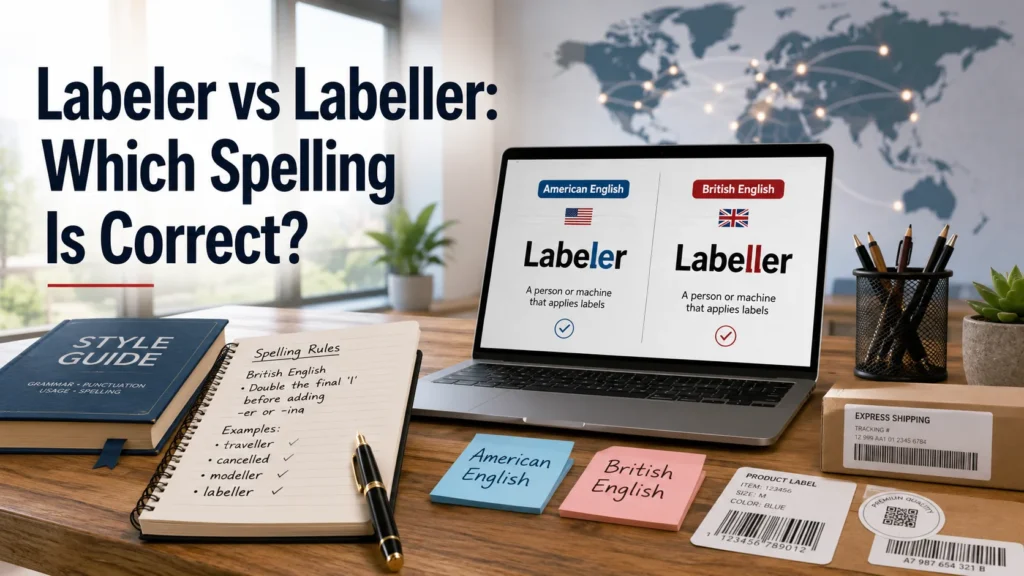
Labeler vs Labeller is a confused topic that often makes learners, but this article gives clear guidance to explore the question in simple terms for better understanding of English language usage. In the world Many people, person and even a device that applies labels to products, packages which contain information like product names, ingredients, usage, instructions show how meaning stays the same in real examples, regardless of regional context across.
Late one evening, I froze while editing product description because a word refused to look right between labeller and labeler. That tiny doubt pushed me to search what thousands of writers, students, marketers and global businesses check every day. Both spellings appear in books, articles, software and tools which only adds uncertainty. Regional spelling rules cause most trouble especially in British and American English where handle of doubled letters differs.
Labeler vs Labeller: What’s the Difference?
The difference between labeler and labeller is purely regional.
| Word | English Variant | Meaning |
| Labeler | American English | A person or machine that applies labels |
| Labeller | British English | A person or machine that applies labels |
That’s it.
The pronunciation stays the same. The definition stays the same. The function stays the same.
Only the spelling changes.
In the United States, writers almost always use labeler with one “L” in the middle.
In the United Kingdom, Australia, and several Commonwealth countries, writers typically use labeller with a double “L.”
This spelling pattern appears throughout English vocabulary.
For example:
| American English | British English |
| Traveler | Traveller |
| Modeler | Modeller |
| Counselor | Counsellor |
| Fueling | Fuelling |
| Canceled | Cancelled |
English evolved differently across regions over centuries. Americans gradually simplified many spellings. British English preserved older forms.
Neither spelling is wrong.
Your audience determines the correct choice.
Quick Answer: Is It “Labeler” or “Labeller”?
Here’s the simplest answer possible:
- Use labeler for American audiences
- Use labeller for British audiences
If your website targets US readers, stick with labeler consistently.
If your content targets UK readers, use labeller instead.
For international websites, things become more nuanced. Many global companies choose one style guide and apply it everywhere.
Consistency matters more than personal preference.
Imagine reading a product page that says:
“Our labeler machine improves warehouse efficiency. This advanced labeller reduces packaging errors.”
That looks messy. Readers notice inconsistencies faster than most writers realize.
Why English Sometimes Doubles the “L”
English spelling behaves like an old toolbox filled with mismatched parts. Some rules make perfect sense. Others feel like they were invented during a storm.
The difference between labeler and labeller comes from a broader spelling pattern tied to suffixes.
In British English, verbs ending with a vowel plus “L” often double the “L” before adding endings.
Examples include:
- Travel → Traveller
- Cancel → Cancelled
- Model → Modeller
- Label → Labeller
American English usually simplifies those spellings:
- Traveler
- Canceled
- Modeler
- Labeler
The shift largely traces back to Noah Webster, the American lexicographer who pushed spelling reform in the United States during the early 1800s.
Webster preferred cleaner, shorter spellings. His influence helped shape modern American English.
That’s why Americans write:
- Color instead of colour
- Theater instead of theatre
- Center instead of centre
- Labeler instead of labeller
British English retained traditional spellings.
Neither system is inherently better. They simply evolved differently.
What Does “Labeler” Mean?
A labeler is either:
- A person who applies labels
- A machine that prints or attaches labels
The meaning depends entirely on context.
In modern business settings, “labeler” often refers to equipment used in:
- Warehouses
- Manufacturing plants
- Shipping centers
- Retail packaging
- Barcode systems
- Ecommerce fulfillment
However, the word also appears in technology and artificial intelligence.
For example, AI companies hire data labelers to classify images, text, and training datasets.
“Labeler” as a Person
A human labeler organizes, identifies, or categorizes items.
Examples include:
- A warehouse employee labeling inventory
- A data annotation specialist tagging images
- A researcher organizing samples
- A medical worker labeling prescriptions
Example Sentences
- The data labeler reviewed thousands of training images.
- Our warehouse hired two new labelers last month.
- The pharmaceutical labeler checked every barcode carefully.
“Labeler” as a Machine
Machines called labelers automate packaging and identification processes.
These devices can:
- Print shipping labels
- Apply stickers
- Add barcodes
- Mark product packaging
- Attach expiration dates
Modern industrial labelers dramatically reduce manual labor.
Large ecommerce businesses rely heavily on automated labeling systems because speed matters. A slow packaging line can create a domino effect across an entire supply chain.
Common Types of Labelers
| Type | Purpose |
| Barcode Labeler | Prints barcode labels |
| Bottle Labeler | Applies labels to bottles |
| Thermal Labeler | Uses heat-based printing |
| Shipping Labeler | Creates package labels |
| Industrial Labeler | Handles mass production |
What Does “Labeller” Mean?
The word labeller means exactly the same thing as labeler.
The only difference lies in regional spelling preferences.
British English uses the double “L” form more frequently because of standard UK spelling conventions.
You’ll commonly see “labeller” in:
- UK manufacturing websites
- British packaging companies
- Australian warehouse documentation
- European technical manuals
Example Sentences
- The automated labeller increased production speed.
- A medical labeller must follow strict compliance rules.
- The warehouse installed a new bottle labeller.
Again, pronunciation remains identical.
Most readers won’t hear a difference because there isn’t one.
Labeler vs Labeller: Side-by-Side Comparison
Sometimes a quick table explains more than ten paragraphs.
| Feature | Labeler | Labeller |
| Correct Spelling | Yes | Yes |
| English Type | American | British |
| Pronunciation | Same | Same |
| Meaning | Same | Same |
| Used in the US | Very common | Rare |
| Used in the UK | Less common | Very common |
Which Spelling Should You Use?
Your audience should decide.
Not your mood. Your keyboard autocorrect isn’t to blame either. This isn’t just random internet opinions.
Use “Labeler” for American English
Choose labeler if your content targets:
- United States readers
- American ecommerce customers
- US-based software users
- American business clients
Common American Usage Examples
- Product labeler
- Shipping labeler
- Barcode labeler
- Data labeler
- Labeler machine
Most US companies prefer simplified spelling because it aligns with American style guides.
That includes:
- AP Style
- Chicago Manual of Style
- Merriam-Webster conventions
Use “Labeller” for British English
Choose labeller when writing for:
- UK audiences
- Australian readers
- British manufacturers
- Commonwealth countries
Common British Usage Examples
- Bottle labeller
- Automatic labeller
- Pharmaceutical labeller
- Warehouse labeller
British readers expect the double “L” spelling. Using American spelling in UK-focused content can feel slightly off.
It’s similar to seeing “color” on a British government website. The meaning remains clear, yet the spelling feels foreign.
How Different Industries Use Labeler and Labeller
The term appears across multiple industries. Context changes the exact meaning.
Ecommerce and Retail
Retail companies use labelers constantly.
Without labels, modern logistics would collapse faster than a cardboard box in heavy rain.
Retail labelers help businesses:
- Track inventory
- Print shipping labels
- Manage barcodes
- Organize warehouse shelves
- Reduce shipping errors
Real Example
An Amazon-style fulfillment center may process hundreds of thousands of labels daily using automated labeler systems.
That scale leaves almost zero room for mistakes.
Manufacturing and Packaging
Manufacturing companies depend heavily on industrial labeling equipment.
These machines apply labels to:
- Bottles
- Boxes
- Food containers
- Pharmaceutical products
- Electronics
Common Manufacturing Labeler Types
| Machine Type | Function |
| Wrap-around labeler | Labels cylindrical containers |
| Front-and-back labeler | Applies dual-side labels |
| Top labeler | Labels flat packages |
| Print-and-apply labeler | Prints and applies labels instantly |
Factories prioritize speed, precision, and compliance.
A faulty labeler can create:
- Shipping delays
- Regulatory issues
- Product recalls
- Inventory confusion
AI and Data Annotation
The rise of artificial intelligence created a completely different meaning for “labeler.”
In AI, a data labeler organizes information for machine learning models.
For example:
- Identifying objects in images
- Categorizing customer support messages
- Tagging speech recordings
- Annotating medical scans
Without human labelers, many AI systems wouldn’t function properly.
Machine learning depends on correctly labeled training data.
Example
If thousands of cat photos get incorrectly labeled as dogs, the AI model learns inaccurate patterns.
Garbage in. Garbage out.
That old programming phrase still applies.
Read more: Healthcare vs Health Care: Which Spelling Is Correct?
Medical and Pharmaceutical Industries
Healthcare relies heavily on accurate labeling systems.
Medical labelers handle:
- Prescription labels
- Patient identification
- Laboratory samples
- Medication tracking
- Compliance warnings
One labeling error in healthcare can trigger serious consequences.
That’s why pharmaceutical companies invest heavily in automated labeling technology.
Precision matters.
A lot.
Is “Labeller” a Real Word?
Yes. Absolutely.
Some people mistakenly assume “labeller” is incorrect because they grew up using American English.
However, major dictionaries recognize both spellings.
Dictionaries That Accept Both Words
| Dictionary | Labeler | Labeller |
| Merriam-Webster | Yes | Limited |
| Oxford English Dictionary | Yes | Yes |
| Cambridge Dictionary | Yes | Yes |
| Collins Dictionary | Yes | Yes |
British English speakers see “labeller” as completely normal.
Language changes depending on geography. That’s true across nearly every major language on Earth.
Why Americans Prefer “Labeler”
American spelling generally favors simplification.
Noah Webster believed English spelling should match pronunciation more closely. He removed extra letters whenever possible.
That philosophy shaped countless American spellings.
Examples include:
| British | American |
| Jewellery | Jewelry |
| Traveller | Traveler |
| Defence | Defense |
| Catalogue | Catalog |
“Labeler” follows that same pattern.
The shorter spelling became standard in the United States over time.
Why British English Uses “Labeller”
British English often preserves historical spelling structures.
The doubled consonant follows traditional UK grammar patterns for many suffixes.
Words ending in vowel + L frequently double the “L” before adding endings.
Examples:
- Travel → Traveller
- Cancel → Cancelled
- Label → Labeller
British spelling emphasizes consistency with those older rules.
Use Regional Keywords Strategically
If your audience lives in the United States:
- Target “labeler”
- Use American spelling consistently
If your audience lives in the UK:
- Target “labeller”
- Use British spelling naturally
Can You Use Both Spellings in One Article?
Yes, but only carefully.
This article intentionally uses both because the topic compares them directly.
Outside comparison articles, mixing spellings randomly weakens readability and brand consistency.
Search engines also use contextual language signals to determine geographic relevance.
Consistency helps.
Common Mistakes People Make
Small spelling mistakes can quietly damage credibility.
Here are the biggest problems writers run into.
Mixing Both Spellings Randomly
This happens constantly.
A blog starts with “labeler” then switches to “labeller” halfway through.
Readers notice.
Professional editors definitely notice.
Better Approach
Choose one spelling style and maintain it throughout the article.
Assuming One Version Is Wrong
This mistake creates unnecessary confusion.
Both spellings are legitimate.
The difference comes down to regional English standards.
Calling “labeller” incorrect is like calling “colour” incorrect in the UK.
That argument collapses instantly.
Ignoring Audience Expectations
Localization matters in modern content marketing.
An American audience expects American spelling.
A British audience expects British spelling.
Failing to localize content can subtly reduce trust.
Confusing “Labeler” With “Label Maker”
These terms overlap but aren’t identical.
| Term | Meaning |
| Labeler | Person or machine applying labels |
| Label Maker | Device used to create labels |
| Label Printer | Printer specifically for labels |
A label maker creates labels.
A labeler may create them, apply them, or both.
Context determines meaning.
Real-World Examples of Labeler and Labeller
Examples make grammar easier to absorb.
American English Examples
- The shipping labeler processed 2,000 packages today.
- Our warehouse upgraded its barcode labeler.
- The AI labeler reviewed customer feedback data.
- Every product passed through the automatic labeler.
British English Examples
- The pharmaceutical labeller improved packaging accuracy.
- Our factory installed a new bottle labeller.
- The warehouse labeller reduced human error significantly.
- Each labeller follows strict compliance procedures.
Labeler vs Labeller in Business Writing
Professional businesses rarely choose spelling randomly.
Large companies create internal style guides to maintain consistency across:
- Websites
- Product manuals
- Packaging
- Marketing campaigns
- Software interfaces
A global brand may standardize American English even in international markets because consistency simplifies operations.
Other companies localize content by region.
Neither approach is universally correct.
The best option depends on:
- Audience location
- Brand voice
- Operational scale
Case Study: How Regional Spelling Affects User Trust
A UK packaging company once tested two landing pages.
One used:
- “Automatic labeller”
The other used:
- “Automatic labeler”
The British spelling version generated higher engagement from UK visitors because the wording felt more natural and localized.
Tiny language details influence perception more than many marketers realize.
People trust language that feels familiar.
Related Words You Should Know
English contains dozens of similar spelling variations.
Understanding the pattern helps prevent future confusion.
| American English | British English |
| Traveler | Traveller |
| Modeler | Modeller |
| Canceled | Cancelled |
| Counseling | Counselling |
| Fueled | Fuelled |
| Catalog | Catalogue |
Once you recognize the pattern, words like labeler and labeller stop looking strange.
FAQs: Labeler vs Labeller
1. What is the difference between labeler and labeller?
Both words mean the same thing. The only difference is spelling, not meaning. “Labeler” is used in American English, while “labeller” is common in British English.
2. Which spelling should I use in writing?
It depends on your audience. If you are writing for the US, use “labeler.” For the UK, Australia, or Canada, “labeller” is preferred.
3. Are both spellings correct?
Yes, both are correct. They follow different regional English rules but have the same meaning.
4. What does a labeler or labeller do?
A labeler or labeller is a person or machine that applies labels to products, packaging, or items like barcodes and ingredient lists.
5. Why are there two spellings?
Because English varies by region. American English simplifies some spellings, while British English keeps older forms.
6. Can using the wrong spelling look unprofessional?
Yes, especially in formal writing, business documents, or academic work. It may look inconsistent to readers.
7. Where is each spelling commonly used?
“Labeler” is common in the United States. “Labeller” is widely used in the United Kingdom, Australia, and Canada.
Conclusion
Both Labeler vs Labeller are correct spellings with the same meaning. The only difference is regional usage—Labeler is the preferred spelling in American English, while Labeller is standard in British English and many Commonwealth countries. Choosing the right version depends on your audience, not on which spelling is “more correct.” By staying consistent throughout your writing and matching your readers’ language preferences, you can improve clarity, maintain professionalism, and build greater trust. Whether you’re writing about packaging, data annotation, manufacturing, or everyday English, understanding the difference between Labeler vs Labeller helps you communicate more confidently and accurately.

Mia Rose brings fifteen years of experience at The University of Edinburgh’s English Literature department, leading students through explorations of classic and contemporary texts, literary theory, and narrative design. Her academic interests center on Victorian and modernist fiction, poetic rhythms, postcolonial storytelling, and digital approaches to literary study—with a keen eye on how voice and perspective frame cultural dialogue. Mia has delivered talks at prestigious global conferences and authored articles in scholarly journals, showcasing her commitment to meaningful research and lively classroom engagement.