
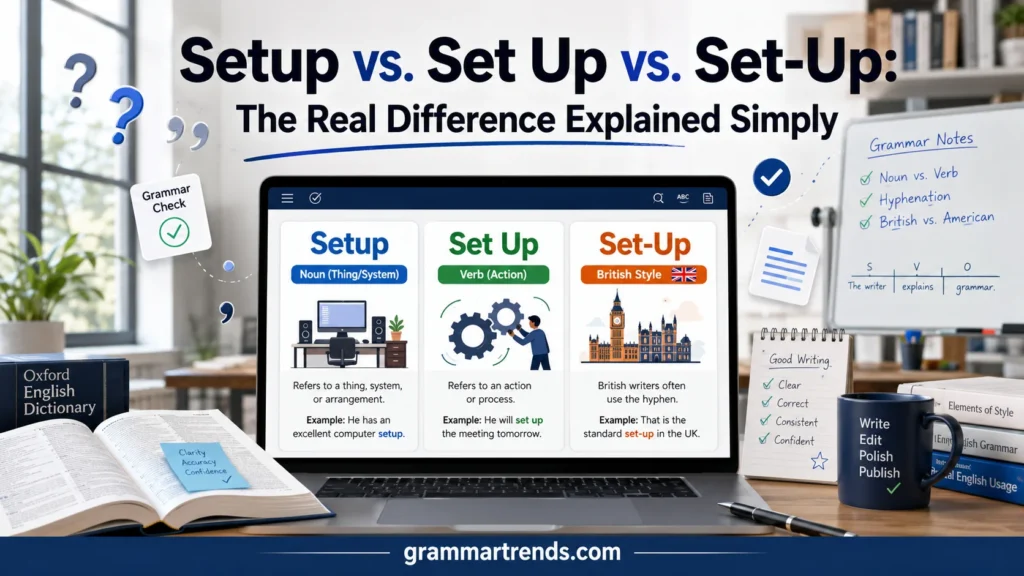
Setup vs. Set Up vs. Set-Up shows how setup, set up, set-up confuse writers in modern English communication and usage clarity is key.
In writing, Setup, Set, Up, Set-Up, What’s, the, Difference often explains why setup, set, up, set-up create confusion for writers, editors, professionals, especially when dealing with noun, verb, adjective usage in modern, English, communication. The difference appears in real writing situations like software, setup, device, system, configuration, installation, process, wizard, where meaning shifts between action and result, causing grammar, mistakes, sentence, structure and unclear writing in both British and American usage.
Understanding contextual, semantic, phrase, and form improves clarity, readability, accuracy, especially in technical, documentation, and user, interface, content, while reflecting linguistic, evolution, word, formation, and the shift from hyphen to clearer non-hyphenated forms.
Real communication use
When you first glance, it’s easy to get confused, but knowing the difference in everyday, communication matters. Setup refers to a thing, place, arrangement, or functions, ensuring everything works smoothly, while set up shows an action, where you are arranging or preparing something correctly. In real tasks like writing an email, meeting, or instructions, mixing them leads to unclear results. Taking a closer look improves clarity, prevents mistakes, and ensures your words, actions, and meaning stay precise, making both writing and communication more professional and natural.
Why People Confuse “Setup,” “Set Up,” and “Set-Up”
The confusion starts because English contains many phrasal verbs that later evolve into nouns or adjectives.
Think about these word pairs:
| Verb | Noun/Adjective |
| Log in | Login |
| Work out | Workout |
| Shut down | Shutdown |
| Back up | Backup |
“Set up” follows the exact same pattern.
At first glance, the differences seem tiny. One space disappears. Sometimes a hyphen appears. That’s it.
But grammar changes completely.
Here’s the simplest way to think about it:
- Set up = an action
- Setup = a thing or arrangement
- Set-up = a mostly British spelling variation
Tiny change. Huge difference.
This mistake appears everywhere because people type quickly. Software interfaces also create confusion. Some apps use “setup” everywhere even when grammar technically calls for “set up.”
That’s why you’ll see phrases like:
- “Setup your account”
- “Setup complete”
- “Easy setup wizard”
Only some of those are grammatically correct.
The Fastest Way to Know Which One to Use
If you only remember one section from this article, make it this one.
The One-Sentence Rule
If the phrase shows action, use “set up.”
If it names a thing, use “setup.”
That single rule solves almost every situation.
Quick Comparison Table
| Version | Part of Speech | Meaning | Example |
| Set up | Verb | To arrange or organize | I’ll set up the meeting |
| Setup | Noun | A system or arrangement | The setup looks clean |
| Setup | Adjective | Describes another noun | Setup process |
| Set-up | Hyphenated noun/adjective | Mostly British English | A complicated set-up |
“Set Up” as a Verb: The Action Form
“Set up” becomes correct when someone actively does something.
You’re arranging. Installing. Preparing. Organizing. Establishing.
That action matters.
What “Set Up” Actually Means
Depending on context, “set up” can mean:
- Arrange something
- Install equipment
- Organize an event
- Prepare a system
- Start a company
- Establish a process
- Configure software
The core idea never changes.
Someone performs an action.
Examples of “Set Up” Used Correctly
Business Examples
- We need to set up a client meeting.
- She helped set up the conference room.
- The company will set up a new branch in Texas.
Technology Examples
- I need to set up my Wi-Fi router.
- Please set up two-factor authentication.
- He spent hours trying to set up the printer.
Everyday Examples
- They’ll set up decorations tomorrow.
- Can you set up the barbecue outside?
- She wants to set up an online store.
Notice something important?
You can usually replace “set up” with another action verb like:
- arrange
- organize
- install
- establish
If replacement works, “set up” is probably correct.
Why “Setup” Cannot Replace a Verb
This mistake appears constantly online:
❌ “I need to setup my laptop.”
Correct version:
✅ “I need to set up my laptop.”
Why?
Because verbs need separation here. “Set” acts as the main verb. “Up” functions as a particle.
Together they create a phrasal verb.
English keeps many phrasal verbs separated:
- Turn on
- Pick up
- Shut down
- Log in
“Set up” follows the same rule.
A Quick Grammar Shortcut
Try adding “to” before the phrase.
If the sentence still sounds natural, you probably need the verb form:
- I want to set up the account. ✅
- I want to setup the account. ❌
That shortcut catches mistakes fast.
“Setup” as a Noun: A Thing, System, or Arrangement
Now things flip.
“Setup” becomes one word when it refers to a thing instead of an action.
You’re no longer doing something.
You’re describing a configuration, structure, arrangement, or system.
What Counts as a “Setup”?
“Setup” often refers to:
- Equipment arrangement
- Software configuration
- Office organization
- Gaming equipment
- Business structure
- Planned scenario
In simple terms, it’s the final arrangement itself.
Examples of “Setup” as a Noun
Technology
- My computer setup runs three monitors.
- Their network setup improved performance.
- The streaming setup cost over $3,000.
Business
- The office setup feels modern.
- Their workflow setup saves hours daily.
- The startup’s legal setup took months.
Home and Lifestyle
- His kitchen setup looks professional.
- The gym setup fits inside the garage.
- Their home theater setup sounds incredible.
Now “setup” acts like a normal noun.
You can place words before it:
- the setup
- this setup
- a setup
- an expensive setup
That’s the clue.
The “The” Test
Here’s an easy memory trick.
If “the” fits naturally before the word, you usually need setup.
Examples:
- The setup looks confusing.
- The setup needs adjustment.
- The setup works perfectly.
You wouldn’t say:
❌ “The set up looks confusing.”
That sounds broken because verbs don’t normally follow articles like “the.”
“Setup” as an Adjective
English loves turning nouns into descriptive modifiers.
That’s exactly what happens here.
“Setup” often describes another noun.
Examples include:
- setup guide
- setup screen
- setup fee
- setup instructions
- setup process
In these cases, “setup” functions like an adjective even though it originated as a noun.
Real Examples You See Online Daily
Software and Apps
- Setup wizard
- Setup menu
- Setup assistant
- Setup tutorial
Business and Finance
- Setup cost
- Setup fee
- Setup procedure
Technical Writing
- Setup documentation
- Setup requirements
- Setup checklist
This form appears heavily in technology because concise labels improve readability.
A button saying “Setup Guide” looks cleaner than “Set Up Guide.”
“Set-Up” With a Hyphen: Is It Still Correct?
Yes. But context matters.
The hyphenated version mainly appears in British English and older editorial styles.
In modern American English, writers usually prefer:
- set up (verb)
- setup (noun/adjective)
without the hyphen.
Why the Hyphen Exists
English once hyphenated many compound words before eventually merging them.
Examples:
| Older Form | Modern Form |
| On-line | Online |
| To-day | Today |
“Set-up” followed the same historical path.
Many British publishers still keep the hyphen in formal writing.
American English vs British English
| Style | Preferred Usage |
| American English | setup |
| British English | set-up or setup |
If your audience sits primarily in the United States, “setup” usually looks more modern and natural.
Should You Use the Hyphen Today?
Usually, no.
Unless:
- Your publication follows British style rules
- Your editor requires it
- Your brand style guide prefers it
Otherwise, modern readers expect:
- set up
- setup
without hyphens.
“It Was a Setup!” — The Informal Meaning
English also uses “setup” informally to describe deception or manipulation.
That usage became common through movies, crime dramas, and pop culture.
What “Setup” Means in Slang
In informal speech, a “setup” can mean:
- A trap
- A planned trick
- A manipulated situation
- A false accusation
Examples:
- “The whole thing was a setup.”
- “He walked into a setup.”
- “They framed him with a setup.”
The word suggests intentional planning behind the scenes.
Pop Culture Examples
Crime shows use this constantly.
A detective discovers planted evidence. Suddenly someone says:
“Wait. This wasn’t random. It was a setup.”
The phrase works because “setup” already implies organization and planning.
Only now the planning involves deception.
Setup vs. Set Up in Technology and Software
Technology creates massive confusion around these terms.
Why?
Because software companies prioritize UI simplicity over strict grammar rules.
That’s why you’ll see inconsistent wording even inside major apps.
Common Tech Examples Explained
| Phrase | Correct? | Why |
| Set up your account | ✅ | Action verb |
| Account setup | ✅ | Noun |
| Setup wizard | ✅ | Adjective |
| Setup your account | ❌ | Incorrect verb usage |
| Initial setup process | ✅ | Descriptive noun |
Why Tech Companies Prefer “Setup”
Software interfaces need short labels.
Buttons have limited space.
That’s why companies often compress language:
- Setup Guide
- Setup Assistant
- Quick Setup
It reads faster and fits cleanly into menus.
Real-World Tech Usage
You’ll commonly see:
Correct
- “Set up your device”
- “Complete account setup”
- “Open the setup menu”
Incorrect But Common
- “Setup your profile”
- “Setup your password”
Many apps technically break grammar rules for convenience.
That doesn’t mean formal writing should copy them.
Setup vs. Set Up in Business Writing
Business writing punishes grammar mistakes faster than casual conversation.
Clients notice them.
Recruiters notice them.
Editors definitely notice them.
Resume Mistakes Recruiters See Constantly
Here’s a common bullet point:
❌ “Setup marketing campaigns for clients.”
Correct version:
✅ “Set up marketing campaigns for clients.”
Why it matters:
The sentence describes an action. Therefore you need the verb form.
Professional Email Examples
Correct
- I’ll set up the Zoom meeting.
- The setup looks excellent.
- Please review the setup instructions.
Incorrect
- I’ll setup the Zoom meeting.
- Please complete the set up.
- The set-up process are simple.
Tiny errors damage credibility more than most people realize.
Why Businesses Care About This Difference
Clear grammar improves:
- Professionalism
- Readability
- Brand authority
- User trust
- Technical clarity
When documentation contains sloppy grammar, readers subconsciously assume the company lacks attention to detail.
That’s not ideal.
Read more: “Arial” vs “Aerial” What’s the Difference?
The Most Common Questions Answered Clearly
Is It “Set Up a Meeting” or “Setup a Meeting”?
Correct:
✅ “Set up a meeting.”
Why?
Because arranging a meeting is an action.
Is It “Account Setup” or “Account Set Up”?
Correct:
✅ “Account setup.”
Here “setup” acts as a noun describing a process.
Can “Set Up” Ever Become One Word as a Verb?
No.
Standard English grammar keeps the verb separated.
Correct:
- Set up the account
Incorrect:
- Setup the account
Is “Set-Up” Outdated?
Not completely.
British English still uses it sometimes. However, American English increasingly avoids the hyphen.
Why Does Spellcheck Miss This Error?
Because all versions technically exist.
Spellcheck checks spelling. It doesn’t always understand grammar context.
That’s why this sentence might escape correction:
❌ “Please setup your account.”
Every word is technically spelled correctly.
The grammar still fails.
The 5 Easiest Memory Tricks to Never Forget the Difference
Grammar rules stick better when attached to shortcuts.
These work surprisingly well.
The Action Test
Ask:
“Is someone doing something?”
If yes, use:
✅ set up
Examples:
- set up a business
- set up a profile
- set up equipment
The “The” Test
Can you place “the” before it naturally?
If yes, use:
✅ setup
Examples:
- the setup
- the gaming setup
- the office setup
The Replace-It Test
Swap the phrase mentally.
If “arrange” works:
Use set up
Example:
- I’ll arrange the meeting
- I’ll set up the meeting
If “system” works:
Use setup
Example:
- The system looks clean
- The setup looks clean
The Plural Test
Can it become plural?
If yes, it’s likely a noun.
Examples:
- office setups
- gaming setups
- network setups
You wouldn’t normally pluralize the verb phrase “set up.”
The Position Test
Look at sentence placement.
After a subject?
Usually verb:
- They set up the event.
After “the” or “a”?
Usually noun:
- The setup looked impressive.
Side-by-Side Examples That Make the Difference Obvious
| Incorrect | Correct |
| I need to setup my PC | I need to set up my PC |
| Their set up looks expensive | Their setup looks expensive |
| Setup your profile first | Set up your profile first |
| The set-up guide is useful | The setup guide is useful |
| We setup the office yesterday | We set up the office yesterday |
Mini Practice Quiz: Can You Spot the Correct Version?
Try these before checking the answers.
Fill in the Blank
Question 1
Please ______ the projector before the meeting.
Question 2
Their gaming ______ includes custom lighting.
Question 3
The IT team will ______ your account tomorrow.
Question 4
This office ______ improves productivity.
Answers
| Question | Correct Answer |
| 1 | set up |
| 2 | setup |
| 3 | set up |
| 4 | setup |
If you got them right, the rule already makes sense.
The Grammar Pattern Behind Similar Word Pairs
Once you understand “setup vs set up,” dozens of confusing English pairs suddenly become easier.
English repeats this pattern constantly.
Login vs Log In
| Verb | Noun |
| Log in | Login |
Examples:
- Please log in first.
- Your login failed.
Workout vs Work Out
| Verb | Noun |
| Work out | Workout |
Examples:
- I work out daily.
- That workout felt brutal.
Shutdown vs Shut Down
| Verb | Noun |
| Shut down | Shutdown |
Examples:
- They shut down the factory.
- The shutdown lasted two days.
Backup vs Back Up
| Verb | Noun |
| Back up | Backup |
Examples:
- Back up your files.
- Create a backup immediately.
See the pattern?
Separated forms often act as verbs.
Combined forms often act as nouns or adjectives.
English grammar loves efficiency.
A Real-World Editing Case Study
Imagine a SaaS company publishing onboarding instructions.
Original copy:
“Setup your account and complete the account set up process.”
Readers immediately notice something feels off.
Edited version:
“Set up your account and complete the account setup process.”
The second version flows naturally because grammar aligns correctly.
Tiny changes improve readability dramatically.
That matters in:
- UX writing
- Documentation
- Technical support
- Marketing copy
Quick Cheat Sheet You Can Remember in 10 Seconds
| If You Mean… | Use This |
| An action | set up |
| A thing/system | setup |
| British-style noun/adjective | set-up |
FAQs on Setup vs Set Up vs Set-Up
1. What is the main difference between setup and set up?
Setup is a noun meaning a thing or arrangement, while set up is a verb meaning the action of arranging or preparing something.
2. When should I use “setup” in a sentence?
Use setup when you are talking about a system, arrangement, or structure, like a computer setup or office setup.
3. Is “set up” always written as two words?
Yes, set up is written as two words when it is used as a verb describing an action.
4. What does “set-up” mean with a hyphen?
Set-up is often used in British English as a noun form, though modern writing increasingly prefers “setup.”
5. Why do people get confused between setup and set up?
They look and sound similar, but they change meaning depending on whether they are used as a noun or a verb.
6. Can “setup” and “set up” be used in the same sentence?
Yes, for example: “I will set up the system after checking the setup.”
7. Which form is most common in modern English?
In modern usage, setup (noun) and set up (verb) are most widely accepted, especially in American English.
Conclusion
The difference between setup, set up, and set-up becomes easy once you understand their roles in grammar. One describes a thing, another shows an action, and the hyphenated form is mostly stylistic. Using them correctly improves clarity, reduces confusion, and makes your writing sound more natural and professional in everyday communication.

Emma Brooke brings 15 years of experience in the Department of English Language and Literature at the University of California, Berkeley, where she has taught and mentored students across courses in British and American literary traditions, critical theory, and narrative form. Her expertise spans 19th- and 20th-century fiction, poetic prosody, postcolonial literatures, and digital humanities, with a focus on how narrative voice shapes cultural meaning. Emma’s work has been presented at international conferences and published in peer-reviewed venues, reflecting her deep commitment to rigorous literary scholarship and accessible teaching.