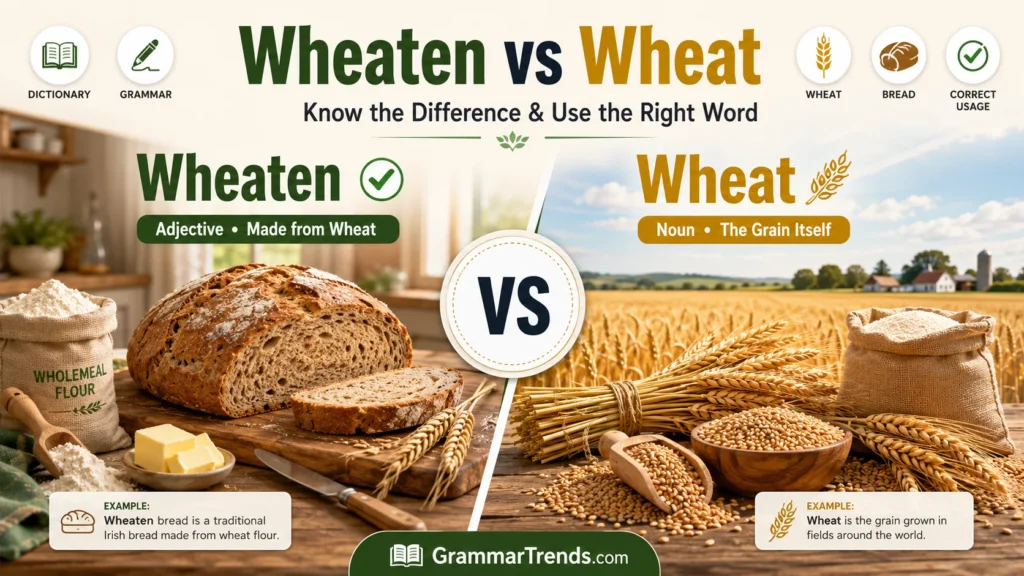
Wheaten vs Wheat often confuses English learners because the words sound alike but carry different meanings in food language today.
Many people mix up wheaten and wheat while writing recipes or discussing baking. From my experience in food writing, this confusion appears often in daily conversations and casual speaking. Wheaten usually describes products made from wheat, including wheaten bread, wheaten flour, baked snacks, baked goods, pasta, and whole wheat flour.
Wheat, however, refers to the grain or cereal grain itself that farmers grow in a field of wheat before it is harvested for baking, animal feed, and biofuel purposes. The difference becomes easier to understand when you focus on the context, especially while drafting a recipe, describing a dog with a gorgeous golden coat, or discussing Northern Irish cuisine with cooks, writers, nutritionists, and pet owners.
Choosing the Right Word in Context
A useful guide for choosing the right word is remembering that wheaten points to food items, while wheat names the crop, flour, or raw ingredients used in food production. This distinction helps improve clarity, communicate clearly, and make sentence structure feel more natural and automatic. You may also notice grammar rules, sentence examples, definitions, origins, interesting facts, exercises, and deeper detail about types of wheat such as durum wheat and hard red wheat.
These varieties are linked with culinary uses, nutritional benefits, and wheat-based product applications. Over time, learners usually understand how the proper word behaves differently in language usage, helping them sharpen skills and build clarity in both formal communication and casual communication while exploring cultural context, regional exceptions, and modern food farming discussions.
Wheaten vs Wheat: Quick Comparison Table
Before diving into the details, this table clears up the core distinction immediately.
| Term | Part of Speech | Meaning | Most Common Usage | Example |
| Wheat | Noun | A cereal grain | Agriculture, food, nutrition | “Wheat grows in dry climates.” |
| Wheaten | Adjective | Made from wheat | Bread, biscuits, baked goods | “She baked a wheaten loaf.” |
The Fastest Way to Remember the Difference
Think of it this way:
- Wheat is the ingredient.
- Wheaten describes something created from that ingredient.
It works the same way as:
- Wood → Wooden
- Wool → Woolen
- Gold → Golden
That pattern makes “wheaten” easier to understand.
What Does “Wheat” Mean?
The word wheat refers to a cereal grain cultivated worldwide for food production. Humans have grown wheat for thousands of years. In fact, historians consider it one of the earliest domesticated crops.
Today, wheat ranks among the world’s most important staple foods alongside rice and corn.
Wheat in Agriculture
Farmers grow wheat primarily for:
- Flour production
- Bread making
- Pasta
- Breakfast cereals
- Livestock feed
Large wheat-producing countries include:
- China
- India
- Russia
- United States
- France
- Canada
Wheat thrives in moderate climates and adapts well to different soils. That flexibility explains why it became such a dominant crop globally.
Types of Wheat
Not all wheat is identical. Different varieties produce different textures and flavors.
| Wheat Type | Main Use | Protein Level |
| Hard Red Wheat | Bread | High |
| Soft Wheat | Cakes and pastries | Low |
| Durum Wheat | Pasta | Very high |
| Whole Wheat | High-fiber baking | Moderate |
| White Wheat | Lighter whole grain products | Moderate |
These distinctions matter because the type of wheat affects:
- Texture
- Gluten strength
- Nutritional value
- Flavor
- Baking performance
For example, bread flour uses hard wheat because higher protein creates stronger gluten networks. Cake flour uses soft wheat because it produces softer textures.
Wheat in Nutrition
Nutrition discussions almost always use the word wheat, not wheaten.
You’ll commonly see:
- Wheat allergy
- Wheat bran
- Whole wheat
- Wheat germ
- Wheat flour
Whole wheat products retain:
- Bran
- Germ
- Endosperm
Refined wheat products remove parts of the grain during processing. That removal reduces fiber and certain nutrients.
Whole Wheat vs Refined Wheat
| Feature | Whole Wheat | Refined Wheat |
| Fiber | High | Lower |
| Nutrients | More retained | Reduced |
| Texture | Dense | Softer |
| Shelf Life | Shorter | Longer |
| Color | Brownish | White |
This distinction becomes important when discussing bread labels later in the article.
What Does “Wheaten” Mean?
Unlike wheat, wheaten functions mainly as an adjective.
It describes foods or products made from wheat.
Examples include:
- Wheaten bread
- Wheaten crackers
- Wheaten biscuits
- Wheaten scones
You rarely see “wheaten” outside food-related contexts.
Why “Wheaten” Sounds Old-Fashioned
Many Americans barely use the word “wheaten” anymore. That’s why it often sounds traditional or slightly formal.
However, the term remains common in:
- Ireland
- Parts of the UK
- Traditional baking communities
In those regions, “wheaten bread” still appears regularly on:
- Bakery signs
- Restaurant menus
- Family recipes
The word carries a rustic tone. It often evokes homemade baking, farmhouse kitchens, and traditional recipes.
That emotional association keeps the term alive.
Read more: Safeness vs Safetiness: Meaning and Differences
The Core Difference Between Wheaten and Wheat
Here’s where people get confused.
English allows nouns to function like adjectives. Because of that rule, phrases like:
- Wheat bread
- Wheat flour
- Wheat pasta
already sound correct.
As a result, “wheaten” became less necessary in modern English.
Still, the distinction matters grammatically.
Wheat Names the Ingredient
When discussing:
- Farming
- Nutrition
- Ingredients
- Allergies
- Crops
the correct word is almost always wheat.
Examples
- “Farmers harvested wheat in July.”
- “This cereal contains wheat.”
- “Wheat prices increased this year.”
In all three examples, the word refers directly to the grain itself.
Wheaten Describes Something Made From Wheat
“Wheaten” modifies another noun.
Examples
- Wheaten loaf
- Wheaten crackers
- Wheaten biscuits
In these phrases, wheaten behaves like:
- Wooden chair
- Golden ring
- Woolen coat
It describes composition.
The Simple Rule Most Writers Use
If you can replace the word with:
“Made from wheat”
then wheaten may work.
If you mean:
The grain itself
use wheat.
That shortcut solves most confusion instantly.
Wheaten Bread vs Wheat Bread: Are They Actually Different?
This question causes enormous confusion online.
Technically, both refer to bread made with wheat flour. Yet regional usage changes the meaning dramatically.
What “Wheat Bread” Usually Means
In American English, wheat bread commonly means:
- Bread made with wheat flour
- Often brown in color
- Sometimes partially whole grain
However, not all wheat bread is whole wheat bread.
That’s where consumers often get misled.
Some commercial wheat breads contain:
- Refined flour
- Added caramel coloring
- Small amounts of whole wheat
The label may sound healthy even when the nutritional value barely differs from white bread.
What “Wheaten Bread” Usually Means
In Ireland and parts of the UK, wheaten bread often refers to a traditional brown soda bread.
Typical characteristics include:
- Dense texture
- Wholemeal flour
- Buttermilk
- Baking soda
- Rustic appearance
It’s less sweet than commercial sandwich bread and usually feels heartier.
Wheaten Bread vs Wheat Bread Comparison
| Feature | Wheat Bread | Wheaten Bread |
| Common Region | United States | Ireland & UK |
| Texture | Soft | Dense |
| Typical Use | Sandwiches | Rustic baking |
| Flour Type | Mixed wheat flour | Wholemeal wheat flour |
| Traditional Recipe | Rarely | Often |
Why Bread Labels Can Be Misleading
Marketing language muddies the waters.
Consumers often assume:
- Brown bread = healthy
- Wheat bread = whole grain
- Multigrain = whole wheat
Those assumptions fail surprisingly often.
Important Fact
A bread labeled “wheat bread” may still contain mostly refined flour.
The only reliable way to confirm whole grain content is checking:
- Ingredient lists
- Nutrition labels
Look for:
- “100% whole wheat”
- “Whole grain wheat flour”
Those phrases matter.
How to Use “Wheat” Correctly in a Sentence
Using “wheat” correctly becomes easy once you remember it’s usually a noun.
Correct Uses of Wheat
Agriculture
- “Kansas produces large amounts of wheat.”
Nutrition
- “She avoids wheat because of allergies.”
Ingredients
- “This flour contains organic wheat.”
Economics
- “Global wheat prices rose after droughts.”
Incorrect Uses of Wheat
Some sentences sound awkward because writers force “wheat” into places where “wheaten” sounds more natural.
Examples
❌ “He served wheat biscuits.”
✅ “He served wheaten biscuits.”
❌ “The bakery sold fresh wheat rolls.”
✅ “The bakery sold fresh wheaten rolls.”
How to Use “Wheaten” Correctly in a Sentence
“Wheaten” works best when describing baked goods and prepared foods.
Correct Examples
- “The café offered warm wheaten scones.”
- “She baked traditional Irish wheaten bread.”
- “We ate homemade wheaten crackers.”
These sound natural because wheaten describes the final food product.
Incorrect Uses of Wheaten
Writers sometimes misuse “wheaten” as a noun.
Incorrect Example
❌ “Farmers planted wheaten across the valley.”
That sentence sounds unnatural because wheaten does not refer to the crop itself.
✅ Correct Version:
“Farmers planted wheat across the valley.
Real-Life Examples of Wheat and Wheaten
Understanding grammar becomes easier with realistic examples.
Examples Using “Wheat”
| Sentence | Why It Works |
| “Wheat exports increased this year.” | Refers to the crop |
| “She has a wheat allergy.” | Ingredient reference |
| “Whole wheat flour contains more fiber.” | Nutritional context |
| “The drought damaged wheat production.” | Agricultural use |
Examples Using “Wheaten”
| Sentence | Why It Works |
| “The bakery specializes in wheaten bread.” | Describes the bread |
| “He bought wheaten crackers.” | Describes a food item |
| “They served warm wheaten rolls.” | Adjective usage |
| “Traditional wheaten loaves use buttermilk.” | Food description |
Common Mistakes People Make With Wheaten vs Wheat
Even experienced writers confuse these terms occasionally.
Here are the biggest errors.
Using “Wheaten” as a Synonym for “Wheat”
This mistake happens constantly.
Incorrect
- “Wheaten is harvested in summer.”
Correct
- “Wheat is harvested in summer.”
Remember:
- Wheat = crop
- Wheaten = descriptive adjective
Assuming Wheat Bread Means Whole Wheat Bread
This misconception affects grocery shoppers every day.
Some wheat breads contain:
- Mostly refined flour
- Added sugar
- Artificial coloring
Consumers often buy them believing they’re nutritionally identical to whole wheat bread.
They aren’t.
Overusing “Wheaten” in Modern American English
In the US, phrases like:
- Wheat bread
- Wheat crackers
- Wheat cereal
sound more natural than wheaten equivalents.
Using “wheaten” excessively may sound overly formal or old-fashioned to American readers.
Thinking “Wheaten” Is Obsolete
The word still appears frequently in:
- Irish baking
- Traditional cookbooks
- Artisan bakeries
- British food writing
It hasn’t disappeared. Its usage simply narrowed over time.
Regional and Cultural Differences Matter
Language changes depending on location.
That reality explains much of the wheaten vs wheat confusion.
American English Usage
American English usually favors simpler compound nouns.
Examples:
- Wheat bread
- Wheat flour
- Wheat cereal
The adjective form “wheaten” appears far less often.
British English Usage
British English retains more traditional food vocabulary.
As a result, phrases like:
- Wheaten loaf
- Wheaten biscuits
still sound natural.
Irish Food Culture and Wheaten Bread
In Ireland, wheaten bread carries cultural significance.
Traditional Irish wheaten bread often includes:
- Wholemeal flour
- Buttermilk
- Baking soda
- Molasses or treacle
Families pass recipes across generations.
For many people, the word “wheaten” immediately suggests homemade brown bread served warm with butter.
That cultural association keeps the term alive.
Grammar Behind Wheat and Wheaten
The distinction becomes clearer once you understand English word formation.
Wheat Is a Noun
It names:
- A crop
- A grain
- An ingredient
Simple.
Wheaten Is an Adjective
It describes:
- Texture
- Composition
- Material
The pattern matches several classic English constructions.
| Noun | Adjective |
| Wood | Wooden |
| Wool | Woolen |
| Gold | Golden |
| Wheat | Wheaten |
Historically, English often added:
- -en
- -n
to create descriptive adjectives.
Over time, many forms disappeared while others survived.
“Wheaten” simply survived in limited contexts.
Why Modern English Prefers “Wheat Bread”
Modern English favors efficiency.
Shorter constructions usually win.
That trend explains why:
- Wheat bread
- Wheat crackers
- Wheat cereal
became more common than their wheaten counterparts.
English increasingly uses nouns as modifiers instead of creating separate adjectives.
Examples include:
- Stone wall
- Chicken soup
- Cotton shirt
“Wheat bread” follows the same structure.
Wheat in Nutrition and Health Discussions
The word “wheat” dominates nutritional language because medical discussions focus on the ingredient itself.
Wheat Allergies
A wheat allergy differs from gluten intolerance.
People with wheat allergies react specifically to proteins found in wheat.
Symptoms may include:
- Hives
- Digestive discomfort
- Swelling
- Breathing difficulties
Food labels clearly identify wheat because it ranks among major allergens in many countries.
Gluten and Wheat Are Not Identical
This distinction surprises many readers.
Important Fact
- Wheat contains gluten.
- Not all gluten comes from wheat.
Other grains containing gluten include:
- Barley
- Rye
That nuance matters when discussing gluten-free diets.
Whole Wheat vs White Bread
Whole wheat bread generally contains:
- More fiber
- More vitamins
- More minerals
White bread often undergoes heavier processing.
However, texture and taste preferences vary widely.
Some people prefer:
- Softer white bread
- Denser whole wheat bread
- Rustic wheaten loaves
Food choice depends on both nutrition and personal preference.
Quick Usage Cheat Sheet
Here’s the easiest reference guide in the entire article.
| If You Mean… | Correct Word |
| The grain itself | Wheat |
| Farming or crops | Wheat |
| Allergies or nutrition | Wheat |
| A food made from wheat | Wheaten |
| Traditional Irish bread | Wheaten |
| Modern US bread labels | Wheat |
Mini Case Study: Why Grocery Shoppers Get Confused
Imagine two bread labels sitting side by side.
Bread A
- “Wheat Bread”
Bread B
- “100% Whole Wheat Bread”
Many shoppers assume both are nutritionally equal.
They aren’t.
Bread A may contain:
- Mostly refined flour
- Added sweeteners
- Minimal whole grain
Bread B must contain whole wheat flour as the primary grain.
That small wording difference changes:
- Fiber levels
- Nutrient density
- Glycemic impact
The lesson?
Tiny language distinctions often carry major practical consequences.
Practice Exercises for Wheaten vs Wheat
Try these quick exercises to test your understanding.
Fill in the Blank
Choose either wheat or wheaten.
- Farmers harvested ______ before the rain arrived.
- She baked traditional Irish ______ bread.
- The cereal contains whole ______ flour.
- He served warm ______ rolls with soup.
- Drought conditions affected global ______ prices.
Answers
- Wheat
- Wheaten
- Wheat
- Wheaten
- Wheat
Correct the Sentence
Incorrect
“She bought fresh wheat biscuits from the bakery.”
Better
“She bought fresh wheaten biscuits from the bakery.”
Incorrect
“Wheaten production declined this year.”
Better
“Wheat production declined this year.”
FAQs
What is the main difference between wheaten and wheat?
Wheaten describes something made from or containing wheat, while wheat refers to the cereal grain itself. For example, wheaten bread is made from wheat flour, but wheat is the raw grain grown by farmers.
Is wheaten a correct English word?
Yes, wheaten is a correct word in the English language. It is commonly used to describe baked goods, flour, and other wheat-based food products.
Can wheat and wheaten be used interchangeably?
No, they should not always be used interchangeably because they have different meanings. Wheat names the grain, while wheaten describes something connected to wheat.
Why do English learners confuse wheaten and wheat?
Many English learners confuse these words because they sound alike, have similar meanings, and are often used in food-related discussions and recipes.
What are some examples of wheaten products?
Common wheaten products include wheaten bread, wheaten flour, baked snacks, pasta, and other baked goods made from wheat flour.
What types of wheat are commonly used in food production?
Popular types of wheat include durum wheat and hard red wheat. These varieties are widely used for baking, pasta production, and other culinary uses.
How can I remember when to use wheaten or wheat?
A simple way to remember is that wheat is the grain itself, while wheaten describes food or products made from that grain. Paying attention to context helps improve clarity in writing and speaking.
Conclusion
Understanding the difference between wheaten and wheat helps improve clarity in both writing and speaking. Although the words sound similar and share connected meanings, they serve different purposes in the English language. Wheaten describes products made from wheat, while wheat refers to the grain itself. Once you understand the context and usage of each term, choosing the correct word becomes simple and natural in everyday communication.

Emma Brooke brings 15 years of experience in the Department of English Language and Literature at the University of California, Berkeley, where she has taught and mentored students across courses in British and American literary traditions, critical theory, and narrative form. Her expertise spans 19th- and 20th-century fiction, poetic prosody, postcolonial literatures, and digital humanities, with a focus on how narrative voice shapes cultural meaning. Emma’s work has been presented at international conferences and published in peer-reviewed venues, reflecting her deep commitment to rigorous literary scholarship and accessible teaching.