
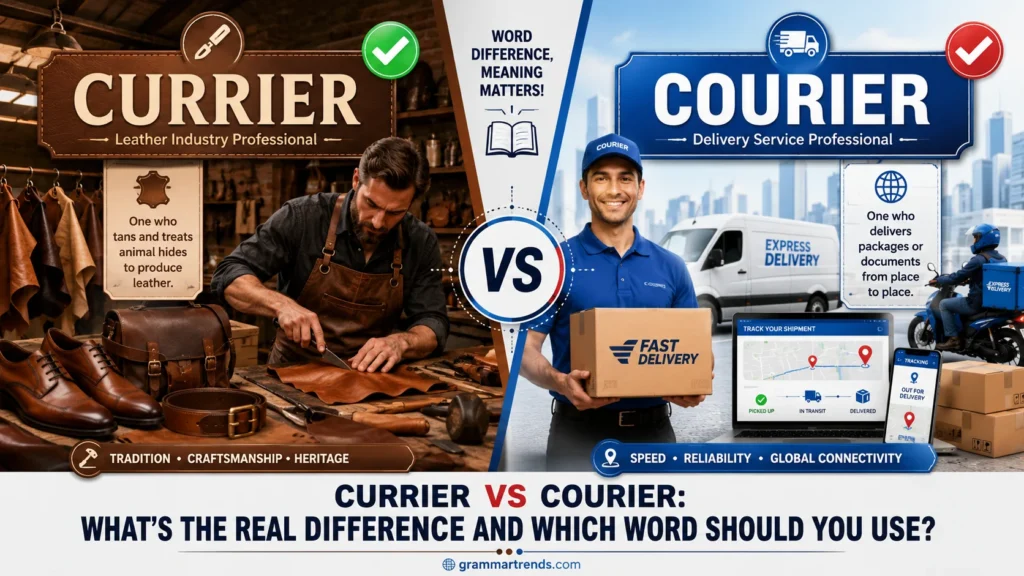
Currier vs Courier is often confused in daily communication, but the difference is very clear when we look at real use in writing, messages, and documents. A currier works in the leather industry, handling tasks, tanning, currying, and preparing products like shoes, belts, and bags, while a courier handles delivery services, moving parcels, items, and messages quickly to improve communication and clarity. Both are skilled worker roles, but their meaning is different, and using the wrong one can cause mistakes, confuse readers, and affect clear written communication and easy understanding.
A person works in these fields using leather, handling materials in one case and transporting goods in the other, where cars, bicycles, trucks, and even foot delivery are used. I often explain this with examples and sentences because they sound alike, yet their proper use is essential to prevent confusion, ensure clarity, and maintain correct writing.
Heading: Logistics and Delivery Systems
In logistics, carriers and couriers play a crucial role in transportation and shipping strategies, helping businesses with distinct purposes, roles, and real benefits explained in this article. The nuances, types, and functionalities are leveraged to build efficient logistics solutions, helping optimize operations while aiming for better insights, a bustling world, and delves into stronger solutions for global movement.
A carrier often moves packages, people, and provides services internationally, while a courier focuses on delivers of goods in a transport system where many things are set apart, including two transport roles. Both are important, and they ensure goods are moved efficiently with transportation networks supporting global trade.
Currier vs Courier at a Glance
Here’s the quick version before diving deeper.
| Word | Meaning | Part of Speech | Typical Usage | Example |
| Currier | A person who dresses, colors, or finishes leather after tanning | Noun | Leather industry, historical trades | The currier prepared the leather hides. |
| Courier | A person or service that delivers items or messages | Noun | Delivery services, business, shipping | The courier arrived with the package. |
Quick takeaway
Courier delivers.
Currier cures or prepares leather.
If you remember only that distinction, you’ll avoid most mistakes.
What Does “Currier” Mean?
The word currier doesn’t appear often in modern conversations. However, it remains a real word with a long history.
Definition of Currier
A currier is a skilled worker who treats leather after the tanning process. The job traditionally involves:
- Softening leather
- Coloring leather
- Finishing leather surfaces
- Making leather more flexible
- Preparing leather for manufacturing
Think of leather production as a chain of steps.
First, someone removes and preserves animal hides. Then tanners process those hides. After that, the currier steps in and improves the material before it becomes products such as:
- Shoes
- Saddles
- Belts
- Bags
- Furniture
- Gloves
The currier acted almost like a finishing artist.
Without that stage, leather could remain stiff or unsuitable for practical use.
The Historical Importance of Curriers
Centuries ago, curriers played a significant role in local economies.
In medieval towns and colonial settlements, leather goods mattered greatly because people depended on them daily.
People needed:
- Riding equipment
- Protective clothing
- Footwear
- Tool belts
- Military gear
Since leather was everywhere, skilled workers held respected positions.
“A craft survives when skilled hands transform raw material into something useful.”
Before industrial manufacturing took over, curriers represented an essential link in the production chain.
Where You’ll See “Currier” Today
Modern readers rarely encounter the word unless they enter specialized fields.
You might find it in:
Historical books
Example:
“The village currier prepared hides for local shoemakers.”
Leather manufacturing discussions
Example:
“Traditional curriers still use hand-finishing methods.”
Family names
Many surnames originated from occupations.
Examples include:
- Baker
- Miller
- Carpenter
- Currier
Occupational surnames often described what a person did for work.
Examples of Currier in Sentences
Here are natural examples:
- The currier polished the leather until it felt soft.
- During colonial times, the currier held an important trade position.
- The apprentice spent years learning techniques from an experienced currier.
- Historians studied how the currier contributed to local commerce.
- Skilled curriers transformed rough hides into usable materials.
Notice something interesting.
Every sentence revolves around leather work.
That pattern becomes helpful later.
What Does “Courier” Mean?
Unlike currier, the word courier appears constantly in modern life.
You probably see it every week.
Maybe even every day.
Definition of Courier
A courier is a person or company that transports items, messages, or documents from one location to another.
Couriers usually specialize in:
- Speed
- reliability
- secure transportation
- tracking services
- direct delivery
A courier can be:
- A person riding a motorcycle
- A bike messenger
- A delivery driver
- A large shipping company
- An international logistics service
Why Couriers Matter Today
The rise of online shopping transformed courier services into a massive industry.
Years ago, people mainly visited physical stores.
Today, customers expect:
- Next-day shipping
- Same-day delivery
- Live package tracking
- International shipping
That expectation created enormous demand.
Modern courier networks move millions of packages daily.
Items commonly transported include:
- Medical supplies
- Legal documents
- Consumer products
- Electronics
- Food deliveries
- Business materials
Courier vs Traditional Mail
People often confuse courier services with postal systems.
While both deliver items, they operate differently.
| Feature | Courier Service | Traditional Mail |
| Delivery speed | Usually faster | Usually slower |
| Tracking | Extensive tracking | Limited tracking |
| Personal service | High | Standard |
| Cost | Often higher | Usually cheaper |
| Same-day delivery | Available | Rare |
Think of standard mail as a city bus.
Think of a courier as a taxi.
Both reach the destination. One typically offers more direct service.
Examples of Courier in Sentences
- The courier delivered the documents before noon.
- We hired a courier service for urgent packages.
- A courier arrived with medical supplies.
- The company uses local couriers for same-day deliveries.
- She tracked her package until the courier reached her home.
Notice the pattern here too.
Everything involves transportation or delivery.
Read more: Developed vs Developped: Which Spelling Is Correct?
The Main Difference Between Currier and Courier
Now the distinction becomes crystal clear.
| Feature | Currier | Courier |
| Primary role | Treats leather | Delivers items |
| Industry | Leather trade | Shipping and logistics |
| Modern usage frequency | Rare | Extremely common |
| Historical relevance | High | Moderate |
| Everyday use | Minimal | Very common |
Why People Confuse These Words
Several reasons explain the confusion.
They look nearly identical
Compare them:
- Currier
- Courier
Only one letter changes.
Your brain often processes familiar patterns quickly and misses subtle differences.
They sound similar
Pronunciation differences can become blurry in fast conversation.
That creates accidental substitutions.
Spellcheck won’t always save you
Spellcheck catches misspelled words.
It doesn’t always catch correct words used incorrectly.
For example:
“The currier delivered my package.”
No spelling error exists.
Yet the meaning remains wrong.
How To Use Currier and Courier Correctly in Sentences
Understanding definitions helps. Using them naturally matters even more.
Sentence Patterns for Currier
A currier typically performs actions involving leather.
Examples:
Subject pattern
- The currier dyed the leather.
Object pattern
- The workshop hired a currier.
Professional context
- Experienced curriers knew dozens of finishing techniques.
Sentence Patterns for Courier
A courier usually performs transportation actions.
Examples:
Subject pattern
- The courier delivered the package.
Object pattern
- We called a courier.
Professional context
- The company depends on reliable couriers.
Incorrect vs Correct Usage
| Incorrect | Correct |
| I called a currier to deliver flowers. | I called a courier to deliver flowers. |
| The courier softened leather hides. | The currier softened leather hides. |
| A currier brought my documents. | A courier brought my documents. |
| The courier treated the animal skins. | The currier treated the animal skins. |
Small correction. Big difference.
Real-Life Examples You Might Encounter
Words make more sense when you see them in realistic situations.
In Business Writing
Businesses frequently use courier.
Examples:
“Please send the signed documents through a courier service.”
“The courier will collect your package tomorrow morning.”
“Our courier partner offers same-day delivery.”
In Historical Texts
Historical writing often includes currier.
Examples:
“The local currier supplied leather to saddle makers.”
“Town records listed a currier among local craftsmen.”
“The currier worked beside the tannery.”
In Everyday Conversations
You rarely hear currier casually.
You hear courier all the time.
Examples:
- “Has the courier arrived yet?”
- “The courier left my package outside.”
- “I paid extra for courier delivery.”
Case Study: One Letter That Changed a Business Email
Imagine a purchasing manager sending this message:
“Please contact the currier regarding delayed shipments.”
The manager meant courier.
A supplier reading that email may pause and wonder:
“Why are we discussing leather workers?”
That tiny typo creates confusion.
In professional communication, precision matters.
One misplaced letter can:
- Cause misunderstandings
- Reduce credibility
- Slow communication
- Create unnecessary questions
Words behave like road signs.
A missing letter can point readers down the wrong road.
Common Mistakes Writers Make With Currier and Courier
Certain mistakes appear repeatedly.
Knowing them helps you avoid them.
Assuming Both Words Relate to Delivery
This mistake happens most often.
Many people assume currier represents an alternate spelling.
It isn’t.
Only courier refers to delivery services.
Relying Completely on Autocorrect
Technology helps.
Technology also makes mistakes.
Spellcheck identifies spelling problems. It doesn’t fully understand meaning.
Always read sentences in context.
Ask:
Does this word match the situation?
Confusing Similar-Sounding Words
English contains many word pairs that create similar problems.
Examples include:
| Word Pair | Difference |
| Affect vs Effect | Action vs result |
| Complement vs Compliment | Complete vs praise |
| Principal vs Principle | Person vs rule |
| Stationary vs Stationery | Still vs writing supplies |
Currier vs courier belongs in that same family of commonly confused words.
A Simple Trick To Remember the Difference
Memory tricks work because they create shortcuts inside your mind.
Courier = Carrying
Think:
Courier carries packages
Both start with C.
Picture a delivery driver carrying boxes to a doorstep.
Currier = Curing Leather
Think:
Currier cures leather
Visualize a craftsman working on animal hides inside an old workshop.
Quick Memory Table
| Word | Memory Trigger |
| Currier | Cures leather |
| Courier | Carries deliveries |
Simple images stick better than long explanations.
Currier vs Courier in Historical and Modern Context
Language changes over time.
Some words become more common.
Others fade into specialized use.
Currier and courier illustrate that shift perfectly.
Historical Meaning of Currier
Centuries ago, leather industries supported local economies.
Curriers held practical importance because nearly everyone depended on leather goods.
Products included:
- Harnesses
- Boots
- Saddles
- Protective clothing
- Travel gear
The profession required skill and patience.
Modern Meaning of Courier
Today, courier services power global commerce.
Modern logistics networks move products around the world constantly.
Examples include:
- E-commerce deliveries
- Overnight shipping
- Medical transportation
- Business logistics
- International trade
The industry grew rapidly because customer expectations changed.
People don’t want to wait weeks.
They want speed.
Interesting Fact
During earlier centuries, a courier often transported messages rather than packages.
Kings, military leaders, and governments depended on human couriers.
Before telephones and email existed, couriers represented the fastest communication method available.
Mini Quiz: Test Yourself
Ready for a quick challenge?
Fill in the blanks.
Questions
Question 1
The ______ delivered my passport this morning.
Question 2
The skilled ______ softened the leather.
Question 3
We hired a ______ service for urgent legal documents.
Question 4
The ______ spent years mastering leather finishing techniques.
Answers
| Question | Correct Answer |
| Question 1 | Courier |
| Question 2 | Currier |
| Question 3 | Courier |
| Question 4 | Currier |
If you answered correctly, the difference probably feels natural now.
FAQs
What is the main difference between currier and courier?
A currier works with leather, while a courier delivers parcels, documents, and messages quickly.
Why do people confuse currier and courier?
They confuse them because both words sound similar, but their meanings and jobs are completely different.
What does a currier do?
A currier is a skilled worker in the leather industry who prepares, softens, and treats leather for products like shoes and belts.
What does a courier do?
A courier works in delivery services, transporting goods, documents, and packages using vehicles or even on foot.
Is courier related to logistics?
Yes, couriers are an important part of logistics and transportation systems that ensure fast delivery of items.
How can I remember the difference easily?
Think of “currier = leather” and “courier = delivery” to avoid confusion.
Which one is more commonly used today?
The word courier is more commonly used today because delivery and logistics services are widely needed.
Conclusion
The difference between currier and courier is simple once understood. A currier belongs to the leather industry, while a courier is part of delivery and logistics services. Knowing this helps improve writing clarity and prevents common confusion in English usage.

Emma Brooke brings 15 years of experience in the Department of English Language and Literature at the University of California, Berkeley, where she has taught and mentored students across courses in British and American literary traditions, critical theory, and narrative form. Her expertise spans 19th- and 20th-century fiction, poetic prosody, postcolonial literatures, and digital humanities, with a focus on how narrative voice shapes cultural meaning. Emma’s work has been presented at international conferences and published in peer-reviewed venues, reflecting her deep commitment to rigorous literary scholarship and accessible teaching.