
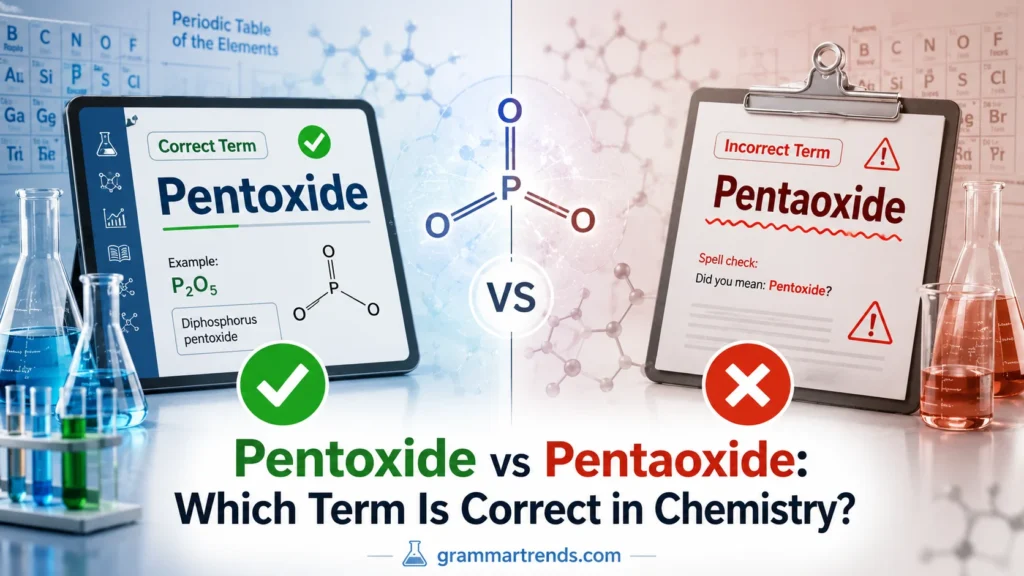
In chemistry, Pentoxide vs Pentaoxide in chemistry confuses many learners as both look same and differ in scientific language usage today in writing contexts. Many learners notice that both terms look almost identical, but their usage changes in scientific communication and chemical nomenclature.
In real scientific writing, Pentoxide is the preferred and standard term, widely accepted by scientists, especially in textbooks and research papers, such as P4O10 and V2O5 examples. It is considered more accurate in modern documentation.
However, Pentaoxide appears in older sources and is now treated as nonstandard or incorrect in most modern chemistry usage. This difference in naming practice helps avoid confusion in lab reports, industrial writing, and clear scientific communication.
What Does Pentoxide Mean?
The term pentoxide refers to a chemical compound that contains five oxygen atoms bonded with another element.
The word combines:
- Pent- = five
- Oxide = oxygen combined with another element
In chemistry, the prefix indicates the number of oxygen atoms present within the compound.
For example:
| Compound | Formula | Meaning |
| Dinitrogen pentoxide | N₂O₅ | Two nitrogen atoms and five oxygen atoms |
| Phosphorus pentoxide | P₂O₅ | Two phosphorus atoms and five oxygen atoms |
| Vanadium pentoxide | V₂O₅ | Two vanadium atoms and five oxygen atoms |
Although the name looks simple, it follows a strict linguistic rule used throughout chemistry.
Why Chemists Use “Pentoxide” Instead of “Pentaoxide”
This is where chemistry naming becomes interesting.
Scientific terminology often removes vowels when two vowels collide awkwardly in pronunciation. The process is called vowel elision.
Instead of saying:
- penta-oxide
Chemists simplify it to:
- pentoxide
The same thing happens with several other chemical names.
Examples of Vowel Elision in Chemistry
| Uncommon Form | Correct Scientific Form |
| Monooxide | Monoxide |
| Tetraoxide | Tetroxide |
| Pentaoxide | Pentoxide |
The goal is simple:
- smoother pronunciation
- easier communication
- standardized naming
Nobody wants chemical names that sound clunky in lectures or laboratories. Imagine saying “dinitrogen pentaoxide” repeatedly during a chemistry class. It feels awkward because the consecutive vowels interrupt the flow of speech.
So chemistry trims the extra vowel and moves on.
Is “Pentaoxide” a Real Word?
Technically, people understand what “pentaoxide” means. It isn’t complete nonsense. However, that does not make it scientifically preferred.
Modern chemistry overwhelmingly favors pentoxide.
If you search academic databases, chemistry textbooks, or peer-reviewed journals, you’ll see “pentoxide” almost exclusively.
That distinction matters.
A word can exist informally without being accepted as standard scientific terminology.
Why Some People Still Use “Pentaoxide”
Several reasons explain the confusion.
People Assume Prefixes Stay Intact
Many learners know:
- mono = one
- di = two
- tri = three
- tetra = four
- penta = five
Naturally, they assume the entire prefix should remain unchanged.
That assumption makes sense linguistically. Chemistry simply follows its own pronunciation rules.
Older Sources Occasionally Used It
Certain historical or poorly edited sources may contain “pentaoxide.” Scientific naming conventions evolved over time, so inconsistencies existed decades ago.
Today, though, professional chemistry writing strongly favors pentoxide.
Pentoxide vs Pentaoxide: The Core Difference
The simplest explanation looks like this:
| Feature | Pentoxide | Pentaoxide |
| Scientifically accepted | Yes | Rarely |
| Used in textbooks | Yes | Almost never |
| Common in research papers | Yes | Extremely uncommon |
| Preferred pronunciation | Yes | No |
| IUPAC-aligned | Yes | No |
| Recommended for academic writing | Yes | No |
If accuracy matters, choose pentoxide every time.
The Chemistry Rule Behind the Missing “A”
Chemistry naming conventions exist for clarity and consistency. Scientists across different countries need terminology that sounds predictable and standardized.
That’s why vowel-dropping rules became common.
When prefixes ending in vowels connect with words beginning with vowels, chemistry frequently removes one vowel to improve pronunciation.
Understanding Vowel Elision
Vowel elision sounds complicated, yet the idea is simple.
Two adjacent vowels can sound awkward together. Scientific language trims the pronunciation to make the word flow naturally.
For example:
- mono + oxide → monoxide
- tetra + oxide → tetroxide
- penta + oxide → pentoxide
The pronunciation becomes smoother and faster.
Think of it like trimming unnecessary branches from a tree. The structure remains strong while the shape becomes cleaner.
Why Pronunciation Matters in Chemistry
Chemistry developed as a spoken science long before digital databases existed.
Researchers needed names that worked well:
- in classrooms
- during lectures
- in laboratory discussions
- at scientific conferences
Shorter and smoother terms improved communication.
Imagine reading complex reactions aloud all day:
- dinitrogen pentoxide
- sulfur trioxide
- carbon monoxide
Now compare that with:
- dinitrogen pentaoxide
- sulfur triaoxide
- carbon monooxide
The second set feels clumsy immediately.
Language efficiency matters more than many people realize.
Common Pentoxide Compounds in Chemistry
Several major compounds use the term “pentoxide.”
These substances play important roles in industry, environmental science, and manufacturing.
Dinitrogen Pentoxide (N₂O₅)
What Is Dinitrogen Pentoxide?
Dinitrogen pentoxide is a highly reactive chemical compound containing:
- 2 nitrogen atoms
- 5 oxygen atoms
Its formula looks like this:
N_2O_5
At room temperature, it appears as a white crystalline solid under stable conditions.
Uses of Dinitrogen Pentoxide
This compound serves several industrial and scientific purposes.
Major Applications
- Production of nitric acid
- Organic synthesis reactions
- Oxidizing processes
- Laboratory nitration reactions
Because it decomposes easily, chemists handle it carefully.
Environmental Importance
Dinitrogen pentoxide also matters in atmospheric chemistry.
It forms through reactions involving nitrogen dioxide and ozone, especially at night.
Scientists study it because it influences:
- air pollution
- smog formation
- atmospheric nitrogen cycles
Environmental chemists monitor these reactions closely since nitrogen oxides contribute heavily to urban air quality problems.
Phosphorus Pentoxide (P₂O₅)
One of the Most Important Industrial Dehydrating Agents
Phosphorus pentoxide ranks among the strongest dehydrating agents used in chemistry.
Its formula appears as:
P_2O_5
However, real phosphorus pentoxide commonly exists as:
- P₄O₁₀
That detail confuses many students.
Why Is It Still Called P₂O₅?
Chemistry often uses empirical formulas for naming simplicity.
The actual molecular structure contains four phosphorus atoms and ten oxygen atoms, yet the simpler ratio becomes:
- P₂O₅
That naming tradition remained widespread for historical reasons.
Industrial Uses of Phosphorus Pentoxide
This compound appears throughout manufacturing and laboratory work.
Common Uses
- Drying gases
- Removing water from chemical reactions
- Producing phosphoric acid
- Pharmaceutical manufacturing
- Fertilizer production
Because it reacts violently with water, laboratories store it carefully in dry environments.
A Simple Analogy
Think of phosphorus pentoxide like an extremely thirsty sponge.
The moment it encounters water, it grabs onto it aggressively. That property makes it incredibly useful in chemical dehydration processes.
Vanadium Pentoxide (V₂O₅)
What Makes Vanadium Pentoxide Important?
Vanadium pentoxide is one of the most commercially valuable vanadium compounds.
Its formula is:
V_2O_5
This bright orange-yellow solid acts as a catalyst in several industrial reactions.
Sulfuric Acid Production
The compound plays a critical role in manufacturing sulfuric acid through the contact process.
That matters because sulfuric acid remains one of the world’s most important industrial chemicals.
Industries use sulfuric acid in:
- fertilizers
- petroleum refining
- wastewater treatment
- battery manufacturing
- metal processing
Without vanadium pentoxide catalysts, large-scale sulfuric acid production would become far less efficient.
Emerging Battery Technology
Researchers also study vanadium pentoxide for advanced battery systems.
Its layered structure allows ion movement, making it useful for:
- lithium-ion batteries
- sodium-ion batteries
- energy storage technologies
As renewable energy expands, interest in vanadium-based materials continues growing.
Read more: Meating vs Meeting: What’s the Real Difference?
Pentoxide in Real Industrial Applications
Pentoxide compounds are not obscure laboratory curiosities. They support enormous industries worldwide.
Chemical Manufacturing
Many oxidation reactions rely on pentoxide compounds.
These reactions help produce:
- plastics
- synthetic fibers
- fertilizers
- industrial acids
Without oxidation chemistry, modern manufacturing would slow dramatically.
Electronics Industry
Certain metal pentoxides appear in:
- semiconductors
- thin-film coatings
- battery electrodes
- optical materials
Electronics manufacturers value these compounds because of their conductive and catalytic properties.
Environmental Engineering
Pentoxide compounds assist in pollution control technologies.
For example:
- catalytic converters
- industrial emission systems
- atmospheric monitoring equipment
Chemistry quietly powers much of modern environmental protection.
Examples of Pentoxide Used Correctly in Sentences
Seeing the word in context helps reinforce proper usage.
Academic Examples
- The experiment required phosphorus pentoxide to remove moisture from the reaction chamber.
- Students analyzed the molecular structure of dinitrogen pentoxide during the lecture.
- Vanadium pentoxide acts as an effective industrial catalyst.
Industrial Examples
- Engineers optimized sulfuric acid production using vanadium pentoxide catalysts.
- The facility stores phosphorus pentoxide in airtight containers.
- Chemical manufacturers rely on pentoxide compounds for oxidation reactions.
Environmental Science Examples
- Atmospheric dinitrogen pentoxide contributes to nighttime nitrogen chemistry.
- Researchers monitored pentoxide formation in polluted urban air.
- Nitrogen oxide reactions strongly affect air quality.
Common Mistakes People Make With Pentoxide and Pentaoxide
Even smart writers make terminology mistakes. Chemistry naming rules can feel unintuitive at first.
Still, some errors appear repeatedly.
Assuming Every Prefix Stays Unchanged
This causes most confusion.
People see:
- penta = five
Then they logically write:
- pentaoxide
Unfortunately, chemistry compresses the pronunciation.
That tiny adjustment changes the accepted spelling completely.
Copying Incorrect Information Online
Not every science article online deserves trust.
Some websites:
- ignore IUPAC naming standards
- recycle inaccurate content
A spelling repeated thousands of times can still be wrong.
That’s why textbooks and peer-reviewed chemistry sources matter.
Confusing Informal Usage With Scientific Standards
Language evolves informally all the time. Scientific terminology works differently.
Chemistry values:
- precision
- consistency
- standardization
Even small spelling differences can affect clarity.
In casual conversation, someone might say “pentaoxide” and still get understood. Academic writing demands stricter accuracy.
How IUPAC Naming Standards Influence Chemical Terms
The International Union of Pure and Applied Chemistry—commonly called IUPAC—developed standardized chemical naming systems.
Their goal was simple:
- eliminate confusion
- create international consistency
- standardize terminology worldwide
That system shapes modern chemistry language today.
Why IUPAC Matters
Without naming standards, chemistry would become chaotic.
Different countries and textbooks could use conflicting names for identical compounds.
Imagine aviation pilots using different names for airplane controls. Confusion would become dangerous quickly.
Chemistry faces similar risks in laboratories and manufacturing.
Standardized naming prevents costly mistakes.
Dictionary Recognition vs Scientific Accuracy
Some dictionaries may list “pentaoxide” because dictionaries record real-world language usage.
That does not mean scientists prefer the term.
There’s a major difference between:
- recognized usage
- recommended usage
For scientific writing, accuracy matters more than informal recognition.
Quick Comparison Cheat Sheet
Pentoxide vs Pentaoxide at a Glance
| Situation | Correct Term |
| Chemistry homework | Pentoxide |
| Scientific journal | Pentoxide |
| Research paper | Pentoxide |
| Laboratory documentation | Pentoxide |
| Casual spelling mistake | Pentaoxide |
| SEO keyword variation | Pentaoxide (limited use) |
Easy Memory Trick
Here’s a simple way to remember the rule:
If “oxide” follows a vowel-ending prefix, chemistry often drops the extra vowel.
Examples:
- monoxide
- tetroxide
- pentoxide
Once you recognize the pattern, the spelling feels natural.
A Short Case Study: Why Small Naming Errors Matter
In educational publishing, tiny terminology errors can spread rapidly online.
Suppose one chemistry blog mistakenly publishes “dinitrogen pentaoxide.”
Then:
- other blogs copy it
- AI tools repeat it
- students quote it
- search engines index it
Suddenly, an incorrect term gains visibility through repetition alone.
This phenomenon happens constantly in digital publishing.
That’s why authoritative chemistry references remain essential.
Scientific accuracy depends on verification, not popularity.
Pentoxide in Classroom Learning
Chemistry students often struggle with nomenclature early on.
The problem isn’t intelligence. It’s pattern recognition.
Chemical naming combines:
- Latin roots
- Greek prefixes
- pronunciation rules
- oxidation principles
- historical conventions
At first, the terminology feels like learning a new language.
Then patterns begin connecting.
Students who understand vowel elision usually master related compound names much faster.
Why Precise Scientific Language Matters
Some people wonder:
“Does one missing vowel really matter?”
In science, yes.
Precision affects:
- laboratory safety
- educational clarity
- technical documentation
- international communication
Tiny wording differences can create misunderstanding in research papers, manufacturing instructions, or chemical inventories.
Science depends on consistency.
That consistency starts with terminology.
7 FAQs on Pentoxide vs Pentaoxide
1. What does Pentoxide mean in chemistry?
It refers to a chemical compound that contains five oxygen atoms bonded with another element.
2. Is Pentaoxide correct in modern chemistry?
No, Pentaoxide is generally considered nonstandard and is rarely used in modern scientific writing.
3. Why do Pentoxide and Pentaoxide look similar?
Both come from the prefix penta- (meaning five) and oxide, so they look almost identical.
4. Which term is commonly used by scientists?
Scientists usually prefer Pentoxide in textbooks, research papers, and lab documentation.
5. Can using the wrong term cause confusion?
Yes, using Pentaoxide instead of Pentoxide can create confusion in chemical writing and formulas.
6. Where is Pentaoxide still found?
It may appear in older chemistry books or outdated scientific texts.
7. What is the safest term to use in exams and reports?
The safest and correct choice is always Pentoxide.
Conclusion
Understanding Pentoxide vs Pentaoxide is important in chemistry because small spelling differences can change meaning in scientific writing. While both terms look similar, only Pentoxide is widely accepted and used in modern chemistry. Knowing this helps students avoid mistakes, improve clarity, and write more accurately in exams, lab reports, and scientific communication.

Emma Rose has spent 15 years in the English Department at the University of California, Los Angeles (UCLA), guiding students through British and American literary classics, critical theory, and narrative techniques. Her scholarly focus includes 19th- and 20th-century fiction, the art of poetry, postcolonial writing, and digital humanities particularly how storytelling voice influences cultural perspectives. Emma has presented her research at major international conferences and published in respected academic journals, underscoring her dedication to both high-level scholarship and engaging teaching.