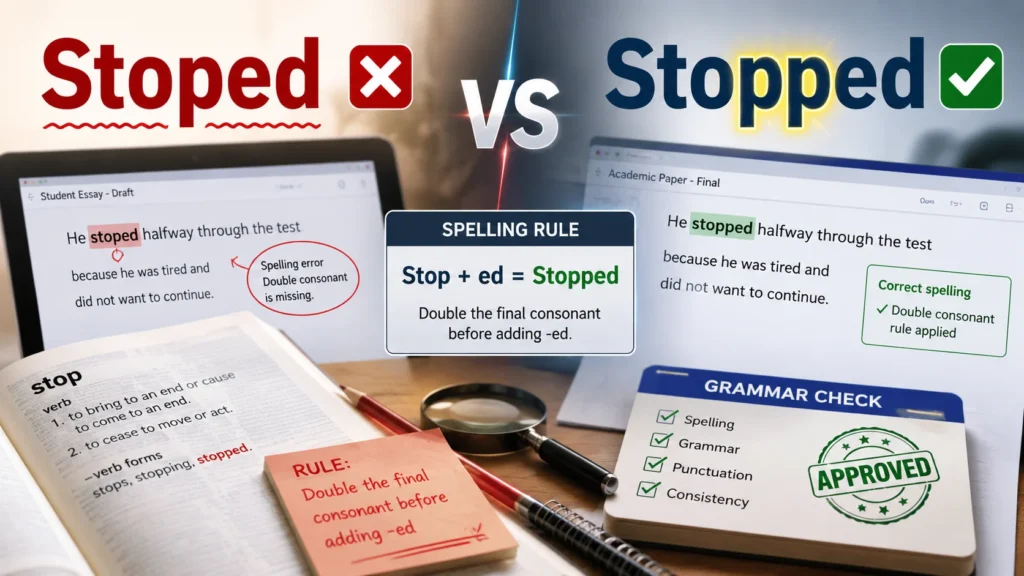
Stopped or Stoped: spelling clarity in English shows correct form stopped vs stoped using grammar rules and simple learning for learners tips
The correct answer, accepted in standard English, english is stopped, stopped, not stoped, stoped, due to double consonants, vowel, and consonant rules where letters are doubled, adding, ed. This improves confidence and supports better language, vocabulary, meaning, and verb, verbs, tense, past, participle use in everyday context.
In real Usage and Learning Pattern, this guide helps learners improve practice, writing, write, speaking, speak through simple, clear, easy-to-understand methods. I often explain, explain, explain with examples, examples like He stopped working, She stopped the car, and music stopped playing, which builds strong understanding, understanding without confusion, confused feelings. In daily contexts, people check correct, incorrect spelling in emails, assignments, and posts to avoid mistakes, mistakes and improve sentences. This strengthens grammar, grammar, verbs, verbs, and overall language usage, helping you improve confidence and reduce errors again and again in real communication.
Stopped or Stoped: Which Spelling Is Correct?
The correct spelling is:
| Word | Correct? | Meaning |
| Stopped | ✅ Yes | Past tense of “stop” |
| Stoped | ❌ No | Misspelling |
The verb “stop” changes to “stopped” in the past tense and past participle form.
Examples
- “The car stopped suddenly.”
- “She stopped talking.”
- “Production stopped after midnight.”
The spelling “stoped” does not follow standard English grammar rules.
Why So Many People Write “Stoped”
This mistake happens because English spelling loves surprises. One moment you simply add “-ed.” The next moment a word doubles its final consonant for no obvious reason.
That inconsistency trips people up.
Here’s why “stoped” feels believable:
- The base word is short
- The pronunciation sounds similar
- Many verbs do not double letters
- Fast typing hides spelling errors
- Autocorrect sometimes misses contextual mistakes
Consider these examples:
| Present Tense | Past Tense |
| Jump | Jumped |
| Walk | Walked |
| Rain | Rained |
Naturally, some people assume:
- Stop → Stoped
But English grammar throws in a curveball here.
The correct form becomes:
- Stop → Stopped
That extra “P” exists for a specific grammatical reason.
Why “Stopped” Has Two P’s
English follows a spelling rule called the consonant doubling rule.
Here’s the basic pattern:
When a one-syllable verb ends in consonant + vowel + consonant, you double the final consonant before adding “-ed.”
The word stop fits perfectly:
- S = consonant
- T/O = vowel sound
- P = consonant
So the final “P” doubles.
The Rule in Action
| Base Verb | Correct Past Tense |
| Stop | Stopped |
| Plan | Planned |
| Drop | Dropped |
| Hop | Hopped |
Without doubling the consonant, pronunciation changes. The word begins looking awkward or incomplete.
The Grammar Behind Consonant Doubling
This rule isn’t random. It protects pronunciation.
If English spelled it as “stoped,” many readers would instinctively pronounce the “O” differently. Doubling the consonant keeps the vowel short.
Compare these examples:
| Word | Pronunciation Style |
| Hoped | Long “O” sound |
| Hopped | Short “O” sound |
| Rated | Long “A” sound |
| Ratted | Short “A” sound |
Notice the pattern?
The double consonant preserves the short vowel sound.
That’s exactly why English writes:
- stopped
- dropped
- planned
instead of:
- stoped
- droped
- planed
When You Double the Final Letter
You usually double the final consonant when these conditions exist:
- The word has one syllable
- It ends in vowel + consonant
- The stress falls on the final syllable
Examples
| Base Word | Correct Form |
| Stop | Stopped |
| Grab | Grabbed |
| Slip | Slipped |
| Trim | Trimmed |
This rule appears constantly in English writing.
Once you recognize it, spelling becomes much easier.
When You Do NOT Double the Final Letter
Not every verb follows this pattern.
You normally avoid doubling the consonant when:
- The word ends with two vowels
- The ending consonant isn’t stressed
- The word structure differs
Examples
| Base Word | Correct Past Form |
| Open | Opened |
| Visit | Visited |
| Rain | Rained |
| Need | Needed |
Notice how these words already contain vowel combinations or multi-syllable structures that change the spelling pattern.
What Does “Stopped” Mean?
The word “stopped” means:
To cease movement, action, activity, or progress.
It functions as both:
- a simple past tense verb
- a past participle
Common Meanings of “Stopped”
Physical Movement Ended
- “The train stopped at the station.”
Activity Ended
- “She stopped studying at midnight.”
Communication Ended
- “He stopped replying to emails.”
Process Ended
- “Production stopped after the power outage.”
The word appears in everyday speech constantly because stopping actions form part of daily communication.
Real-Life Examples of “Stopped” in Sentences
Here are natural examples across different contexts.
Everyday Conversation
- “The baby stopped crying.”
- “Traffic stopped for nearly an hour.”
- “I stopped drinking soda last year.”
Workplace Usage
- “The software stopped responding.”
- “Operations stopped during maintenance.”
Academic Writing
- “The experiment stopped after contamination occurred.”
Sports Commentary
- “The goalkeeper stopped the penalty kick.”
Medical Context
- “Doctors stopped the bleeding quickly.”
The flexibility of the word explains why correct spelling matters so much.
Is “Stoped” Ever a Real Word?
Technically, there’s one rare exception.
The word “stope” exists in mining terminology. A “stope” refers to a step-like excavation inside a mine.
In that specialized context:
- “stoped” can function as a past-tense form of “stope.”
However, this has nothing to do with the verb “stop.”
Outside mining terminology:
“Stoped” is considered incorrect English spelling.
That distinction matters because some people stumble across the rare technical term online and assume the spelling works universally.
It doesn’t.
Common Mistakes People Make With “Stopped”
Spelling errors rarely happen in isolation. Usually, the brain follows shortcuts.
Here are the biggest reasons people misspell “stopped.”
Forgetting the Double-Consonant Rule
This causes most errors.
People remember “add -ed” but forget the consonant doubling step.
Incorrect
- “She stoped talking.”
Correct
- “She stopped talking.”
Trusting Sound Instead of Structure
English pronunciation can fool you.
“Stopped” and “stoped” sound similar in fast speech. Because of that, writers often rely on instinct instead of grammar patterns.
That shortcut backfires.
Mixing Similar Word Patterns
English contains similar-looking verbs that behave differently.
| Word | Past Tense |
| Hope | Hoped |
| Stop | Stopped |
| Bake | Baked |
| Drop | Dropped |
That inconsistency creates confusion.
Casual Typing Habits
Texting culture changed spelling behavior dramatically.
People type quickly. They skip letters. They rely on autocorrect. Over time, incorrect spelling starts feeling visually normal.
That’s dangerous in:
- professional writing
- exams
- resumes
- business communication
- academic papers
Easy Tricks to Remember “Stopped”
Memory tricks help when grammar rules feel overwhelming.
Here are practical shortcuts that actually work.
The “One Vowel, One Consonant” Trick
If a short one-syllable verb ends in:
- vowel + consonant
you usually double the consonant.
Example Pattern
| Word | Correct Form |
| Stop | Stopped |
| Hop | Hopped |
| Drop | Dropped |
The “Two Signs Stop Traffic” Trick
Imagine a stop sign.
Now imagine two stop signs side by side.
That image helps many learners remember the double P in “stopped.”
It sounds silly. It works surprisingly well.
Visual Recognition Training
Once you learn the rule, “stoped” starts looking unfinished.
That’s because your brain begins recognizing correct English spelling patterns automatically.
Professional editors use this instinct constantly.
“Stopped” in Different Grammar Structures
The word functions in multiple tenses and sentence structures.
Understanding those uses improves both grammar and fluency.
“Stopped” as Simple Past Tense
This describes an action completed in the past.
Examples
- “The rain stopped.”
- “He stopped running.”
- “They stopped arguing.”
The action already ended.
“Stopped” as a Past Participle
Past participles usually appear with helping verbs.
Examples
- “The machine has stopped working.”
- “She had stopped before sunset.”
- “Traffic was stopped by police.”
This structure appears constantly in formal English.
“Stopping” in Continuous Tenses
The continuous form changes differently.
Examples
- “She is stopping by later.”
- “They were stopping traffic.”
- “The driver was stopping carefully.”
Notice that “stopping” also doubles the consonant.
Same grammar rule. Same pattern.
Negative Sentences With “Stopped”
Negative constructions often create confusion for learners.
Correct Examples
- “He never stopped trying.”
- “She didn’t stop laughing.”
- “The company hasn’t stopped growing.”
Notice something important:
After “didn’t,” the base verb returns to “stop.”
That happens because “did” already carries the past tense.
British vs American English: Is There Any Difference?
No difference exists here.
Both American English and British English use:
- stopped
Neither version accepts:
- stoped
This matters because many spelling differences exist between US and UK English:
| American English | British English |
| Color | Colour |
| Center | Centre |
| Traveling | Travelling |
However, “stopped” stays the same in both systems.
Dictionary Definitions and Official Grammar Sources
Major dictionaries consistently recognize “stopped” as correct.
Trusted Sources Include
- Merriam-Webster
- Cambridge Dictionary
- Oxford English Dictionary
- Collins Dictionary
- Grammarly
- APA Style guidelines
These sources all define “stopped” as the correct past tense form of “stop.”
They also identify “stoped” as incorrect outside rare mining terminology.
Quick Comparison Table: Stopped vs Stoped
| Feature | Stopped | Stoped |
| Correct spelling | ✅ Yes | ❌ No |
| Standard English | ✅ Yes | ❌ No |
| Dictionary approved | ✅ Yes | ❌ No |
| Used professionally | ✅ Yes | ❌ No |
| Grammatically correct | ✅ Yes | ❌ No |
| Accepted in essays | ✅ Yes | ❌ No |
That table tells the entire story quickly.
Correct and Incorrect Usage Examples
Seeing mistakes side by side helps reinforce learning.
Correct Usage
- “The bus stopped suddenly.”
- “She stopped texting me.”
- “Production stopped overnight.”
- “The athlete stopped training temporarily.”
Incorrect Usage
- “The bus stoped suddenly.”
- “He stoped calling.”
- “The machine stoped working.”
Why the Incorrect Versions Fail
They break the consonant doubling rule.
English spelling expects the double consonant to preserve pronunciation and structure.
Without it, the word looks grammatically incomplete.
Read More: Comprable vs Comparable: The Correct Spelling and Usage Explained
Case Study: Why Students Commonly Write “Stoped”
A large percentage of English learners struggle with doubled consonants.
Teachers frequently report errors involving:
- stopped
- planned
- occurred
- beginning
- preferred
Why?
Because English mixes phonetics with historical spelling patterns. Learners naturally expect consistency.
Unfortunately, English rarely behaves consistently.
Classroom Pattern
Students often follow this sequence:
- Learn “add -ed”
- Apply rule universally
- Write “stoped”
- Receive correction
- Learn consonant doubling later
That progression happens worldwide.
Why Native English Speakers Still Misspell “Stopped”
This isn’t just a learner issue.
Native speakers make this mistake too.
Here’s why:
- Fast typing habits
- Mobile keyboard errors
- Reduced proofreading
- Predictive text dependence
- Informal internet writing
Social media made spelling more casual. Unfortunately, casual mistakes often migrate into professional settings.
That’s why mastering core spelling patterns still matters.
Words Similar to “Stopped”
Learning related patterns strengthens your spelling instinct.
Similar Double-Consonant Verbs
| Present | Past |
| Clap | Clapped |
| Grab | Grabbed |
| Slip | Slipped |
| Jog | Jogged |
| Drag | Dragged |
Similar Continuous Forms
| Present | Continuous |
| Stop | Stopping |
| Run | Running |
| Sit | Sitting |
Notice how the doubling pattern repeats.
English loves patterns once you learn where to look.
Why Correct Spelling Matters More Than People Think
Some people dismiss spelling as unimportant. In reality, spelling strongly affects credibility.
A single mistake can shape how readers judge:
- intelligence
- professionalism
- attention to detail
- education level
- authority
Real-World Impact
In Job Applications
Misspellings weaken resumes immediately.
In Academic Writing
Grammar errors lower grades.
In Business Emails
Clients may question professionalism.
In Blog Content
Readers lose trust quickly.
Correct spelling builds confidence. Incorrect spelling creates distraction.
Mini Quiz: Stopped or Stoped?
Test yourself.
Choose the Correct Word
Question 1
“The engine suddenly _____ working.”
- A) stoped
- B) stopped
Question 2
“She _____ answering emails yesterday.”
- A) stopped
- B) stoped
Question 3
“The rain finally _____.”
- A) stopped
- B) stoped
Answers
| Question | Correct Answer |
| 1 | Stopped |
| 2 | Stopped |
| 3 | Stopped |
If you answered all three correctly, the rule probably clicked.
FAQs on Stopped or Stoped
1. Which spelling is correct, stopped or stoped?
The correct spelling is stopped. Stoped is incorrect in standard English and is rarely used except in mining context.
2. Why is stopped spelled with double “p”?
Because of a grammar rule: when a short verb ends in a vowel + consonant (stop), the final consonant is doubled before adding “-ed”.
3. Is stoped ever correct?
Yes, but only in a very specific mining term. In everyday English, it is considered wrong.
4. What does stopped mean?
Stopped means to end an action or come to a halt, either physically or in activity.
5. Why do people get confused between stopped and stoped?
Because both words look similar, but only one follows standard English spelling rules.
6. Can I use stopped in formal writing?
Yes, stopped is the correct and accepted form in emails, exams, articles, and professional writing.
7. How can I remember the correct spelling?
Use a simple trick: double the last letter before “-ed” → stop becomes stopped.
Conclusion
The confusion between Stopped or Stoped is common, but the rule is simple. In standard English, stopped is always correct for everyday use, while stoped is mostly limited to technical mining terminology. Once you remember the double consonant rule, you can avoid this mistake easily and write with more confidence in any situation.

Mia Rose brings fifteen years of experience at The University of Edinburgh’s English Literature department, leading students through explorations of classic and contemporary texts, literary theory, and narrative design. Her academic interests center on Victorian and modernist fiction, poetic rhythms, postcolonial storytelling, and digital approaches to literary study—with a keen eye on how voice and perspective frame cultural dialogue. Mia has delivered talks at prestigious global conferences and authored articles in scholarly journals, showcasing her commitment to meaningful research and lively classroom engagement.