
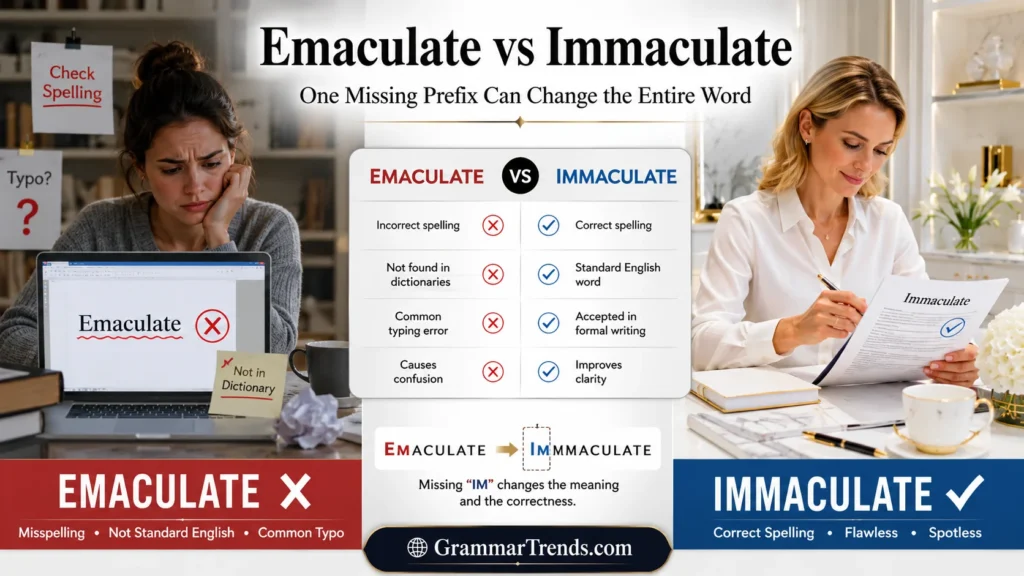
Emaculate vs Immaculate confusion still appears when people check writing, as spelling looks similar and causes mistakes in use in writing now. I’ve seen many learners struggle because Emaculate vs Immaculate looks almost identical while reading or typing quickly, which leads to confused writing and repeated mistakes. However, understanding the correct form improves clarity, reduces errors, and builds confidence in how you use words in daily communication.
The word immaculate means perfectly clean, flawless, and free from flaws, often used in grammar, fashion, homes, and design, while emaculate is treated as a wrong spelling and marked as an error by most dictionaries. Knowing this difference helps students, writers, and professionals improve communication, quality, and accuracy in emails, articles, and social media writing, making their language more clear and correct in real situations.
Emaculate vs Immaculate: Quick Answer
Here’s the fastest answer possible.
| Word | Correct? | Meaning |
| Emaculate | ❌ No | Misspelling |
| Immaculate | ✅ Yes | Perfectly clean, flawless, or spotless |
The confusion usually happens because people pronounce the beginning of immaculate too softly. In fast speech, “immaculate” can sound like “emaculate,” especially in casual conversation.
However, standard English dictionaries recognize only immaculate.
What Does “Immaculate” Mean?
The word immaculate describes something that is:
- Perfectly clean
- Free from flaws
- Spotless
- Extremely neat
- Pure or unblemished
People often use it to describe:
- Homes
- Clothing
- Cars
- Writing
- Performances
- Physical appearance
- Religious concepts
Simple Definition
Immaculate = perfectly clean or flawless
The word carries a polished tone. It sounds stronger than words like clean or neat.
For example:
- A clean room may still have clutter.
- An immaculate room looks untouched, organized, and pristine.
That difference matters.
Is “Emaculate” a Real Word?
In standard English, no.
Emaculate does not appear in major dictionaries as an accepted English word. It survives online mainly because people:
- Hear the word incorrectly
- Type quickly
- Depend too much on autocorrect
- Forget the “im” prefix
Search engines now recognize the typo because it appears so often. That doesn’t make it correct.
Why the Misspelling Happens So Often
English pronunciation can play tricks on your ears.
When spoken naturally, immaculate sounds like this:
ih-MAK-yuh-lit
Notice how the first syllable becomes soft and quick. Many listeners barely hear the “im” sound. As a result, they spell it phonetically as “emaculate.”
That’s a classic spelling trap.
Emaculate vs Immaculate: Side-by-Side Comparison
Here’s a cleaner breakdown.
| Feature | Emaculate | Immaculate |
| Correct English spelling | No | Yes |
| Found in dictionaries | No | Yes |
| Part of speech | None | Adjective |
| Meaning | None | Spotless or flawless |
| Common online use | Typo | Proper word |
| Accepted in academic writing | No | Yes |
If you’re writing:
- essays,
- emails,
- blog posts,
- resumes,
- captions,
- or business documents,
always use immaculate.
Why People Misspell “Immaculate”
Some spelling mistakes happen once. This one happens constantly.
Why?
Because the brain prefers sounds over structure.
The Hidden “Im” Sound
In spoken English, people compress sounds. The opening “im” in immaculate often disappears into the sentence rhythm.
For example:
- “Her house was immaculate.”
- Spoken quickly, it sounds close to:
- “Her house was emaculate.”
Your ears hear one thing. The dictionary says another.
Similar English Patterns Cause Confusion
English contains many words with prefixes that change pronunciation.
Here are a few examples:
| Correct Word | Common Wrong Version |
| Impossible | Empossible |
| Immediate | Emediate |
| Immature | Emmature |
| Immaculate | Emaculate |
The pattern repeats because the “im-” prefix softens during speech.
Fast Typing Makes It Worse
Autocorrect catches many mistakes. Yet it doesn’t catch everything.
Sometimes users:
- Ignore red underlines
- Type quickly on mobile devices
- Copy incorrect spellings from social media
Once a typo spreads online, more people repeat it.
That’s how “emaculate” survives.
The Origin and Etymology of “Immaculate”
This word has ancient roots.
Understanding them makes the spelling easier to remember.
Latin Origin of Immaculate
The word comes from the Latin term:
immaculatus
It breaks down into:
- im- = not
- macula = stain or spot
So the literal meaning becomes:
“Not stained.”
That original meaning still shapes the modern definition today.
How the Word Entered English
English borrowed immaculate through religious and scholarly Latin traditions during the late Middle Ages.
At first, writers mainly used it in spiritual contexts. Later, the meaning expanded into everyday language.
Today, people use it for:
- homes,
- design,
- fashion,
- sports,
- grooming,
- organization,
- and writing quality.
The word evolved. The core meaning stayed intact.
Religious Meaning of “Immaculate”
One of the most famous uses appears in Christianity.
The Immaculate Conception
Many people misunderstand this phrase.
The term Immaculate Conception refers to the belief that the Virgin Mary was conceived without original sin.
It does not refer to the birth of Jesus.
That distinction matters historically and theologically.
In religious writing, immaculate often means:
- spiritually pure,
- unstained by sin,
- morally flawless.
That deeper meaning helped preserve the word for centuries.
How To Use “Immaculate” Correctly in Sentences
The best way to master a word is to see it in action.
Here are the most common uses.
Immaculate for Cleanliness
This is the most popular meaning.
Examples
- Her apartment looked immaculate before the guests arrived.
- The restaurant kitchen remained immaculate during inspection.
- He kept his white sneakers immaculate despite the rain.
Notice the pattern:
- spotless,
- neat,
- polished,
- carefully maintained.
Immaculate for Appearance
People also use the word for style and presentation.
Examples
- She walked into the meeting wearing an immaculate suit.
- His handwriting remained immaculate throughout the exam.
- The hotel lobby featured immaculate marble floors.
This version implies precision and care.
Immaculate in Sports
Sports commentators love this word.
Why?
Because it sounds dramatic without sounding exaggerated.
Examples
- The striker delivered an immaculate finish.
- She played an immaculate defensive game.
- The quarterback threw an immaculate pass under pressure.
Here, immaculate means:
- flawless,
- technically perfect,
- executed with precision.
Immaculate in Writing and Communication
Editors and teachers use this word often.
Examples
- Her grammar was immaculate.
- The report arrived in immaculate condition.
- His presentation slides looked immaculate.
The word suggests professionalism and polish.
25 Natural Examples of “Immaculate” in Sentences
Here’s a wider variety of examples you can model.
Everyday Examples
- The garden looked immaculate after the landscaping work.
- His desk stayed immaculate all year.
- She maintained an immaculate skincare routine.
- The wedding venue appeared immaculate under the lights.
- Their new car still smelled factory fresh and immaculate.
Professional Examples
- The architect delivered immaculate blueprints.
- Her legal documentation was immaculate.
- The chef maintained immaculate hygiene standards.
- The store displayed its products in immaculate rows.
- His resume looked immaculate compared to the others.
Read More: “Unenroll vs Disenroll” Correct Meaning and Usage
Academic Examples
- The student submitted an immaculate research paper.
- Her citations were immaculate from start to finish.
- The professor praised the immaculate structure of the essay.
Sports Examples
- He pitched an immaculate inning.
- The gymnast gave an immaculate performance.
- Her timing throughout the race was immaculate.
- The team executed an immaculate counterattack.
Religious or Literary Examples
- The poem described an immaculate soul.
- The cathedral featured immaculate white stone.
- The painting symbolized immaculate purity.
- The priest referenced the Immaculate Conception during the sermon.Common Mistakes Writers Make
Even experienced writers misuse this word occasionally.
Here are the biggest mistakes.
Writing “Emaculate” Because It Sounds Correct
This is the most common issue by far.
The brain trusts pronunciation too much.
Quick Fix
Remember:
Every correct version starts with “Im.”
Think:
- impossible
- immortal
- immaculate
Same prefix family.
Assuming “Immaculate” Means “Perfect”
This mistake creates awkward sentences.
Example
❌ “He has an immaculate personality.”
That sounds unnatural because immaculate usually describes:
- cleanliness,
- condition,
- presentation,
- precision.
A better option:
✅ “He has an excellent personality.”
Using “Immaculate” Too Casually
The word sounds polished and somewhat formal.
Compare these:
- “The room was clean.”
- “The room was immaculate.”
The second sentence feels stronger and more elevated.
Overusing it weakens the effect.
Words Similar to “Immaculate”
Choosing the right synonym improves your writing dramatically.
Each similar word carries its own shade of meaning.
| Word | Best Use |
| Spotless | Physical cleanliness |
| Pristine | Untouched condition |
| Flawless | Performance or beauty |
| Perfect | General excellence |
| Neat | Casual organization |
| Pure | Moral or spiritual meaning |
| Polished | Professional appearance |
Spotless vs Immaculate
These words overlap heavily.
Difference
- Spotless focuses on cleanliness.
- Immaculate includes elegance and perfection.
Example:
- “The floor was spotless.”
- “The mansion looked immaculate.”
The second paints a fuller picture.
Pristine vs Immaculate
People often confuse these too.
Key Difference
- Pristine suggests untouched originality.
- Immaculate emphasizes maintained perfection.
Example:
- A pristine forest remains untouched.
- An immaculate office stays perfectly maintained.
Small distinction. Big impact.
Synonyms and Antonyms of “Immaculate”
Strong Synonyms
Here are the best alternatives.
| Synonym | Tone |
| Flawless | Strong and polished |
| Spotless | Clean-focused |
| Pristine | Elegant |
| Unblemished | Formal |
| Perfect | Broad |
| Pure | Spiritual |
| Neat | Casual |
Common Antonyms
These words express the opposite meaning.
| Antonym | Meaning |
| Messy | Disorganized |
| Dirty | Unclean |
| Flawed | Imperfect |
| Stained | Marked or spotted |
| Imperfect | Not flawless |
| Untidy | Careless appearance |
Memory Tricks To Remember “Immaculate”
Spelling memory improves when attached to images or stories.
Here are practical tricks that actually work.
The “I’m Clean” Trick
Say this slowly:
“I’m immaculate.”
Now shorten it mentally:
- “I’m clean.”
- spotless,
- polished,
- perfect.
That connection sticks surprisingly well.
Remember the Root “Macula”
Latin root:
- macula = stain
So:
- immaculate = without stains
Once you learn the root, the spelling becomes logical instead of random.
Visual Memory Method
Picture:
- a spotless white hotel room,
- crisp white gloves,
- perfectly aligned furniture.
Should You Ever Use the Misspelling in Writing?
Only in specific cases:
- spelling comparison articles,
- grammar correction guides,
- educational content.
Otherwise, avoid it entirely.
Using “emaculate” in:
- resumes,
- academic papers,
- professional emails,
- or business writing
can damage credibility instantly.
Expert Grammar Tips To Avoid Spelling Errors
Small habits make a huge difference.
Read Words in Chunks
Break longer words apart.
Example:
- im-mac-u-late
This technique improves retention fast.
Learn Prefix Patterns
Many English words share the “im-” prefix.
Examples:
- impossible
- immortal
- immovable
- immaculate
Seeing the pattern helps your brain predict correct spelling.
Don’t Depend Fully on Autocorrect
Autocorrect misses:
- contextual mistakes,
- uncommon typos,
- repeated errors.
Always proofread manually.
That extra minute saves embarrassment.
Slow Down During Editing
Fast writing creates avoidable spelling errors.
Professional editors often:
- write quickly,
- edit slowly.
That system works.
Mini Case Study: Why “Immaculate” Works So Well in Marketing
Luxury brands love this word.
Why?
Because it communicates:
- precision,
- exclusivity,
- cleanliness,
- quality,
- trust.
Real Examples of Brand Language
You’ll often see phrases like:
- “immaculate craftsmanship”
- “immaculate detailing”
- “immaculate presentation”
- “kept in immaculate condition”
Car dealerships especially use it heavily.
Example
“2019 Mercedes-Benz in immaculate condition.”
That phrase instantly sounds more premium than:
“Very clean car.”
Words shape perception.
Immaculate in Pop Culture and Sports
The word appears more often than people realize.
The “Immaculate Inning” in Baseball
Baseball uses a special term:
Immaculate inning
It means:
- a pitcher strikes out all three batters,
- using only nine pitches.
That’s rare.
Fans love the phrase because it sounds dramatic and elite.
“Immaculate Reception”
One of the most famous NFL plays ever carries this name.
The Immaculate Reception happened in 1972 when Franco Harris made a legendary catch for the Pittsburgh Steelers.
The nickname stuck because the play looked almost miraculous.
That shows how immaculate often implies:
- precision,
- perfection,
- something extraordinary.
7 FAQs on Emaculate vs Immaculate
1. What does “immaculate” mean?
It means something is perfectly clean, flawless, or free from errors, often used for homes, design, or appearance.
2. Is “emaculate” a correct English word?
No, emaculate is considered a misspelling of “immaculate” and is not accepted in standard English.
3. Why do people confuse emaculate and immaculate?
Because both words sound similar, leading to spelling confusion and frequent writing mistakes.
4. Where is “immaculate” commonly used?
It is commonly used in grammar, fashion, homes, design, and descriptions of cleanliness or perfection.
5. Can I use “emaculate” in formal writing?
No, using emaculate in formal writing is incorrect and may be marked as a spelling error.
6. How can I avoid this mistake?
You can avoid it by remembering that only immaculate is correct and checking spelling tools before submitting writing.
7. Does using the correct word improve writing quality?
Yes, using immaculate correctly improves clarity, communication quality, and overall writing credibility.
Conclusion
Understanding the difference between Emaculate vs Immaculate helps avoid common spelling errors in everyday writing. While immaculate represents something perfectly clean and flawless, emaculate is simply a wrong spelling that should be avoided. Using the correct form improves your writing accuracy, boosts confidence, and makes your communication more professional and clear in all contexts.

Emma Brooke brings 15 years of experience in the Department of English Language and Literature at the University of California, Berkeley, where she has taught and mentored students across courses in British and American literary traditions, critical theory, and narrative form. Her expertise spans 19th- and 20th-century fiction, poetic prosody, postcolonial literatures, and digital humanities, with a focus on how narrative voice shapes cultural meaning. Emma’s work has been presented at international conferences and published in peer-reviewed venues, reflecting her deep commitment to rigorous literary scholarship and accessible teaching.