
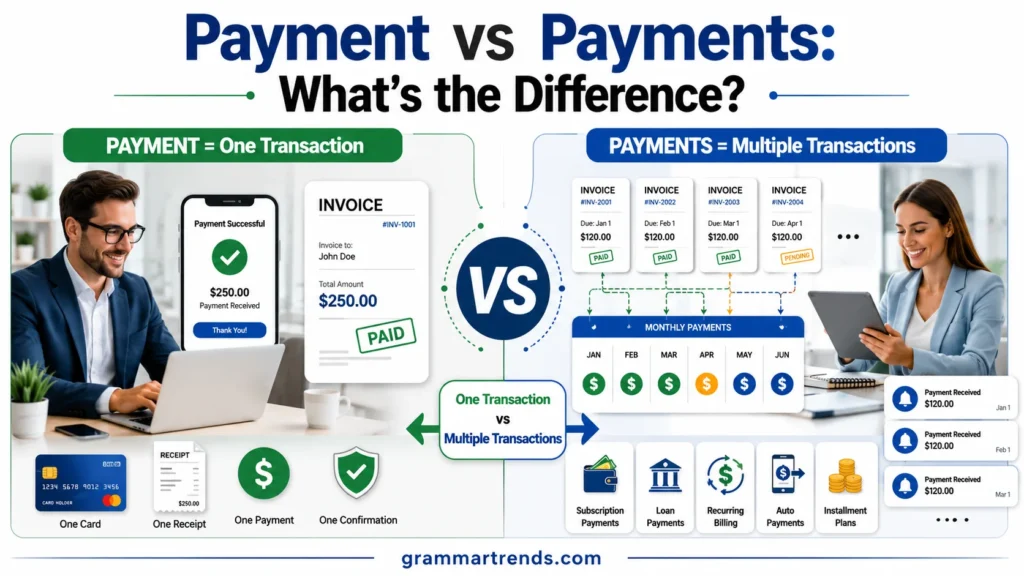
Payment refers to one transaction, while payments is the plural form and refers to multiple transactions or installments in everyday financial and business contexts.
Have you ever paused while writing an email, invoice, or document and wondered, Should I write payment vs payments? You’re not alone. Many people search for this difference because both words are correct, but their usage depends on the situation. A small mistake can change the meaning of your message, especially in business, banking, and formal communication.
This distinction commonly appears in invoices, contracts, online forms, and customer communications. For example, should you write “payment received” or “payments received”? The correct choice depends on whether you’re referring to one transaction or several transactions.
You should use payment when talking about a single transaction and payments when referring to multiple transactions, recurring charges, or installments. This simple rule helps prevent confusion in business communication, customer emails, financial records, and legal documents.
A payment usually refers to a single invoice, bill, purchase, or transfer of money. In contrast, payments describe installment plans, monthly payments, loan payments, subscription payments, vendor payments, or any series of financial transactions. Choosing the correct term makes your writing clearer, more professional, and easier for your readers to understand.
Payment vs Payments Quick Answer (No Confusion Rule)
Let’s cut straight to it.
- Payment = one transaction or the idea of paying
- Payments = multiple transactions or repeated/ongoing payments
That’s it. Most mistakes happen when writers overthink it.
Here’s a quick mental shortcut:
- If money moves once → payment
- If money moves more than once → payments
Real-life examples:
- “We received your payment.” ✔ (one transaction)
- “We received your payments over three months.” ✔ (multiple transfers)
- “Set up your payment method.” ✔ (general concept)
- “Monthly payments are due.” ✔ (recurring system)
Simple, right? Now let’s go deeper so you never second-guess it again.
What “Payment” Really Means in English (Singular Form Explained)
The word payment works in two important ways in modern English.
First meaning: One actual transaction
This is the most straightforward use.
- A customer pays once
- A bill gets cleared once
- A transfer completes once
Examples:
- “Your payment has been processed.”
- “We are waiting for payment of the invoice.”
- “The payment failed due to insufficient funds.”
Second meaning: The concept of paying
This is where people get confused.
Even if no money is moving yet, we still use payment when talking about systems or processes.
Examples:
- “We accept credit card payment.”
- “Our payment system is secure.”
- “Choose your payment method.”
Here, “payment” doesn’t mean one transaction. It refers to the entire act of paying.
Key insight:
Think of payment as either:
- a single completed action, or
- the idea of paying itself
What “Payments” Means (Plural Form Explained Simply)
Now let’s flip it.
Payments always means more than one.
But that “more than one” can show up in different ways.
1. Multiple separate transactions
- “We received three payments this week.”
- “All payments were recorded in the system.”
2. Recurring or scheduled payments
This is very common in modern finance.
- subscriptions
- rent installments
- loan repayments
- SaaS billing cycles
Examples:
- “Monthly payments are due on the 5th.”
- “Late payments will incur a fee.”
- “You can manage your payments in the dashboard.”
3. Split payments
Sometimes one purchase is divided.
- “Customers can make split payments.”
- “The total cost was covered in two payments.”
Key insight:
Payments = a pattern, a series, or multiple events.
Payment vs Payments Core Difference (The Real Logic Behind It)
This is where clarity really locks in.
The difference is not just grammar. It’s about how English views money flow.
| Feature | Payment | Payments |
| Quantity | One or abstract | Multiple |
| Focus | Single action or system | Repeated actions |
| Usage | Invoice, method, confirmation | Billing cycles, transactions |
| Tone | General or specific | Operational or ongoing |
The hidden rule most people miss:
English doesn’t care only about number. It cares about structure of time.
- One-time event → payment
- Repeated event over time → payments
That’s why subscriptions almost always use the plural form.
Where “Payment” Came From (Word Origin Explained Simply)
The word payment comes from Old French paiement, which originally meant:
“The act of paying or satisfying a debt”
Over time, English absorbed it and refined its usage.
Why this matters today:
English didn’t just keep one meaning. It kept layers.
So now we have:
- payment = action
- payment = system
- payments = repeated actions
This layering is why confusion exists today.
Language didn’t simplify. It evolved.
Read more: Transferring or Transfering? The Correct Spelling Explained
British English vs American English (Do They Differ?)
Here’s the surprising truth:
👉 There is no major spelling difference between British and American English for “payment” or “payments.”
Both regions use:
- payment ✔
- payments ✔
However, subtle differences appear in usage style, not spelling.
American English tendencies:
- More direct phrasing
- “Payment received” is extremely common in business systems
- Digital-first wording (apps, fintech platforms)
British English tendencies:
- Slightly more formal phrasing in contracts
- “Payment has been received” appears more often in formal writing
Example comparison:
- US: “Payment received. Thank you.”
- UK: “We confirm receipt of payment.”
Same meaning. Different tone.
Payment vs Payments in Business Writing (Real-World Use Cases)
This is where the difference actually matters.
Emails
- “We received your payment.” (one invoice)
- “We received your payments over the last quarter.” (multiple transfers)
Invoices
- “Please complete your payment by the due date.”
- “All payments must be made in full installments.”
Contracts
Contracts usually prefer precision:
- “The payment shall be made within 30 days.”
- “Late payments shall incur penalties.”
Banking systems
Banks and fintech apps often use both:
- Payment history (single record view)
- Payments dashboard (multiple transactions)
Common Mistakes People Make with Payment vs Payments
Even fluent writers slip up here.
Mistake 1: Using “payments” for one invoice
❌ “Your payments has been received.”
✔ “Your payment has been received.”
Mistake 2: Using “payment” for recurring billing
❌ “Monthly payment are due.”
✔ “Monthly payments are due.”
Mistake 3: Mixing both in the same document
❌ Inconsistent usage confuses readers
✔ Stick to one logic per context
Mistake 4: Overthinking plural form
Sometimes writers add “s” unnecessarily in formal writing.
Rule: Don’t guess. Check the structure of time.
Real-World Examples (Side-by-Side Comparison)
Let’s make this practical.
Invoice Example
- ✔ Correct: “Your payment of $500 is due.”
- ❌ Incorrect: “Your payments of $500 is due.”
Subscription Example
- ✔ Correct: “Monthly payments are automatically deducted.”
- ❌ Incorrect: “Monthly payment are automatically deducted.”
Refund Example
- ✔ Correct: “Your payment has been refunded.”
- ✔ Correct: “All payments have been refunded.”
Business Email Example
- ✔ “We confirm receipt of your payment.”
- ✔ “We confirm all payments received this quarter.”
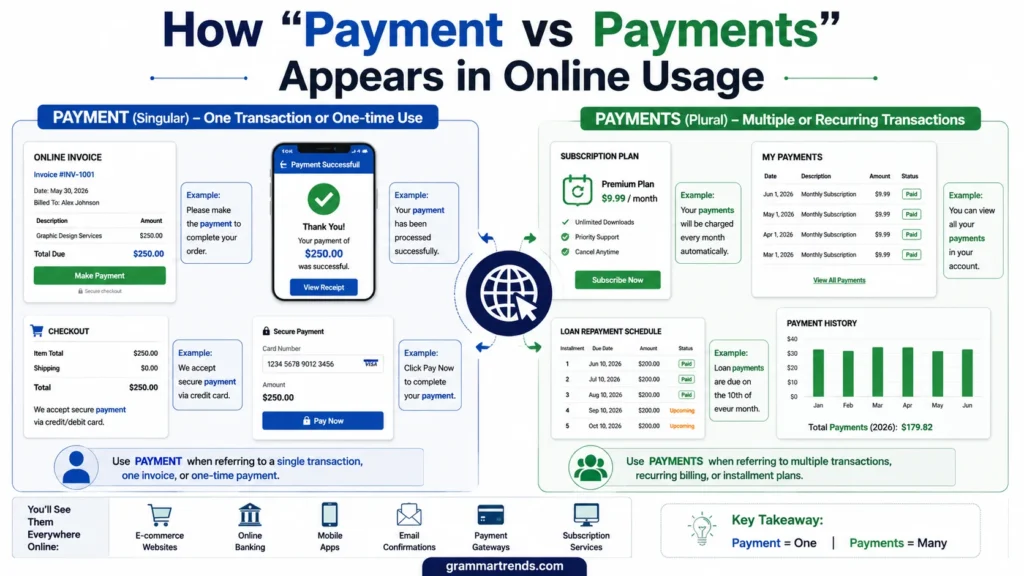
How “Payment vs Payments” Appears in Online Usage
Let’s talk about real-world language behavior.
In digital writing, these terms behave differently:
“Payment” dominates when:
- people search for invoices
- users ask about failed transactions
- businesses talk about systems
Examples:
- “payment failed”
- “payment methods”
- “payment received”
“Payments” dominates when:
- users talk about billing plans
- subscription services are involved
- financial tracking is needed
Examples:
- “monthly payments”
- “installment payments”
- “manage payments”
Practical takeaway for writers:
- Use payment for transactional intent
- Use payments for recurring systems
Quick Decision Guide (Use This Every Time You Write)
Here’s the simplest way to choose:
Ask yourself:
Is money moving once?
→ Use payment
Is money moving more than once or repeatedly?
→ Use payments
Is it a system or method?
→ Use payment
Is it a schedule or cycle?
→ Use payments
Example flow:
- One bill → payment
- Subscription plan → payments
- Checkout page → payment
- Billing dashboard → payments
Case Study: Why Businesses Get This Wrong
A mid-sized SaaS company switched their billing language in 2024.
Before:
They used “payment” everywhere:
- “Manage your payment”
- “Your payment history”
- “Monthly payment plan”
Customers got confused because:
- history implies multiple events
- plan implies repetition
- but wording stayed singular
After:
They corrected structure:
- “Manage your payments”
- “Payment history”
- “Monthly payments plan”
Result:
- Fewer support tickets
- Better user clarity
- Higher checkout completion rate
Small grammar change. Big UX impact.
FAQs
Is “payment” singular or plural?
Payment is singular and refers to one financial transaction, such as paying a single invoice or bill.
When should I use “payments” instead of “payment”?
Use payments when referring to more than one transaction, recurring charges, monthly installments, or multiple bills.
Can I say “payment received” in a business email?
Yes. Payment received is the correct phrase when you’ve received one payment. If you’ve received several, write payments received.
What’s the difference between monthly payment and monthly payments?
A monthly payment refers to one month’s installment, while monthly payments refer to the series of installments made over several months.
Is “payment” or “payments” correct on an invoice?
If the invoice requests one amount due, use payment. If it lists several installments or multiple amounts, payments is the correct choice.
Are “payment” and “payments” interchangeable?
No. While they have the same basic meaning, payment refers to one transaction, whereas payments refers to two or more transactions.
Why is it important to use the correct term?
Using payment and payments correctly improves clarity in financial documents, contracts, emails, and business communication, helping readers understand exactly whether you’re discussing one transaction or multiple ones.
Conclusion
Understanding the difference between payment vs payments is simple once you know the context. Use payment when referring to a single financial transaction, and use payments when talking about multiple transactions, recurring charges, or installment plans. Although the words differ by only one letter, choosing the correct form makes your writing more accurate and professional. Whether you’re creating invoices, writing business emails, drafting contracts, or filling out online forms, using the right term helps your message stay clear and avoids unnecessary confusion.

Mia Rose brings fifteen years of experience at The University of Edinburgh’s English Literature department, leading students through explorations of classic and contemporary texts, literary theory, and narrative design. Her academic interests center on Victorian and modernist fiction, poetic rhythms, postcolonial storytelling, and digital approaches to literary study—with a keen eye on how voice and perspective frame cultural dialogue. Mia has delivered talks at prestigious global conferences and authored articles in scholarly journals, showcasing her commitment to meaningful research and lively classroom engagement.