
Many people search for inexcusable vs unexcusable because both words look correct and seem to describe behavior or mistakes that cannot be justified. At first glance, they appear interchangeable, which makes them a common source of confusion for students, writers, and even native English speakers.
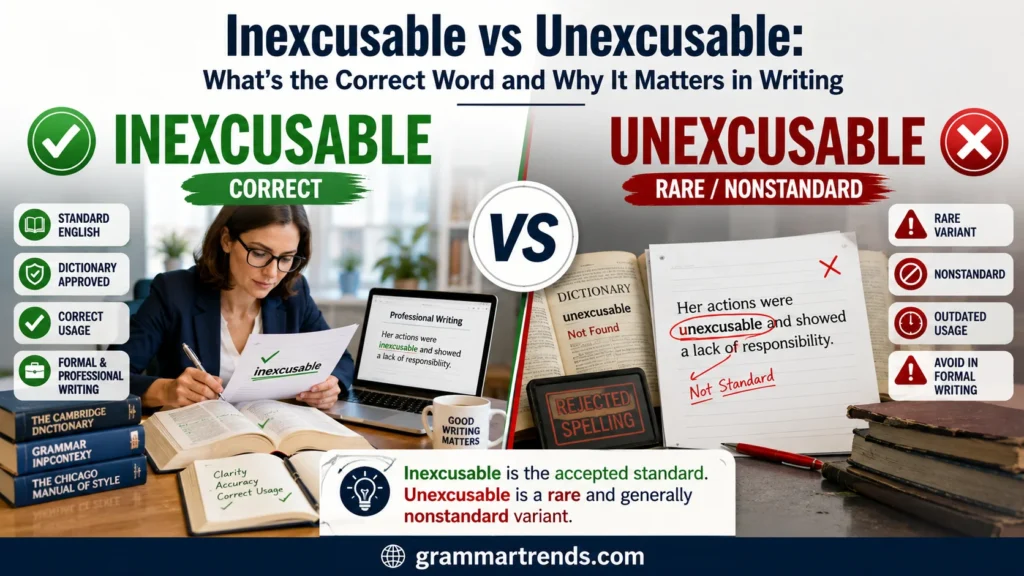
The short answer is simple: inexcusable is the standard, widely accepted word in both American and British English. Unexcusable does exist, but it’s extremely rare, sounds outdated to most readers, and isn’t the preferred choice in modern writing. That’s why you’ll find inexcusable in dictionaries, style guides, newspapers, books, and professional communication far more often than its uncommon alternative.
In this guide, you’ll learn exactly what inexcusable means, why unexcusable is rarely used, how the two words developed, and which one you should choose in everyday writing. We’ll also cover their origins, spelling rules, American and British usage, real-life examples, common mistakes, and practical tips to help you avoid confusion.
By the end of this article, you’ll know when to use inexcusable, why it’s the correct choice in nearly every situation, and how to write with greater confidence and accuracy.
Inexcusable vs Unexcusable: Quick Answer Before We Go Deep
Let’s clear it up fast.
- Inexcusable → Correct, standard English
- Unexcusable → Nonstandard, widely considered incorrect
If you’re writing anything formal, academic, or professional, stick with inexcusable every time.
Now the real question is why this is the case—and that’s where things get interesting.
Inexcusable vs Unexcusable: The Linguistic Background
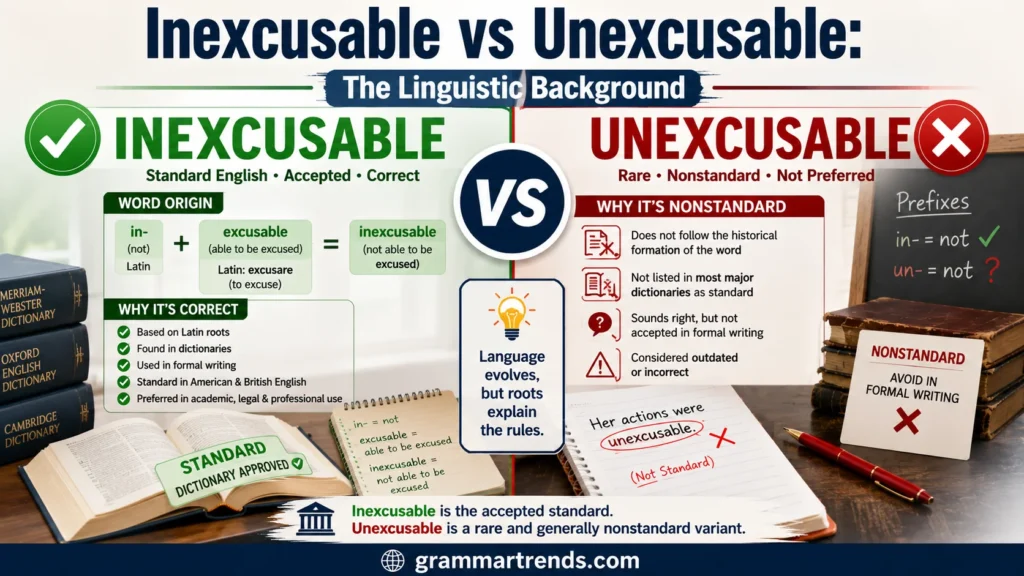
To understand why one word works and the other doesn’t, you need to look at how English builds negative words.
English often uses prefixes to flip meaning. Two of the most common are:
- in-
- un-
Both can mean “not,” but they don’t behave the same way.
How “Inexcusable” Developed in English
The word inexcusable comes from Latin roots.
- excusable → able to be forgiven or justified
- in- → a Latin-derived negation meaning “not”
So inexcusable literally means:
“not able to be excused or forgiven”
This form entered English through French and Latin influence, which shaped much of formal vocabulary.
Over time, inexcusable became the standardized form used in:
- Legal writing
- Academic texts
- Literature
- Journalism
You’ll find it in dictionaries, style guides, and official documentation without exception.
Why “Unexcusable” Sounds Right But Isn’t Standard
Now here’s where confusion happens.
English speakers naturally lean on the prefix un- because it feels more flexible and common:
- unhappy
- unclear
- unfair
- unkind
So it’s easy to assume:
“excusable → unexcusable”
But English doesn’t apply prefixes randomly. Some words “lock in” a specific form historically.
In this case, excusable paired with in-, not un-, early in its evolution. Once that standard became dominant, unexcusable never gained official acceptance.
Today:
- It appears occasionally in informal writing
- It is flagged as incorrect in formal grammar usage
- It is absent from most reputable dictionaries as a standard entry
Definitions of Inexcusable vs Unexcusable
Before you use any word correctly, you need to understand its meaning clearly.
What “Inexcusable” Actually Means
Inexcusable describes something so wrong or unjustified that it cannot be forgiven.
It carries emotional weight. You’re not just saying something is bad—you’re saying it crosses a line.
Common contexts include:
- Moral failure
- Professional negligence
- Serious mistakes
- Ethical violations
Simple meaning:
Something too wrong to justify or excuse.
Is “Unexcusable” a Real Word?
Technically, people do write it. But here’s the truth:
- It is nonstandard English
- Most dictionaries do not list it as correct usage
- Editors and educators mark it as an error
Think of it like a word that “exists in practice” but not in accepted language standards.
If you use it in writing, readers may assume it’s a spelling mistake.
Inexcusable vs Unexcusable: The Real Differences
Even though both words aim to express the same idea, they behave very differently in practice.
Here’s a simple breakdown:
| Feature | Inexcusable | Unexcusable |
| Correct spelling | Yes | No (nonstandard) |
| Formal writing | Accepted | Not accepted |
| Academic use | Standard | Considered incorrect |
| Dictionary presence | Yes | Rare or absent |
| Reader perception | Professional | Error or typo |
This isn’t just grammar trivia. It affects how people judge your writing instantly.
How to Use “Inexcusable” in Real Sentences
Let’s make this practical. You don’t need theory—you need usage.
Everyday Usage Examples of Inexcusable
These examples show how people naturally use the word:
- That behavior was inexcusable, and he knew it.
- Missing the deadline without warning is inexcusable.
- Her comments were rude and completely inexcusable.
- It’s inexcusable to ignore safety rules in that environment.
Notice the tone: strong, direct, and judgmental.
Professional and Formal Usage
In formal writing, the word becomes even more serious:
- The company’s response was deemed inexcusable by regulators.
- Such negligence is considered inexcusable under industry standards.
- The court described the actions as inexcusable misconduct.
In these cases, the word signals accountability and seriousness.
Why People Confuse Inexcusable and Unexcusable
This confusion is more common than you might think. English learners and native speakers both make the mistake.
Here’s why it happens:
Prefix Overgeneralization
People learn:
- un = not
- in = not
So they assume they are interchangeable.
They aren’t.
English doesn’t follow a single rule for negation. It follows historical patterns.
Sound-Based Spelling
When you say “unexcusable” out loud, it sounds natural. That makes the spelling feel valid.
But English spelling often breaks phonetic logic due to historical evolution.
Autocorrect and Informal Typing
Some informal apps or messaging platforms may not flag the error, which reinforces the mistake.
Similar Word Patterns
People compare it with words like:
- unacceptable
- unbelievable
- unnecessary
So “unexcusable” feels like it should exist too.
But language history disagrees.
Read more: Decision vs “Descision”: How to Use Decision Correctly?
Common Writing Mistakes and How to Avoid Them
Let’s get practical. If you want to stop making this mistake, focus on patterns, not memorization.
Mistake Patterns
- Automatically typing “unexcusable”
- Relying on spoken English instincts
- Guessing prefixes instead of checking spelling
How to Fix It Quickly
Try these simple habits:
- Pause before writing negative adjectives
- Ask yourself: “Have I seen this in formal writing?”
- Use dictionary lookup for uncertain words
- Read your sentence out loud
That last one helps more than you think.
Memory Trick to Always Choose the Right Word
Here’s a simple trick that works.
Think of it like this:
“If it’s serious enough to judge someone, it needs IN-.”
So:
- Inexcusable = serious judgment word
- Unexcusable = sounds casual or mistaken
Another way to remember it:
- INexcusable = IN the dictionary
- UNexcusable = UNsure territory
Simple. Sticky. Easy to recall.
Real-World Impact of Using the Wrong Word
This isn’t just about grammar rules. It affects perception.
Professional Writing
If you write “unexcusable” in a report, readers may:
- Question your attention to detail
- Assume weaker language skills
- Lose confidence in your argument
Academic Writing
Teachers and examiners often mark it as:
- Spelling error
- Incorrect word choice
Even if your idea is correct, the error can reduce your score.
Case Study: Editorial Correction Scenario
A freelance writer submitted an article to a business blog and used “unexcusable” twice.
Result:
- Editor flagged both instances
- Article required revision
- Final note included “attention to language precision needed”
Nothing major broke—but credibility took a hit.
That’s how small errors ripple outward.
Inexcusable vs Unexcusable: Correct vs Incorrect Usage Examples
Let’s make it crystal clear with side-by-side comparisons.
Correct Usage: Inexcusable
- The delay was inexcusable given the preparation time.
- It is inexcusable to ignore safety warnings.
- His actions were inexcusable under company policy.
- That level of negligence is simply inexcusable.
Incorrect Usage: Unexcusable
- The delay was unexcusable given the preparation time. ❌
- It is unexcusable to ignore safety warnings. ❌
- His actions were unexcusable under company policy. ❌
Even if the meaning is understood, the form is still wrong in standard English.
Related Confusing Word Pairs in English
This mistake isn’t isolated. English is full of similar traps.
Here are a few common ones:
- Invaluable vs Unvaluable → only “invaluable” is correct
- Inactive vs Unactive → “unactive” is nonstandard
- Incorrect vs Uncorrect → “uncorrect” is wrong in modern English
- Ineffective vs Uneffective → only “ineffective” is correct
Notice a pattern? English prefers in- and im- in many formal negations.
FAQs
1. Is inexcusable or unexcusable the correct word?
Inexcusable is the correct and widely accepted word in modern English. It describes something that cannot be justified, forgiven, or excused. Although unexcusable exists, it is extremely rare and is generally considered outdated.
2. Why is unexcusable rarely used?
Most modern dictionaries, style guides, and professional writers prefer inexcusable. Over time, unexcusable has fallen out of common use, so choosing inexcusable makes your writing sound more natural and current.
3. Do inexcusable and unexcusable have the same meaning?
Yes. Both words mean “not able to be excused” or “impossible to justify.” The difference is not in meaning but in usage. Inexcusable is the standard choice, while unexcusable is an uncommon variant.
4. Is inexcusable used in both American and British English?
Yes. Inexcusable is the preferred spelling in both American English and British English. You’ll regularly see it in books, newspapers, academic writing, and everyday communication on both sides of the Atlantic.
5. Can I use unexcusable in formal writing?
It’s better not to. While readers may understand what you mean, unexcusable can sound outdated or unusual. For essays, business writing, and professional documents, inexcusable is the safer and more widely accepted choice.
6. What is an example of inexcusable in a sentence?
Here is a simple example:
Ignoring a serious safety warning was inexcusable.
The sentence shows that the action could not reasonably be justified or forgiven.
7. How can I remember the correct word?
A simple trick is to remember that inexcusable is the version you’ll almost always find in dictionaries and professional writing. If you’re unsure which word to use, choose inexcusable—it’s the standard form and the one readers expect.
Conclusion
Although inexcusable vs unexcusable share the same basic meaning, they aren’t used equally in modern English. Inexcusable is the standard, dictionary-approved choice for describing actions, behavior, mistakes, or decisions that cannot be justified, forgiven, or excused. You’ll find it consistently used in American and British English across professional writing, journalism, academic texts, and everyday communication.
By contrast, unexcusable is a rare and outdated variant that appears only occasionally in older texts or historical sources. While it isn’t technically incorrect, using it today can make your writing sound unusual or old-fashioned.
When in doubt, choose inexcusable. It’s the clear, natural, and widely accepted spelling that readers expect. Sticking with the standard form will make your writing more polished, professional, and easier to understand.

Emma Brooke brings 15 years of experience in the Department of English Language and Literature at the University of California, Berkeley, where she has taught and mentored students across courses in British and American literary traditions, critical theory, and narrative form. Her expertise spans 19th- and 20th-century fiction, poetic prosody, postcolonial literatures, and digital humanities, with a focus on how narrative voice shapes cultural meaning. Emma’s work has been presented at international conferences and published in peer-reviewed venues, reflecting her deep commitment to rigorous literary scholarship and accessible teaching.